












Excited-state proton transfer in protonated adrenaline revealed by cryogenic UV photodissociation spectroscopy
文献情報
出版日
2020-04-28
DOI
10.1039/D0CP01127D
インパクトファクター
3.676
著者
Jordan Dezalay, Michel Broquier, Satchin Soorkia
原文を見る
要旨
We report a comprehensive study of the structures and deactivation processes of protonated adrenaline through cryogenic UV photodissociation spectroscopy. Single UV and double-resonance UV-UV hole burning spectroscopies have been performed and compared to coupled-cluster SCS-CC2 calculations performed on the ground and first electronic states. Three conformers were assigned, two lowest energy gauche conformers along with a higher energy conformer with an extended structure which is indeed the global minimum in solution. This demonstrates the kinetic trapping of this high energy gas phase conformer during the electrospray process. At the band origin of all conformers, the main fragmentation channel is the Cα–Cβ bond cleavage, triggered by an excited state proton transfer to the catechol ring. Internal conversion leading to the water loss channel competes with the direct dissociation and tends to prevail with the increase of excess energy brought by the UV laser. Picosecond time-resolved pump–probe spectroscopy was performed to measure the excited state lifetimes of the three conformers of AdH+, which decay with the increase of excess energy in the ππ* state, from 2 ns at the band origin down to few hundreds of picoseconds 0.5 eV to the blue. Finally, about 0.8 eV above the band origin, the πσ* state is directly reached, leading to the opening of the H-loss channel.
関連文献
A rare ligand bridged ferromagnetically coupled MnIV3 complex with a ground spin state of S = 9/2
Thushan Pathmalingam, Serge I. Gorelsky, Tara J. Burchell, Rodolphe Clérac, Muralee Murugesu
2008-04-16
Communication
DOI: 10.1039/B802279H
Physicochemical properties of highly conductive urea–EtMeImCl melts
Tetsuya Tsuda, Takashi Tomioka, Charles L. Hussey
2008-04-11
Communication
DOI: 10.1039/B802386G
Gold-catalysed intramolecular trans-allylsilylation of alkynes forming 3-allyl-1-silaindenes
Takanori Matsuda, Sho Kadowaki, Yoshiyuki Yamaguchi, Masahiro Murakami
2008-05-20
Communication
DOI: 10.1039/B804721A
A potential role for protein tyrosine phosphatase inhibition by a RuIII–edta complex (edta = ethylenediaminetetraacetate) in its biological activity
Debabrata Chatterjee, Anannya Mitra, Aviva Levina, Peter A. Lay
2008-05-28
Communication
DOI: 10.1039/B803261K
Peptide/protein–polymer conjugates: synthetic strategies and design concepts
Marc A. Gauthier, Harm-Anton Klok
2008-04-17
Feature Article
DOI: 10.1039/B719689J
Polysilane-supported Pd and Pt nanoparticles as efficient catalysts for organic synthesis
Hidekazu Oyamada, Ryo Akiyama, Hiroyuki Hagio, Takeshi Naito, Shū Kobayashi
2006-09-05
Communication
DOI: 10.1039/B610241G
TTF-based bent-core liquid crystals
Inmaculada C. Pintre, José Luís Serrano, M. Blanca Ros, Josu Ortega, Ibón Alonso, Josu Martínez-Perdiguero, César L. Folcia, Jesús Etxebarria, Faustyna Goc, David B. Amabilino, Josep Puigmartí-Luis, Elba Gomar-Nadal
2008-03-31
Communication
DOI: 10.1039/B801196F
Decelerated chirality interconversion of an optically inactive 310-helical peptide by metal chelation
Naoki Ousaka, Norihiko Tani, Ryo Sekiya
2008-04-21
Communication
DOI: 10.1039/B803080D
こちらもおすすめ
28770-01-62-(2-Isopropyl-1,3-o...
化合物よくある質問
「邻羟基阿托伐他汀内酯标准品」に適用される法規ガイドelinesは何ですか?
CAS番号163217-74-1の「邻羟基阿托伐他汀内酯标准品」は、GHS分類では危険物に分類されず、主にREACH規則とFDA/EPAの管理対象となります。R...
163217-74-1ortho-Hydroxy Atorva...
化合物よくある質問
メチル(3R)-3-アミノ-2,3-ジヒドロ-1-ベンゾファンラニン-5-カルボイル酸塩塩酸塩の主な用途は何ですか?
メチル(3R)-3-アミノ-2,3-ジヒドロ-1-ベンゾファンラニン-5-カルボイル酸塩塩酸塩は、医薬品や合成化学の研究に広く用いられます。また、特定の薬物の前...
2241594-15-8Methyl (3R)-3-amino-...
化合物よくある質問
トランス-4-メチルピロリジン-3-オール塩酸塩はどのように合成されますか?
トランス-4-メチルピロリジン-3-オール塩酸塩は、4-メチルピロリジンの塩酸塩化によって合成されます。一般的な合成方法では、4-メチルピロリジンを塩酸に加えて...
265108-42-7trans-4-Methylpyrrol...
化合物よくある質問
硫雜環丁烷-1,1-二氧化物は安全ですか?
硫雜環丁烷-1,1-二氧化物は安全ではありません。毒性は報告されていませんが、高温下で分解し、可燃性があるため、高圧ガスは注意が必要です。密閉した容器で保管し、...
5687-92-3Thietane 1,1-dioxide
6054-10-02H, 8H-Benzo[1,2-b
化合物よくある質問
9-ヒドロキシエリプチシネ塩酸塩はどのように合成されますか?
9-ヒドロキシエリプチシネ塩酸塩は、エリプチシネから塩酸を添加することで合成されます。選択性は高いですが、収率は約70%です。
52238-35-49-Hydroxyellipticine...
化合物よくある質問
5-塩素-2-(メチルアミノ)フェニル-(2-塩素フェニル)メタン酮の物理化学的性質は何ですか?
5-塩素-2-(メチルアミノ)フェニル-(2-塩素フェニル)メタン酮のCAS番号は5621-86-3です。この化合物は白色の結晶性粉末で、分子量は415.03で...
5621-86-3[5-Chloro-2-(methyla...
化合物よくある質問
1-[2-(4-甲氧基-苯氧基)-乙基]-哌嗪はどのように保存すればよいですか?
1-[2-(4-甲氧基-苯氧基)-乙基]-哌嗪は、直射日光を避けて暗所に、室温(15-25℃)で保管し、密閉容器に入れることで安定性を保つことができます。
117132-44-21-[2-(4-Methoxy-phen...
化合物よくある質問
2-[3-(4-甲氧基フェニル)プロピル]-4,4,5,5-四メチル-1,3,2-ドイボロロールアンの主な用途は何ですか?
2-[3-(4-甲氧基フェニル)プロピル]-4,4,5,5-四メチル-1,3,2-ドイボロロールアンは、医薬品の合成、有機合成化学、および新材料の研究で使用され...
1073371-72-82-[3-(4-Methoxypheny...
掲載誌
Physical Chemistry Chemical Physics

CiteScore:
5.5
自己引用率:
10.3%
年間論文数:
3036
Physical Chemistry Chemical Physics (PCCP) is an international journal co-owned by 19 physical chemistry and physics societies from around the world. This journal publishes original, cutting-edge research in physical chemistry, chemical physics and biophysical chemistry. To be suitable for publication in PCCP, articles must include significant innovation and/or insight into physical chemistry; this is the most important criterion that reviewers and Editors will judge against when evaluating submissions. The journal has a broad scope and welcomes contributions spanning experiment, theory, computation and data science. Topical coverage includes spectroscopy, dynamics, kinetics, statistical mechanics, thermodynamics, electrochemistry, catalysis, surface science, quantum mechanics, quantum computing and machine learning. Interdisciplinary research areas such as polymers and soft matter, materials, nanoscience, energy, surfaces/interfaces, and biophysical chemistry are welcomed if they demonstrate significant innovation and/or insight into physical chemistry. Joined experimental/theoretical studies are particularly appreciated when complementary and based on up-to-date approaches.
おすすめ化合物

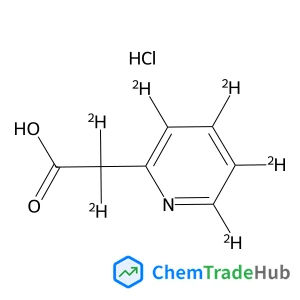
2,2-dideuterio-2-(3,4,5,6-tetradeuterio-2-pyridyl)acetic acid;hydrochloride
CAS番号:
1329799-67-8
分子式:
C7H2ClD6NO2
![N-[2-(4-Hydroxyphenoxy)-4-nitrophenyl]methanesulfonamide structure](https://static.chemtradehub.com/structs/109/109032-22-6-7c88.webp "N-[2-(4-Hydroxyphenoxy)-4-nitrophenyl]methanesulfonamide structure")
おすすめサプライヤー






免責事項
このページに表示される学術雑誌情報は、参考および研究目的のみを目的としています。当社は雑誌出版社とは提携しておらず、投稿の取り扱いも行っておりません。出版に関するお問い合わせは、各雑誌出版社に直接ご連絡ください。
表示されている情報に誤りがある場合は、support@chemtradehub.com までご連絡ください。迅速に確認し、対応いたします。