












Analytical magnetostatic model for 2D arrays of interacting magnetic nanowires and nanotubes
文献情報
出版日
2020-06-02
DOI
10.1039/D0CP00808G
インパクトファクター
3.676
著者
Yenni Velázquez-Galván, Armando Encinas
原文を見る
要旨
A fully analytical model to describe the magnetostatic properties of these 2D nanocylinder arrays (tubes and wires) is presented. The model allows calculating the components of the effective demagnetizing field as a function of the cylinder height, inner and outer diameters, and the center-to-center distance. From these components, it is possible to calculate the shape anisotropy of the cylinder, the dipolar interaction between them, and the total magnetostatic energy. The model allows performing calculations very simply, using a simple spreadsheet or open-access software such as Geogebra. This allows analyzing the effect of each geometrical parameter in the different contributions to the magnetostatic energy. Amongst the most interesting findings is that the model describes naturally the magnetization easy-axis reorientation transition induced by the dipolar interaction, for which a general phase diagram has been calculated for both tubes and wires. For the case of nanowires, our results show a very good agreement with previously published results. While for nanotubes, the model predicts that the magnetization easy-axis reorientation transition is frustrated as the tube wall thickness decreases and reaches a critical value even when the distance between tubes is reduced to its lowest possible value.
関連文献
Synthesis of propargylic fluorides from allenylsilanes
Laurence Carroll, Mª Carmen Pacheco, Ludivine Garcia, Véronique Gouverneur
2006-08-23
Communication
DOI: 10.1039/B610013A
Coupling–isomerization–Claisen sequences – mechanistic dichotomies in hetero domino reactions‡
Daniel M. D'Souza, Frank Rominger, Thomas J. J. Müller
2006-09-12
Communication
DOI: 10.1039/B609669G
Mechanism for the elimination of aromatic molecules from polyenes in tandem mass spectrometry
Ernani Pinto, Pio Colepicolo, Paul J. Gates
2006-08-23
Communication
DOI: 10.1039/B609672G
Selective monitoring of parts per million levels of CO by covalently immobilized metal complexes on glass
Tarkeshwar Gupta, Marc Altman, Sandra Lo Schiavo, Placido G. Mineo, Ignazio L. Fragalà, Guennadi Evmenenko, Pulak Dutta, Milko E. van der Boom
2008-04-22
Communication
DOI: 10.1039/B802670J
In situ investigation of the oxidative addition in homogeneous Pd catalysts by synchronised time resolved UV-Vis/EXAFS
Gemma Guilera, Mark A. Newton, Charlene Polli, Sakura Pascarelli, Meritxell Guinó, King Kuog (Mimi) Hii
2006-09-04
Communication
DOI: 10.1039/B606772G
An efficient and reusable carbon-supported platinum catalyst for aerobic oxidation of alcohols in water
Yun Hau Ng, Shigeru Ikeda, Takashi Harada, Yoshihiro Morita, Michio Matsumura
2008-05-07
Communication
DOI: 10.1039/B803912G
Bent phenyl groups in lithiosilanes—crystal structures and interpretation of this unanticipated feature
Carsten Strohmann, Christian Däschlein
2008-04-16
Communication
DOI: 10.1039/B802211A
Solvents for ring-closing metathesis reactions
Claire S. Adjiman, Adam J. Clarke, Gregory Cooper, Paul C. Taylor
2008-04-28
Communication
DOI: 10.1039/B802921K
Rh(ii)-catalyzed skeletal reorganization of enynes involving selective cleavage of C–C triple bonds
Kazusa Ota, Naoto Chatani
2008-05-29
Communication
DOI: 10.1039/B805100C
こちらもおすすめ
28770-01-62-(2-Isopropyl-1,3-o...
化合物よくある質問
「邻羟基阿托伐他汀内酯标准品」に適用される法規ガイドelinesは何ですか?
CAS番号163217-74-1の「邻羟基阿托伐他汀内酯标准品」は、GHS分類では危険物に分類されず、主にREACH規則とFDA/EPAの管理対象となります。R...
163217-74-1ortho-Hydroxy Atorva...
化合物よくある質問
メチル(3R)-3-アミノ-2,3-ジヒドロ-1-ベンゾファンラニン-5-カルボイル酸塩塩酸塩の主な用途は何ですか?
メチル(3R)-3-アミノ-2,3-ジヒドロ-1-ベンゾファンラニン-5-カルボイル酸塩塩酸塩は、医薬品や合成化学の研究に広く用いられます。また、特定の薬物の前...
2241594-15-8Methyl (3R)-3-amino-...
化合物よくある質問
トランス-4-メチルピロリジン-3-オール塩酸塩はどのように合成されますか?
トランス-4-メチルピロリジン-3-オール塩酸塩は、4-メチルピロリジンの塩酸塩化によって合成されます。一般的な合成方法では、4-メチルピロリジンを塩酸に加えて...
265108-42-7trans-4-Methylpyrrol...
化合物よくある質問
硫雜環丁烷-1,1-二氧化物は安全ですか?
硫雜環丁烷-1,1-二氧化物は安全ではありません。毒性は報告されていませんが、高温下で分解し、可燃性があるため、高圧ガスは注意が必要です。密閉した容器で保管し、...
5687-92-3Thietane 1,1-dioxide
6054-10-02H, 8H-Benzo[1,2-b
化合物よくある質問
9-ヒドロキシエリプチシネ塩酸塩はどのように合成されますか?
9-ヒドロキシエリプチシネ塩酸塩は、エリプチシネから塩酸を添加することで合成されます。選択性は高いですが、収率は約70%です。
52238-35-49-Hydroxyellipticine...
化合物よくある質問
5-塩素-2-(メチルアミノ)フェニル-(2-塩素フェニル)メタン酮の物理化学的性質は何ですか?
5-塩素-2-(メチルアミノ)フェニル-(2-塩素フェニル)メタン酮のCAS番号は5621-86-3です。この化合物は白色の結晶性粉末で、分子量は415.03で...
5621-86-3[5-Chloro-2-(methyla...
化合物よくある質問
1-[2-(4-甲氧基-苯氧基)-乙基]-哌嗪はどのように保存すればよいですか?
1-[2-(4-甲氧基-苯氧基)-乙基]-哌嗪は、直射日光を避けて暗所に、室温(15-25℃)で保管し、密閉容器に入れることで安定性を保つことができます。
117132-44-21-[2-(4-Methoxy-phen...
化合物よくある質問
2-[3-(4-甲氧基フェニル)プロピル]-4,4,5,5-四メチル-1,3,2-ドイボロロールアンの主な用途は何ですか?
2-[3-(4-甲氧基フェニル)プロピル]-4,4,5,5-四メチル-1,3,2-ドイボロロールアンは、医薬品の合成、有機合成化学、および新材料の研究で使用され...
1073371-72-82-[3-(4-Methoxypheny...
掲載誌
Physical Chemistry Chemical Physics

CiteScore:
5.5
自己引用率:
10.3%
年間論文数:
3036
Physical Chemistry Chemical Physics (PCCP) is an international journal co-owned by 19 physical chemistry and physics societies from around the world. This journal publishes original, cutting-edge research in physical chemistry, chemical physics and biophysical chemistry. To be suitable for publication in PCCP, articles must include significant innovation and/or insight into physical chemistry; this is the most important criterion that reviewers and Editors will judge against when evaluating submissions. The journal has a broad scope and welcomes contributions spanning experiment, theory, computation and data science. Topical coverage includes spectroscopy, dynamics, kinetics, statistical mechanics, thermodynamics, electrochemistry, catalysis, surface science, quantum mechanics, quantum computing and machine learning. Interdisciplinary research areas such as polymers and soft matter, materials, nanoscience, energy, surfaces/interfaces, and biophysical chemistry are welcomed if they demonstrate significant innovation and/or insight into physical chemistry. Joined experimental/theoretical studies are particularly appreciated when complementary and based on up-to-date approaches.
おすすめ化合物
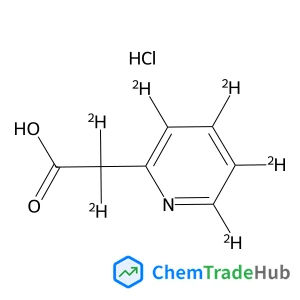
2,2-dideuterio-2-(3,4,5,6-tetradeuterio-2-pyridyl)acetic acid;hydrochloride
CAS番号:
1329799-67-8
分子式:
C7H2ClD6NO2

![1-[(4-Methylphenyl)sulfonyl]-3-(4,4,5,5-tetramethyl-1,3,2-dioxaborolan-2-yl)-1H-pyrrolo[2,3-b]pyridine-5-carbonitrile structure](https://static.chemtradehub.com/structs/143/1434747-57-5-fc0d.webp "1-[(4-Methylphenyl)sulfonyl]-3-(4,4,5,5-tetramethyl-1,3,2-dioxaborolan-2-yl)-1H-pyrrolo[2,3-b]pyridine-5-carbonitrile structure")
おすすめサプライヤー





免責事項
このページに表示される学術雑誌情報は、参考および研究目的のみを目的としています。当社は雑誌出版社とは提携しておらず、投稿の取り扱いも行っておりません。出版に関するお問い合わせは、各雑誌出版社に直接ご連絡ください。
表示されている情報に誤りがある場合は、support@chemtradehub.com までご連絡ください。迅速に確認し、対応いたします。