


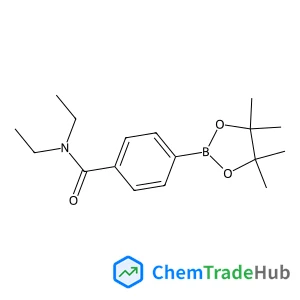
N,N-Diethyl-4-(4,4,5,5-tetramethyl-1,3,2-dioxaborolan-2-yl)benzamide
CAS番号:
325142-99-2
分子式:
C17H26BNO3
Dilek Yalcin, Andrew J. Christofferson, Calum J. Drummond, Tamar L. Greaves
Ionic liquids (ILs) are increasingly receiving interest for a wide range of applications. However, for many applications their cost and/or viscosity can be too high. This can be addressed by using protic ionic liquids as cheaper alternatives, and through mixing with molecular solvents. However, mixing ILs with a molecular solvent adds another dimension to the compositional space, as well as increasing the complexity of solvent–solute interactions. In this study, we have investigated the solvation properties of binary mixtures of PILs with molecular solvents. The selected binary solvent systems are the PILs ethylammonium nitrate (EAN) and propylammonium nitrate (PAN) combined with either water, methanol, acetonitrile or DMSO. In addition, water is combined with the other molecular solvents for comparison. The mole fractions of the secondary solvents were 0, 0.25, 0.5, 0.75, 0.9 and 1 for all combinations, which resulted in a total of 66 solvent mixtures. The solvation properties in each of these mixtures were determined from spectroscopic measurements of 4 well-known solvatochromic probe molecules as solutes. The solvation properties were comparatively investigated, and interpreted, in terms of the specific and non-specific interactions between PIL–solvent, PIL–solute and solvent–solute. All 66 solvent mixtures were also analysed using FTIR with no probe molecules present. In addition, through molecular dynamics simulations, the dye–solvent interactions were simulated for two of the dye molecules in water–EAN binary systems, and the radial distribution functions for the key interactions were obtained. The results showed that the solvation parameters of the binary mixtures deviated considerably from the ideal solvation behaviour. In many cases, bulk compositions and the estimated excess compositions in the solvation shells of the probes were different, suggesting preferential solvation, the extent of which is solute dependent. Our results clearly show that using PILs in a mixture with molecular solvents can strongly enhance the solvation capability.

Nature Reviews Drug Discovery

Foundations of Chemistry

European Journal of Organic Chemistry

CrystEngComm

Angewandte Chemie International Edition

Faraday Discussions

Mini-Reviews in Medicinal Chemistry

Lab on a Chip

Environmental Toxicology and Pharmacology

Journal of Enzyme inhibition and Medicinal Chemistry
Yanchen Han, Shengjie Ling, Zeming Qi, Zhengzhong Shao, Xin Chen
DOI: 10.1039/C8CP00802G
Dinesh Mishra, Vladislav Lobodin, Chengqi Zhang, Fadi Aldeek, Eric Lochner, Hedi Mattoussi
DOI: 10.1039/C7CP08682B
Mantas Šimėnas, Aneta Ciupa, Gediminas Usevičius, Kęstutis Aidas, Daniel Klose, Gunnar Jeschke, Mirosław Mączka, Georg Völkel, Andreas Pöppl, Jūras Banys
DOI: 10.1039/C8CP01426D
I. Alcón
DOI: 10.1039/C7CP08076J
Sandeep P. Patil, Sri Harsha Chilakamarri, Bernd Markert
DOI: 10.1039/C8CP01061G
M. Allan, M. Lacko, P. Papp, Š. Matejčík, M. Zlatar, I. I. Fabrikant, J. Kočišek, J. Fedor
DOI: 10.1039/C8CP01387J
M. Sarwar, J. Armstrong, A. P. E. York, I. Hitchcock
DOI: 10.1039/C8CP01022F
Hong Chen
DOI: 10.1039/C7CP05557A
DOI: 10.1039/C8CP01029C
2-ヒドロキシ-5-ニトロベンジンブロモイドは特定の化学反応に適しているため、代替品は限られています。しかし、同様の構造を持つ2-ヒドロキシ-4-ニトロベンジン...
N-(2-ブロモフェニル)-1-チロール-3-オキソ-3-(ピペリジニル)プロペン-2-イル)ベンゼンアミドは有毒で、皮膚や粘膜に刺激を与える可能性があります。...
この化合物は、新規治療薬の開発に注目されています。市場では、その有効性と安全性が評価され、研究分野では、分子生物学と医薬化学の新たな発見が期待されています。
Succinimidyl-alanyl-phenylalanyl-prolyl-phenylalanine 4-nitroanilide は主に医薬品開発やポ...
メチル6-アミノ-5-クロロピリジン-2-カーボイル酸(CAS番号: 1256794-05-4)の使用には、GHS( Globally Harmonized S...
取り扱いには、耐薬品性の容器を使用し、通気性の良い場所で操作することを推奨します。漏れ時は、SDS(安全データシート)を参照して適切な措置を取ること。手洗いと洗...
(S)-3-ベンZYルピペリジン塩酸塩は、CAS番号1258940-00-9で表される化合物です。これは、(S)-3-苯基哌啶的盐酸盐であり、主に医薬品の原料と...
3,5-二甲基金剛胺は、主に医薬品の原料として使用され、また抗うつ薬や抗アルツハイマー薬の開発に利用されます。さらに、化粧品や食品添加物の製造でも重要な役割を果...
ビス(4-メチル-2-ペンチル)フェニルカルボン酸エステル (CAS番号: 1398066-13-1) の代替品には、ビス(2-エチルヘキシル)フェノールカルボ...

Physical Chemistry Chemical Physics (PCCP) is an international journal co-owned by 19 physical chemistry and physics societies from around the world. This journal publishes original, cutting-edge research in physical chemistry, chemical physics and biophysical chemistry. To be suitable for publication in PCCP, articles must include significant innovation and/or insight into physical chemistry; this is the most important criterion that reviewers and Editors will judge against when evaluating submissions. The journal has a broad scope and welcomes contributions spanning experiment, theory, computation and data science. Topical coverage includes spectroscopy, dynamics, kinetics, statistical mechanics, thermodynamics, electrochemistry, catalysis, surface science, quantum mechanics, quantum computing and machine learning. Interdisciplinary research areas such as polymers and soft matter, materials, nanoscience, energy, surfaces/interfaces, and biophysical chemistry are welcomed if they demonstrate significant innovation and/or insight into physical chemistry. Joined experimental/theoretical studies are particularly appreciated when complementary and based on up-to-date approaches.
![6-Benzyl-4,5,6,7-tetrahydro-1H-pyrazolo[3,4-c]pyridin-3(2H)-one structure](https://static.chemtradehub.com/structs/909/909187-64-0-f54f.webp "6-Benzyl-4,5,6,7-tetrahydro-1H-pyrazolo[3,4-c]pyridin-3(2H)-one structure")
![5-Methyl-4,5,6,7-tetrahydropyrazolo[1,5-a]pyrazin-2-amine structure](https://static.chemtradehub.com/structs/122/1227210-33-4-8d64.webp "5-Methyl-4,5,6,7-tetrahydropyrazolo[1,5-a]pyrazin-2-amine structure")



