












Gold-doped silver nanoclusters with enhanced photophysical properties
文献情報
出版日
2018-04-17
DOI
10.1039/C7CP08682B
インパクトファクター
3.676
著者
Dinesh Mishra, Vladislav Lobodin, Chengqi Zhang, Fadi Aldeek, Eric Lochner, Hedi Mattoussi
原文を見る
要旨
We detail the characterization of atomically precise, luminescent silver and gold bimetallic nanoclusters (Ag and AgAuNCs) grown in the presence of bidentate lipoic acid (LA, the oxidized form) and dihydrolipoic acid (DHLA, the reduced form) ligands. We found that while doping AuNCs with Ag or Cu precursors using up to a 50% molar fraction (during growth) did not lead to any photoluminescence enhancement, doping of AgNCs with Au resulted in a six-fold enhancement of the PL emission compared to undoped AgNCs. The effect of doping is also reflected in the optical absorption and PL excitation spectra of the gold-doped NCs (AgAuNCs), where a clear blue shift in the absorbance features with respect to the pure AgNCs has been measured. Mass spectrometry measurements using ESI-MS showed that the AgNCs and Au-doped AgNCs had the compositions Ag29(DHLA)12 and Ag28Au(DHLA)12, respectively. The bimetallic nature of the AgAuNC cores was further supported by X-ray Photoelectron Spectroscopy (XPS) measurements. Data showed that the binding energies of the Ag and Au atoms measured from the nanoclusters were shifted with respect to those of the Ag and Au metals. Furthermore, the change in the Ag binding energy was affected by the presence of Au atoms. DOSY-NMR measurements performed on both sets of nanoclusters yielded no change in the hydrodynamic radius measured for either set of NCs when capped with the same ligands.
関連文献
Facile preparation of a nano-imprinted polymer on magnetite nanoparticles for the rapid separation of lead ions from aqueous solution
Delong Kong, Ning Qiao, Nian Wang, Zhuo Wang, Qi Wang, Zhiyong Zhou, Zhongqi Ren
2018-04-19
Paper
DOI: 10.1039/C8CP01163J
Nanopore-mediated ultrashort laser-induced formation and erasure of volume nanogratings in glass
Anton Rudenko, Jean-Philippe Colombier, Tatiana E. Itina
2018-01-25
Paper
DOI: 10.1039/C7CP07603G
Strain-induced modulations of electronic structure and electron–phonon coupling in dense H3S
Chang Liu, Hang Zhai, Ying Sun, Weiguang Gong, Yan Yan, Quan Li, Weitao Zheng
2018-01-29
Paper
DOI: 10.1039/C8CP00205C
Molecular dynamics simulations of the structure of mixtures of protic ionic liquids and monovalent and divalent salts at the electrochemical interface
Víctor Gómez-González, Borja Docampo-Álvarez, J. Manuel Otero-Mato, Oscar Cabeza, Luis J. Gallego, Luis M. Varela
2018-04-26
Paper
DOI: 10.1039/C8CP01180J
Collisional excitation of interstellar PO(X2Π) by He: new ab initio potential energy surfaces and scattering calculations
François Lique, Izaskun Jiménez-Serra, Serena Viti, Sarantos Marinakis
2017-09-25
Paper
DOI: 10.1039/C7CP05605B
Thermal activation of methane by vanadium boride cluster cations VBn+ (n = 3–6)
2018-01-17
Communication
DOI: 10.1039/C8CP00071A
Dissociative ionisation of adamantane: a combined theoretical and experimental study
Alessandra Candian, Jordy Bouwman, Patrick Hemberger, Andras Bodi, Alexander G. G. M. Tielens
2017-11-17
Paper
DOI: 10.1039/C7CP05957D
Li deposition and desolvation with electron transfer at a silicon/propylene-carbonate interface: transition-state and free-energy profiles by large-scale first-principles molecular dynamics
Tsukuru Ohwaki, Taisuke Ozaki, Yukihiro Okuno, Hideto Imai, Minoru Otani
2018-03-05
Paper
DOI: 10.1039/C7CP08569A
こちらもおすすめ
化合物よくある質問
2-ヒドロキシ-5-ニトロベンジンブロモイドの代替品はありますか?
2-ヒドロキシ-5-ニトロベンジンブロモイドは特定の化学反応に適しているため、代替品は限られています。しかし、同様の構造を持つ2-ヒドロキシ-4-ニトロベンジン...
772-33-82-(Bromomethyl)-4-ni...
化合物よくある質問
N-(2-ブロモフェニル)-1-チロール-3-オキソ-3-(ピペリジニル)プロペン-2-イル)ベンゼンアミドを取り扱う際の実験室安全事項は何ですか?
N-(2-ブロモフェニル)-1-チロール-3-オキソ-3-(ピペリジニル)プロペン-2-イル)ベンゼンアミドは有毒で、皮膚や粘膜に刺激を与える可能性があります。...
1800044-77-2N-[(1Z)-1-(2-Bromoph...
化合物よくある質問
1,3プロパンジオール,2-[2-(2アミノ-6クロロ-9Hピリミジン-9-イル)エチル-1,1,2,2-D4]-2,3-ジアセタートの市場動向や研究トレンドはどうですか?
この化合物は、新規治療薬の開発に注目されています。市場では、その有効性と安全性が評価され、研究分野では、分子生物学と医薬化学の新たな発見が期待されています。
1020718-81-31,3-Propanediol, 2-[...
579-44-2Ethanone, 2-hydroxy-...
化合物よくある質問
Succinimidyl-alanyl-phenylalanyl-prolyl-phenylalanine 4-nitroanilide はどの業界で使用されていますか?
Succinimidyl-alanyl-phenylalanyl-prolyl-phenylalanine 4-nitroanilide は主に医薬品開発やポ...
128802-73-3succinimidyl-alanyl-...
化合物よくある質問
メチル6-アミノ-5-クロロピリジン-2-カーボイル酸について、適用される法規ガイドラインは何ですか?
メチル6-アミノ-5-クロロピリジン-2-カーボイル酸(CAS番号: 1256794-05-4)の使用には、GHS( Globally Harmonized S...
1256794-05-4Methyl 6-amino-5-chl...
化合物よくある質問
エチル4-(シクロ Pentagonyl)アミノ-2-メチル硫化基ピリミジン-5-カルボキシレートを取り扱う際の実験室安全事項は何ですか?
取り扱いには、耐薬品性の容器を使用し、通気性の良い場所で操作することを推奨します。漏れ時は、SDS(安全データシート)を参照して適切な措置を取ること。手洗いと洗...
211245-62-4ethyl 4-(cyclopentyl...
化合物よくある質問
(S)-3-ベンZYルピペリジン塩酸塩とは何ですか?
(S)-3-ベンZYルピペリジン塩酸塩は、CAS番号1258940-00-9で表される化合物です。これは、(S)-3-苯基哌啶的盐酸盐であり、主に医薬品の原料と...
1258940-00-9(S)-3-Phenylpiperidi...
化合物よくある質問
3,5-二甲基金剛胺の主な用途は何ですか?
3,5-二甲基金剛胺は、主に医薬品の原料として使用され、また抗うつ薬や抗アルツハイマー薬の開発に利用されます。さらに、化粧品や食品添加物の製造でも重要な役割を果...
19988-45-52-(2,3-Dihydroxyphen...
化合物よくある質問
ビス(4-メチル-2-ペンチル)フェニルカルボン酸エステルの代替品はありますか?
ビス(4-メチル-2-ペンチル)フェニルカルボン酸エステル (CAS番号: 1398066-13-1) の代替品には、ビス(2-エチルヘキシル)フェノールカルボ...
1398066-13-1Bis(4-methyl-2-penty...
掲載誌
Physical Chemistry Chemical Physics

CiteScore:
5.5
自己引用率:
10.3%
年間論文数:
3036
Physical Chemistry Chemical Physics (PCCP) is an international journal co-owned by 19 physical chemistry and physics societies from around the world. This journal publishes original, cutting-edge research in physical chemistry, chemical physics and biophysical chemistry. To be suitable for publication in PCCP, articles must include significant innovation and/or insight into physical chemistry; this is the most important criterion that reviewers and Editors will judge against when evaluating submissions. The journal has a broad scope and welcomes contributions spanning experiment, theory, computation and data science. Topical coverage includes spectroscopy, dynamics, kinetics, statistical mechanics, thermodynamics, electrochemistry, catalysis, surface science, quantum mechanics, quantum computing and machine learning. Interdisciplinary research areas such as polymers and soft matter, materials, nanoscience, energy, surfaces/interfaces, and biophysical chemistry are welcomed if they demonstrate significant innovation and/or insight into physical chemistry. Joined experimental/theoretical studies are particularly appreciated when complementary and based on up-to-date approaches.
おすすめ化合物
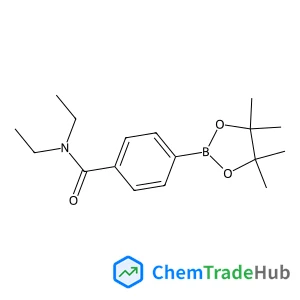
N,N-Diethyl-4-(4,4,5,5-tetramethyl-1,3,2-dioxaborolan-2-yl)benzamide
CAS番号:
325142-99-2
分子式:
C17H26BNO3
おすすめサプライヤー





免責事項
このページに表示される学術雑誌情報は、参考および研究目的のみを目的としています。当社は雑誌出版社とは提携しておらず、投稿の取り扱いも行っておりません。出版に関するお問い合わせは、各雑誌出版社に直接ご連絡ください。
表示されている情報に誤りがある場合は、support@chemtradehub.com までご連絡ください。迅速に確認し、対応いたします。