












The energetics of carbonated PuO2 surfaces affects nanoparticle morphology: a DFT+U study
文献情報
出版日
2020-03-11
DOI
10.1039/D0CP00021C
インパクトファクター
3.676
著者
Samuel Moxon, Adam R. Symington, Joshua S. Tse, James Dawson, Joseph M. Flitcroft, Stephen C. Parker, David J. Cooke, Robert M. Harker, Marco Molinari
原文を見る
要旨
Radiolytic corrosion of actinide materials represent an issue for the long term storage and disposal of nuclear materials. Molecular species adsorbed at the surface of the actinides may impact the rate of radiolysis, and as the surfaces corrode, the soluble toxic and radioactive species leach into groundwater. It is therefore critical to characterise the surface composition of actinides. Here, we employ ab initio modelling to determine the surface composition of PuO2 with respect to adsorbed CO2. We found that CO2 interacts strongly with the surface forming carbonate species. By mapping the energetics of this interaction, we then calculate the temperature of desorption, finding that surface morphology has a strong impact on the adsorption of CO2, with the {100} being the most and the {111} the least affected by carbonation. Finally, we predict the effect of carbonation on the morphology of PuO2 nanoparticles as a function of temperature and pressure, finding that truncated octahedral is the preferred morphology. This modelling strategy helps characterise surface compensition and nanoparticle morphology, and we discuss the implication for radiolytically driven dispersal of material into the environment.
関連文献
A catalytic role of surface silanol groups in CO2 capture on the amine-anchored silica support
Moses Cho, Joonho Park, Cafer T. Yavuz, Yousung Jung
2018-04-06
Paper
DOI: 10.1039/C7CP07973G
Accurate theoretical characterization of dioxygen difluoride: a problem resolved
Alexander Alijah, Thibaud Cours, Nejm-Eddine Jaidane, Najoua Derbel
2018-04-06
Paper
DOI: 10.1039/C7CP08659H
The reaction of fluorine atoms with methanol: yield of CH3O/CH2OH and rate constant of the reactions CH3O + CH3O and CH3O + HO2
Emmanuel Assaf, Coralie Schoemaecker, Luc Vereecken, Christa Fittschen
2017-11-06
Paper
DOI: 10.1039/C7CP05770A
General formalism for vibronic Hamiltonians in tetragonal symmetry and beyond
Riley J. Hickman, Robert A. Lang, Tao Zeng
2018-04-03
Paper
DOI: 10.1039/C8CP01394B
Modifying bis(triflimide) ionic liquids by dissolving early transition metal carbamates
Cinzia Chiappe, Christian Silvio Pomelli
2018-01-18
Paper
DOI: 10.1039/C7CP07289A
Anharmonicity in a double hydrogen transfer reaction studied in a single porphycene molecule on a Cu(110) surface
S. Liu, D. Baugh, K. Motobayashi, X. Zhao, S. Gawinkowski, L. Grill, M. Persson, T. Kumagai
2018-03-29
Paper
DOI: 10.1039/C8CP00178B
Excimer formation and evolution of excited state properties in discrete dimeric stacking of an anthracene derivative: a computational investigation
Yu Gao, Haichao Liu, Shitong Zhang, Qiang Gu, Yue Shen, Yunpeng Ge, Bing Yang
2018-04-06
Paper
DOI: 10.1039/C8CP00834E
H-Abstraction reactions by OH, HO2, O, O2 and benzyl radical addition to O2 and their implications for kinetic modelling of toluene oxidation
M. Pelucchi, C. Cavallotti, T. Faravelli, S. J. Klippenstein
2018-01-25
Paper
DOI: 10.1039/C7CP07779C
Rationalisation of the optical signatures of nor-dihydroxanthene-hemicyanine fused near-infrared fluorophores by first-principle tools
Cloé Azarias, Isabelle Navizet, Paul Fleurat-Lessard, Boris Le Guennic, Jean-Alexandre Richard, Denis Jacquemin
2018-04-03
Paper
DOI: 10.1039/C8CP01587B
Examination of inequivalent wetting on the crystal habit surfaces of RS-ibuprofen using grid-based molecular modelling
I. Rosbottom, J. H. Pickering, B. Etbon, R. B. Hammond, K. J. Roberts
2018-04-17
Paper
DOI: 10.1039/C7CP08354H
こちらもおすすめ
化合物よくある質問
2-ヒドロキシ-5-ニトロベンジンブロモイドの代替品はありますか?
2-ヒドロキシ-5-ニトロベンジンブロモイドは特定の化学反応に適しているため、代替品は限られています。しかし、同様の構造を持つ2-ヒドロキシ-4-ニトロベンジン...
772-33-82-(Bromomethyl)-4-ni...
化合物よくある質問
N-(2-ブロモフェニル)-1-チロール-3-オキソ-3-(ピペリジニル)プロペン-2-イル)ベンゼンアミドを取り扱う際の実験室安全事項は何ですか?
N-(2-ブロモフェニル)-1-チロール-3-オキソ-3-(ピペリジニル)プロペン-2-イル)ベンゼンアミドは有毒で、皮膚や粘膜に刺激を与える可能性があります。...
1800044-77-2N-[(1Z)-1-(2-Bromoph...
化合物よくある質問
1,3プロパンジオール,2-[2-(2アミノ-6クロロ-9Hピリミジン-9-イル)エチル-1,1,2,2-D4]-2,3-ジアセタートの市場動向や研究トレンドはどうですか?
この化合物は、新規治療薬の開発に注目されています。市場では、その有効性と安全性が評価され、研究分野では、分子生物学と医薬化学の新たな発見が期待されています。
1020718-81-31,3-Propanediol, 2-[...
579-44-2Ethanone, 2-hydroxy-...
化合物よくある質問
Succinimidyl-alanyl-phenylalanyl-prolyl-phenylalanine 4-nitroanilide はどの業界で使用されていますか?
Succinimidyl-alanyl-phenylalanyl-prolyl-phenylalanine 4-nitroanilide は主に医薬品開発やポ...
128802-73-3succinimidyl-alanyl-...
化合物よくある質問
メチル6-アミノ-5-クロロピリジン-2-カーボイル酸について、適用される法規ガイドラインは何ですか?
メチル6-アミノ-5-クロロピリジン-2-カーボイル酸(CAS番号: 1256794-05-4)の使用には、GHS( Globally Harmonized S...
1256794-05-4Methyl 6-amino-5-chl...
化合物よくある質問
エチル4-(シクロ Pentagonyl)アミノ-2-メチル硫化基ピリミジン-5-カルボキシレートを取り扱う際の実験室安全事項は何ですか?
取り扱いには、耐薬品性の容器を使用し、通気性の良い場所で操作することを推奨します。漏れ時は、SDS(安全データシート)を参照して適切な措置を取ること。手洗いと洗...
211245-62-4ethyl 4-(cyclopentyl...
化合物よくある質問
(S)-3-ベンZYルピペリジン塩酸塩とは何ですか?
(S)-3-ベンZYルピペリジン塩酸塩は、CAS番号1258940-00-9で表される化合物です。これは、(S)-3-苯基哌啶的盐酸盐であり、主に医薬品の原料と...
1258940-00-9(S)-3-Phenylpiperidi...
化合物よくある質問
3,5-二甲基金剛胺の主な用途は何ですか?
3,5-二甲基金剛胺は、主に医薬品の原料として使用され、また抗うつ薬や抗アルツハイマー薬の開発に利用されます。さらに、化粧品や食品添加物の製造でも重要な役割を果...
19988-45-52-(2,3-Dihydroxyphen...
化合物よくある質問
ビス(4-メチル-2-ペンチル)フェニルカルボン酸エステルの代替品はありますか?
ビス(4-メチル-2-ペンチル)フェニルカルボン酸エステル (CAS番号: 1398066-13-1) の代替品には、ビス(2-エチルヘキシル)フェノールカルボ...
1398066-13-1Bis(4-methyl-2-penty...
掲載誌
Physical Chemistry Chemical Physics

CiteScore:
5.5
自己引用率:
10.3%
年間論文数:
3036
Physical Chemistry Chemical Physics (PCCP) is an international journal co-owned by 19 physical chemistry and physics societies from around the world. This journal publishes original, cutting-edge research in physical chemistry, chemical physics and biophysical chemistry. To be suitable for publication in PCCP, articles must include significant innovation and/or insight into physical chemistry; this is the most important criterion that reviewers and Editors will judge against when evaluating submissions. The journal has a broad scope and welcomes contributions spanning experiment, theory, computation and data science. Topical coverage includes spectroscopy, dynamics, kinetics, statistical mechanics, thermodynamics, electrochemistry, catalysis, surface science, quantum mechanics, quantum computing and machine learning. Interdisciplinary research areas such as polymers and soft matter, materials, nanoscience, energy, surfaces/interfaces, and biophysical chemistry are welcomed if they demonstrate significant innovation and/or insight into physical chemistry. Joined experimental/theoretical studies are particularly appreciated when complementary and based on up-to-date approaches.
おすすめ化合物
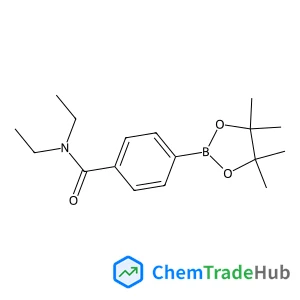
N,N-Diethyl-4-(4,4,5,5-tetramethyl-1,3,2-dioxaborolan-2-yl)benzamide
CAS番号:
325142-99-2
分子式:
C17H26BNO3
![Methyl 4-({[(2-methyl-2-propanyl)oxy]carbonyl}amino)bicyclo[2.2.2]octane-1-carboxylate structure](https://static.chemtradehub.com/structs/943/943845-74-7-b7e5.webp "Methyl 4-({[(2-methyl-2-propanyl)oxy]carbonyl}amino)bicyclo[2.2.2]octane-1-carboxylate structure")
おすすめサプライヤー





免責事項
このページに表示される学術雑誌情報は、参考および研究目的のみを目的としています。当社は雑誌出版社とは提携しておらず、投稿の取り扱いも行っておりません。出版に関するお問い合わせは、各雑誌出版社に直接ご連絡ください。
表示されている情報に誤りがある場合は、support@chemtradehub.com までご連絡ください。迅速に確認し、対応いたします。