












Computational and experimental studies on Cu/Au-catalyzed stereoselective synthesis of 1,3-disubstituted allenes
文献情報
出版日
2019-04-16
DOI
10.1039/C9QO00364A
インパクトファクター
5.281
著者
María Magdalena Cid, María Lago-Silva, Marta González Comesaña, Olalla Nieto Faza, Carlos Silva López
原文を見る
要旨
Cu- and Au-mediated formation of allenes from terminal alkynes and aldehydes via propargylamine intermediates is hampered by reversibility in the propargylamine formation. The use of a stable Au(I) catalyst in the reaction using a chiral propargylamine provided clues to disentangle the mechanism of the whole process that would have been otherwise hidden. Additionally, the process was observed to be stereoselective when an enantiomerically pure chiral propargylamine was used as starting substrate providing the corresponding 1,3-disubstituted allenes with high enantiomeric ratio.
関連文献
Separation and quantification of dead species in styreneRAFT polymerization by gradient polymerelution chromatography
Ruiwei Guo, Zhipeng Shi, Xingxing Wang, Anjie Dong
2012-03-23
Paper
DOI: 10.1039/C2PY20102J
Recent advances in (reactive) melt processing of cellulose acetate and related biodegradable bio-compositions
Robert Quintana, Olivier Persenaire, Leila Bonnaud, Philippe Dubois
2011-11-28
Minireview
DOI: 10.1039/C1PY00421B
Polymeric vesicles mimicking glycocalyx (PV-Gx) for studying carbohydrate–protein interactions in solution
Lu Su, Yu Zhao, Guosong Chen, Ming Jiang
2012-04-13
Paper
DOI: 10.1039/C2PY20110K
Bioerodible polyphosphazenes and their medical potential
Harry R. Allcock, Nicole L. Morozowich
2011-11-16
Review Article
DOI: 10.1039/C1PY00468A
Solution-processable triarylamine-based electroactive high performance polymers for anodically electrochromic applications
Hung-Ju Yen, Guey-Sheng Liou
2011-10-03
Review Article
DOI: 10.1039/C1PY00346A
Electrochemical investigations on anticorrosive and electrochromic properties of electroactive polyurea
Tzu-Chun Yeh, Tsao-Cheng Huang, Hsiu-Ying Huang, Yu-Pei Huang, Yu-Ting Cai, Shih-Ting Lin, Yen Wei, Jui-Ming Yeh
2012-05-28
Paper
DOI: 10.1039/C2PY20061A
ATRP–RCMpolymercyclization: synthesis of amphiphilic cyclic polystyrene-b-poly(ethylene oxide) copolymers
Eisuke Baba, Satoshi Honda, Takuya Yamamoto, Yasuyuki Tezuka
2011-11-23
Paper
DOI: 10.1039/C1PY00475A
Substituent effects on the stabilities of polymeric and small molecule bis-terpyridine complexes
Ian M. Henderson, Ryan C. Hayward
2012-03-13
Paper
DOI: 10.1039/C2PY20042B
A ‘smart’ approach towards the formation of multifunctional nano-assemblies by simple mixing of block copolymers having a common temperature sensitive segment
Mitsuhiro Ebara, Naokazu Idota, Ravin Narain
2012-02-15
Paper
DOI: 10.1039/C2PY00589A
こちらもおすすめ
化合物よくある質問
6- bromo-1-cyclopropyl-1H-benzimidazoleの市場動向や研究トレンドはどうですか?
6- bromo-1-cyclopropyl-1H-benzimidazoleは、抗炎症、抗ウイルス作用を持つことが報告されており、新薬開発の研究対象として注目...
1416713-53-56-Bromo-1-cyclopropy...
化合物よくある質問
環氧プロpanol-d5を取り扱う際の実験室安全事項は何ですか?
取り扱う際には、防護眼鏡と手袋を使用し、ドラフトチャンバー内で操作することを推奨します。漏洩時には適切な手順で処理し、安全データシートを常に参照してください。
1246819-20-4Glycidol-d5
化合物よくある質問
2,2’-ジメチル-3,3’-ビピリジンはどのように合成されますか?
2,2’-ジメチル-3,3’-ビピリジンは、ピリジンと2-メチルアクリルアミドを有機合成反応で合成します。この反応では、ピリジンと2-メチルアクリルアミドを含有...
86156-55-02,2’-Dimethyl-3,3’-b...
化合物よくある質問
6-甲基ピリジン-2-ボリック酸の主な用途は何ですか?
6-甲基ピリジン-2-ボリック酸は、合成化学、医薬品合成、以及研究用途などに広く使用され、特に組換えDNA技術や分子生物学の研究において重要な役割を果たします。
372963-50-3(6-Methyl-2-pyridiny...
化合物よくある質問
(R)-3-(1-甲基-2-氧環己基)プロpano酸メチルは安全ですか?
(R)-3-(1-甲基-2-氧環己基)プロpano酸メチルは一定の安全性がありますが、直接的な皮膚接触や吸入は避けるべきです。使用する際は適切な個々の安全データ...
94089-47-1methyl 3-[(1R)-1-met...
化合物よくある質問
ketorolacはどのように保存すればよいですか?
ketorolacは、密封して遮光容器に保管し、直射日光や高温を避けて保存してください。温度は常温で保存し、湿度をなるべく低く保つことが推奨されます。
74103-06-3rac Ketorolac
化合物よくある質問
L-2,3-二氨基丙酸二盐酸盐を取り扱う際の実験室安全事項は何ですか?
L-2,3-二氨基丙酸二盐酸盐は腐食性が強く、皮膚や粘膜に刺激を与える可能性があります。取り扱う際は、防塵マスク、ゴーグル、手袋を使用し、適切な排気設備を使用し...
19777-68-5(S)-2,3-Diaminopropa...
化合物よくある質問
2-(4-溴ピリジン-2-基)乙腈の物理化学的性質は何ですか?
2-(4-溴ピリジン-2-基)乙腈のCAS番号は312325-73-8です。主に結晶形態で存在し、分子量は159.01 g/molです。この化合物は水に溶けやす...
312325-73-8(4-Bromo-2-pyridinyl...
化合物よくある質問
3-フローロ-[1,1-ベンジレン]-3,4-ジカルボン酸を取り扱う際の実験室安全事項は何ですか?
この化合物は毒性は低いですが、直接的な接触や吸入に注意が必要です。PPE(個人防護具)を着用し、ドラフトチャンバーを使用して操作することを推奨します。また、漏洩...
1261915-32-53'-Fluoro-[1,1'-biph...
化合物よくある質問
3-(1-氧代-1,3-二氢-2H-2-异吲哚)丙酸の主な用途は何ですか?
3-(1-氧代-1,3-二氢-2H-2-异吲哚)丙酸は、薬理学研究や医薬品製造において広く用いられる化合物です。また、工業的な用途でも一部の化学反応の触媒や助剤...
83747-30-23-(1-Oxo-1,3-dihydro...
掲載誌
Organic Chemistry Frontiers

CiteScore:
7.8
自己引用率:
8.7%
年間論文数:
724
Organic Chemistry Frontiers publishes high-quality research from across organic chemistry. Emphases are placed on studies that make significant contributions to the field of organic chemistry by reporting either new or significantly improved protocols or methodologies. Topics include, but are not limited to the following: Organic synthesis Development of synthetic methodologies Catalysis Natural products Functional organic materials Supramolecular and macromolecular chemistry Physical and computational organic chemistry
おすすめ化合物
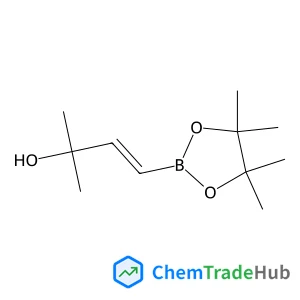
(E)-2-methyl-4-(4,4,5,5-tetramethyl-1,3,2-dioxaborolan-2-yl)but-3-en-2-ol
CAS番号:
581802-26-8
分子式:
C11H21BO3
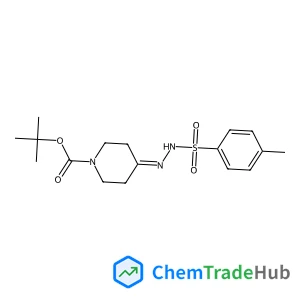
tert-Butyl 4-(2-(p-Tolylsulfonyl)hydrazono)piperidine-1-carboxylate
CAS番号:
1046478-89-0
分子式:
C17H25N3O4S
おすすめサプライヤー



免責事項
このページに表示される学術雑誌情報は、参考および研究目的のみを目的としています。当社は雑誌出版社とは提携しておらず、投稿の取り扱いも行っておりません。出版に関するお問い合わせは、各雑誌出版社に直接ご連絡ください。
表示されている情報に誤りがある場合は、support@chemtradehub.com までご連絡ください。迅速に確認し、対応いたします。