












A biomimetic strategy for the selective recognition of organophosphates in 100% water: synergies of electrostatic interactions, cavity embedment and metal coordination
文献情報
出版日
2019-04-01
DOI
10.1039/C9QO00263D
インパクトファクター
5.281
著者
Solène Collin, Nicolas Giraud, Elise Dumont, Olivia Reinaud
原文を見る
要旨
Phosphate recognition in water is a hot topic due to their importance in biology and environment. The design and conception of water-soluble receptors that are efficient and selective is a difficult task because of the water medium, which provides highly competitive electrostatic interactions. A possible strategy relies on multipoint recognition with a polycationic site for electrostatic interaction with the phosphate moiety and a hydrophobic cavity for the organic one. Following this strategy, a detailed study of the hosting properties of a water-soluble resorcinarene-based metallo-cavitand, WRim4Zn, with various organophosphates is presented. The ZnII receptor showed good affinity and selectivity for n-alkyl phosphates (CnP) having from 2 to 6 carbons, in 100% water at physiological pH. The strongest association was obtained with C6P [K′pD7.4 = 3.6 × 10⁴ M−1] whereas C7P binds 100 times less strongly. This very sharp selectivity pattern stands in strong contrast with carboxylate guests for which the optimum size corresponds to acetate. The different selectivity pattern stems from a switch in the coordination mode of ZnII upon phosphate binding, inducing the decoordination of two out of the four imidazole arms grafted on the resorcinarene macrocycle. Hence, the efficiency of WRim4Zn for alkyl phosphate recognition and unusual selectivity relative to the organic moiety of the phosphate analytes is ascribed to the synergistic action of a metal binding site for the phosphate head (the ZnII receptor is 100 times more efficient than the cavity ligand WRim4 itself), a hydrophobic cavity for alkyl embedment, protonated arms leading to further electrostatic stabilization, spacers between the recognition points (ZnII, imidazoliums, resorcinarene bowl cavity) allowing directional and spatial control of guest binding. Another key point is the water-solubility of the hydrophobic core insured by the pyridinium feet positioned away from the receptacle, which avoids the destructuring of the receptor metallo-site. Phosphodiesters, which are singly charged and congested, are not recognized. Hence, the good affinity displayed for C6P makes WRim4Zn one of the best cavity-based receptor for organophosphates described to date. These results open new routes for sensing biologically and environmentally important organic anions, considering the tunability of the functionalization pattern of the resorcinarene core.
関連文献
Peripherally diketopyrrolopyrrole-functionalized dendritic oligothiophenes – synthesis, molecular structure, properties and applications
Qun Luo, Junkai Wang, Yi Lin, Changquan Tang, Junyan Dou, Hongwei Tan, Qingdong Zheng, Chang-Qi Ma, Zheng Cui
2017-01-10
Paper
DOI: 10.1039/C6PY02161A
Control over the assembly and rheology of supramolecular networks via multi-responsive double hydrophilic copolymers
Jérémy Brassinne, Charles-André Fustin, Jean-François Gohy
2017-01-30
Paper
DOI: 10.1039/C6PY02143C
“Arm-first” approach for the synthesis of star-shaped stereoregular polymers through living coordination polymerization
Zhenghai Shi, Fang Guo, Rui Tan, Hui Niu, Tingting Li, Yang Li
2017-01-31
Communication
DOI: 10.1039/C6PY02097F
Microporous polyimide networks constructed through a two-step polymerization approach, and their carbon dioxide adsorption performance
Hongyan Yao, Na Zhang, Ningning Song, Kunzhi Shen, Pengfei Huo, Shiyang Zhu, Yunhe Zhang, Shaowei Guan
2017-01-04
Paper
DOI: 10.1039/C6PY01814A
Synthesis of highly branched polymers by reversible complexation-mediated copolymerization of vinyl and divinyl monomers
Hongjun Yang, Zhongrui Wang, Yulei Zheng, Wenyan Huang, Xiaoqiang Xue, Bibiao Jiang
2017-02-21
Paper
DOI: 10.1039/C7PY00174F
Macroporous uniform azide- and alkyne-functional polymer microspheres with tuneable surface area: synthesis, in-depth characterization and click-modification
Marco Albuszis, Peter J. Roth, Werner Pauer, Hans-Ulrich Moritz
2014-06-17
Paper
DOI: 10.1039/C4PY00709C
A tumor-targeting dextran–apoprotein conjugate integrated with enediyne chromophore shows highly potent antitumor efficacy
Bin Li, Xiu-jun Liu, Liang Li, Sheng-hua Zhang, Yi Li, Dian-dong Li, Yong-su Zhen
2014-05-20
Paper
DOI: 10.1039/C4PY00532E
Synthetic strategies for the generation of ABCA' type asymmetric tetrablock terpolymers
Siddharth Chanpuriya, Marc A. Hillmyer, Frank S. Bates
2014-06-13
Paper
DOI: 10.1039/C4PY00614C
Microwave-assisted solution polycondensation of l-lactic acid using a Dean–Stark apparatus for a non-thermal microwave polymerization effect induced by the electric field
Shinji Yamada, Akinori Takasu, Sadatsugu Takayama, Kazuhiko Kawamura
2014-05-16
Paper
DOI: 10.1039/C4PY00639A
こちらもおすすめ
化合物よくある質問
6- bromo-1-cyclopropyl-1H-benzimidazoleの市場動向や研究トレンドはどうですか?
6- bromo-1-cyclopropyl-1H-benzimidazoleは、抗炎症、抗ウイルス作用を持つことが報告されており、新薬開発の研究対象として注目...
1416713-53-56-Bromo-1-cyclopropy...
化合物よくある質問
環氧プロpanol-d5を取り扱う際の実験室安全事項は何ですか?
取り扱う際には、防護眼鏡と手袋を使用し、ドラフトチャンバー内で操作することを推奨します。漏洩時には適切な手順で処理し、安全データシートを常に参照してください。
1246819-20-4Glycidol-d5
化合物よくある質問
2,2’-ジメチル-3,3’-ビピリジンはどのように合成されますか?
2,2’-ジメチル-3,3’-ビピリジンは、ピリジンと2-メチルアクリルアミドを有機合成反応で合成します。この反応では、ピリジンと2-メチルアクリルアミドを含有...
86156-55-02,2’-Dimethyl-3,3’-b...
化合物よくある質問
6-甲基ピリジン-2-ボリック酸の主な用途は何ですか?
6-甲基ピリジン-2-ボリック酸は、合成化学、医薬品合成、以及研究用途などに広く使用され、特に組換えDNA技術や分子生物学の研究において重要な役割を果たします。
372963-50-3(6-Methyl-2-pyridiny...
化合物よくある質問
(R)-3-(1-甲基-2-氧環己基)プロpano酸メチルは安全ですか?
(R)-3-(1-甲基-2-氧環己基)プロpano酸メチルは一定の安全性がありますが、直接的な皮膚接触や吸入は避けるべきです。使用する際は適切な個々の安全データ...
94089-47-1methyl 3-[(1R)-1-met...
化合物よくある質問
ketorolacはどのように保存すればよいですか?
ketorolacは、密封して遮光容器に保管し、直射日光や高温を避けて保存してください。温度は常温で保存し、湿度をなるべく低く保つことが推奨されます。
74103-06-3rac Ketorolac
化合物よくある質問
L-2,3-二氨基丙酸二盐酸盐を取り扱う際の実験室安全事項は何ですか?
L-2,3-二氨基丙酸二盐酸盐は腐食性が強く、皮膚や粘膜に刺激を与える可能性があります。取り扱う際は、防塵マスク、ゴーグル、手袋を使用し、適切な排気設備を使用し...
19777-68-5(S)-2,3-Diaminopropa...
化合物よくある質問
2-(4-溴ピリジン-2-基)乙腈の物理化学的性質は何ですか?
2-(4-溴ピリジン-2-基)乙腈のCAS番号は312325-73-8です。主に結晶形態で存在し、分子量は159.01 g/molです。この化合物は水に溶けやす...
312325-73-8(4-Bromo-2-pyridinyl...
化合物よくある質問
3-フローロ-[1,1-ベンジレン]-3,4-ジカルボン酸を取り扱う際の実験室安全事項は何ですか?
この化合物は毒性は低いですが、直接的な接触や吸入に注意が必要です。PPE(個人防護具)を着用し、ドラフトチャンバーを使用して操作することを推奨します。また、漏洩...
1261915-32-53'-Fluoro-[1,1'-biph...
化合物よくある質問
3-(1-氧代-1,3-二氢-2H-2-异吲哚)丙酸の主な用途は何ですか?
3-(1-氧代-1,3-二氢-2H-2-异吲哚)丙酸は、薬理学研究や医薬品製造において広く用いられる化合物です。また、工業的な用途でも一部の化学反応の触媒や助剤...
83747-30-23-(1-Oxo-1,3-dihydro...
掲載誌
Organic Chemistry Frontiers

CiteScore:
7.8
自己引用率:
8.7%
年間論文数:
724
Organic Chemistry Frontiers publishes high-quality research from across organic chemistry. Emphases are placed on studies that make significant contributions to the field of organic chemistry by reporting either new or significantly improved protocols or methodologies. Topics include, but are not limited to the following: Organic synthesis Development of synthetic methodologies Catalysis Natural products Functional organic materials Supramolecular and macromolecular chemistry Physical and computational organic chemistry
おすすめ化合物
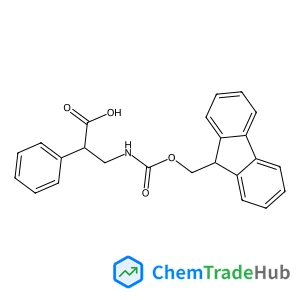
(S)-3-((((9H-Fluoren-9-yl)methoxy)carbonyl)amino)-2-phenylpropanoic acid
CAS番号:
1217663-60-9
分子式:
C24H21NO4
おすすめサプライヤー



免責事項
このページに表示される学術雑誌情報は、参考および研究目的のみを目的としています。当社は雑誌出版社とは提携しておらず、投稿の取り扱いも行っておりません。出版に関するお問い合わせは、各雑誌出版社に直接ご連絡ください。
表示されている情報に誤りがある場合は、support@chemtradehub.com までご連絡ください。迅速に確認し、対応いたします。