


Synthesis of highly branched polymers by reversible complexation-mediated copolymerization of vinyl and divinyl monomers
文献情報
出版日
2017-02-21
DOI
10.1039/C7PY00174F
インパクトファクター
5.582
著者
Hongjun Yang, Zhongrui Wang, Yulei Zheng, Wenyan Huang, Xiaoqiang Xue, Bibiao Jiang
原文を見る
要旨
Here, we report the reversible complexation-mediated copolymerization (RCMcP) of vinyl and divinyl monomers for the synthesis of highly branched polymers. A conventional azo radical initiator, 2,2′-azobisisoheptonitrile (V65), a free-radical polymerization inhibitor (I2), and a highly reactive but inexpensive salt (NaI) were used to initiate and control the polymerization. The highly branched structures and process of branching were confirmed and thoroughly investigated. The reactivity of the vinyl groups incorporated into the copolymer was found to be similar to that of the monomers used in the RCMcP reaction. Large numbers of branched structures occurred when the conversion of MMA (conv.MMA) reached 56.6%, at which point the amount of pendant vinyl groups in the polymer reached a maximum value. The most significant branching occurred when the conv.MMA approached 90% because of intermolecular reactions between macromolecules. The polymerization reaction can also be performed without deoxygenation, with no obvious prolongation of induction. This work provides a simple, easy, and versatile method for the synthesis of highly branched polymers from commercially available compounds.
おすすめジャーナル

Journal of Peptide Science

Journal of Natural Medicines

Russian Chemical Bulletin

Organic Process Research & Development

Russian Journal of Coordination Chemistry

Drug Discovery Today

Chemical Communications

Saudi Pharmaceutical Journal

Current Opinion in Colloid & Interface Science

Current Opinion in Solid State & Materials Science
関連文献
Optimizing the orbital occupation in the multiple minima problem of magnetic materials from the metaheuristic firefly algorithm
Adam Payne, Guillermo Avedaño-Franco, Xu He, Eric Bousquet, Aldo H. Romero
2019-09-17
Paper
DOI: 10.1039/C9CP03618K
Systematic modification of the indium tin oxide work function via side-chain modulation of an amino-acid functionalization layer
Naomi Kramer, Soumyajit Sarkar, Leeor Kronik, Nurit Ashkenasy
2019-09-23
Paper
DOI: 10.1039/C9CP04079J
Ternary 12-electron CBe3X3+ (X = H, Li, Na, Cu, Ag) clusters: planar tetracoordinate carbons and superalkali cations
Lin-Yan Feng, Chuan Dong, Hua-Jin Zhai
2019-09-12
Paper
DOI: 10.1039/C9CP04437J
Comprehensive understanding of intrinsic mobility in the monolayers of III–VI group 2D materials
Jianhui Chen, Xiaolin Tan, Peng Lin, Baisheng Sa, Jian Zhou, Yinggan Zhang, Cuilian Wen, Zhimei Sun
2019-09-09
Paper
DOI: 10.1039/C9CP04407H
A unique pentagonal network structure of the NiS2 monolayer with high stability and a tunable bandgap
2020-03-07
Paper
DOI: 10.1039/D0CP00434K
The co-reactant role during plasma enhanced atomic layer deposition of palladium
Ji-Yu Feng, Matthias M. Minjauw, Ranjith K. Ramachandran, Michiel Van Daele, Hilde Poelman, Timo Sajavaara, Jolien Dendooven, Christophe Detavernier
2020-04-07
Paper
DOI: 10.1039/D0CP00786B
Correction: Thermodynamics, kinetics and electronic properties of point defects in β-FeSi2
Chen Ming, Pengfei Qiu, Yi-Yang Sun, Lidong Chen
2019-09-25
Correction
DOI: 10.1039/C9CP90237F
Efficient thermal- and photocatalysts made of Au nanoparticles on MgAl-layered double hydroxides for energy and environmental applications
2019-09-16
Paper
DOI: 10.1039/C9CP04445K
β12-Borophene becomes a semiconductor and semimetal via a perpendicular electric field and dilute charged impurity
T. C. Phong
2019-09-20
Paper
DOI: 10.1039/C9CP04719K
Holistic approach to chemical degradation of Nafion membranes in fuel cells: modelling and predictions
Philipp Frühwirt, Jens T. Törring, Tomaž Katrašnik, Georg Gescheidt
2020-02-26
Paper
DOI: 10.1039/C9CP04986J
こちらもおすすめ
28770-01-62-(2-Isopropyl-1,3-o...
化合物よくある質問
「邻羟基阿托伐他汀内酯标准品」に適用される法規ガイドelinesは何ですか?
CAS番号163217-74-1の「邻羟基阿托伐他汀内酯标准品」は、GHS分類では危険物に分類されず、主にREACH規則とFDA/EPAの管理対象となります。R...
163217-74-1ortho-Hydroxy Atorva...
化合物よくある質問
メチル(3R)-3-アミノ-2,3-ジヒドロ-1-ベンゾファンラニン-5-カルボイル酸塩塩酸塩の主な用途は何ですか?
メチル(3R)-3-アミノ-2,3-ジヒドロ-1-ベンゾファンラニン-5-カルボイル酸塩塩酸塩は、医薬品や合成化学の研究に広く用いられます。また、特定の薬物の前...
2241594-15-8Methyl (3R)-3-amino-...
化合物よくある質問
トランス-4-メチルピロリジン-3-オール塩酸塩はどのように合成されますか?
トランス-4-メチルピロリジン-3-オール塩酸塩は、4-メチルピロリジンの塩酸塩化によって合成されます。一般的な合成方法では、4-メチルピロリジンを塩酸に加えて...
265108-42-7trans-4-Methylpyrrol...
化合物よくある質問
硫雜環丁烷-1,1-二氧化物は安全ですか?
硫雜環丁烷-1,1-二氧化物は安全ではありません。毒性は報告されていませんが、高温下で分解し、可燃性があるため、高圧ガスは注意が必要です。密閉した容器で保管し、...
5687-92-3Thietane 1,1-dioxide
6054-10-02H, 8H-Benzo[1,2-b
化合物よくある質問
9-ヒドロキシエリプチシネ塩酸塩はどのように合成されますか?
9-ヒドロキシエリプチシネ塩酸塩は、エリプチシネから塩酸を添加することで合成されます。選択性は高いですが、収率は約70%です。
52238-35-49-Hydroxyellipticine...
化合物よくある質問
5-塩素-2-(メチルアミノ)フェニル-(2-塩素フェニル)メタン酮の物理化学的性質は何ですか?
5-塩素-2-(メチルアミノ)フェニル-(2-塩素フェニル)メタン酮のCAS番号は5621-86-3です。この化合物は白色の結晶性粉末で、分子量は415.03で...
5621-86-3[5-Chloro-2-(methyla...
化合物よくある質問
1-[2-(4-甲氧基-苯氧基)-乙基]-哌嗪はどのように保存すればよいですか?
1-[2-(4-甲氧基-苯氧基)-乙基]-哌嗪は、直射日光を避けて暗所に、室温(15-25℃)で保管し、密閉容器に入れることで安定性を保つことができます。
117132-44-21-[2-(4-Methoxy-phen...
化合物よくある質問
2-[3-(4-甲氧基フェニル)プロピル]-4,4,5,5-四メチル-1,3,2-ドイボロロールアンの主な用途は何ですか?
2-[3-(4-甲氧基フェニル)プロピル]-4,4,5,5-四メチル-1,3,2-ドイボロロールアンは、医薬品の合成、有機合成化学、および新材料の研究で使用され...
1073371-72-82-[3-(4-Methoxypheny...
掲載誌
Polymer Chemistry

CiteScore:
8.6
自己引用率:
7.3%
年間論文数:
457
Polymer Chemistry welcomes submissions in all areas of polymer science that have a strong focus on macromolecular chemistry. Manuscripts may cover a broad range of fields, yet no direct application focus is required.
おすすめ化合物
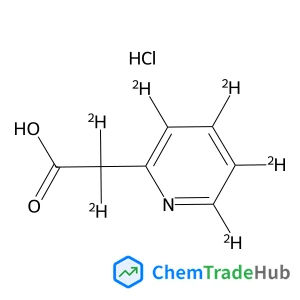
2,2-dideuterio-2-(3,4,5,6-tetradeuterio-2-pyridyl)acetic acid;hydrochloride
CAS番号:
1329799-67-8
分子式:
C7H2ClD6NO2
![(3R,5R)-1-[(Benzyloxy)carbonyl]-5-methyl-3-piperidinecarboxylic acid structure](https://static.chemtradehub.com/structs/126/1269757-29-0-c552.webp "(3R,5R)-1-[(Benzyloxy)carbonyl]-5-methyl-3-piperidinecarboxylic acid structure")
(3R,5R)-1-[(Benzyloxy)carbonyl]-5-methyl-3-piperidinecarboxylic acid
CAS番号:
1269757-29-0
分子式:
C15H19NO4
![1-[(4-Methylphenyl)sulfonyl]-3-(4,4,5,5-tetramethyl-1,3,2-dioxaborolan-2-yl)-1H-pyrrolo[2,3-b]pyridine-5-carbonitrile structure](https://static.chemtradehub.com/structs/143/1434747-57-5-fc0d.webp "1-[(4-Methylphenyl)sulfonyl]-3-(4,4,5,5-tetramethyl-1,3,2-dioxaborolan-2-yl)-1H-pyrrolo[2,3-b]pyridine-5-carbonitrile structure")
おすすめサプライヤー








免責事項
このページに表示される学術雑誌情報は、参考および研究目的のみを目的としています。当社は雑誌出版社とは提携しておらず、投稿の取り扱いも行っておりません。出版に関するお問い合わせは、各雑誌出版社に直接ご連絡ください。
表示されている情報に誤りがある場合は、support@chemtradehub.com までご連絡ください。迅速に確認し、対応いたします。