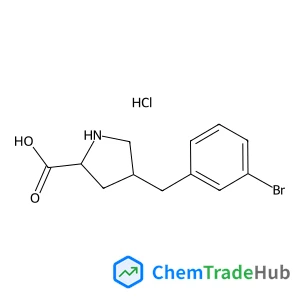
(2S,4R)-4-(3-Bromobenzyl)pyrrolidine-2-carboxylic acid hydrochloride
CAS番号:
1049734-10-2
分子式:
C12H15BrClNO2
Meng-Juan Zhang, David J. Young, Hai-Yan Li
The challenge in the C–C cross-coupling of secondary and primary alcohols using acceptorless dehydrogenation coupling (ADC) is the difficulty in accurately controlling product selectivities. Herein, we report a controlled approach to a diverse range of β-alkylated secondary alcohols, α-alkylated ketones and α,β-unsaturated ketones using the ADC methodology employing a Ni(II) 4,6-dimethylpyrimidine-2-thiolate cluster catalyst under different reaction conditions. This catalyst could tolerate a wide range of substrates and exhibited a high activity for the annulation reaction of secondary alcohols with 2-aminobenzyl alcohols to yield quinolines. This work is an example of precise chemoselectivity control by careful choice of reaction conditions.
Daniela Kerlé, Majid Namayandeh Jorabchi, Sebastian Wohlrab, Dietmar Paschek
DOI: 10.1039/C6CP06792A
A. V. Gorbunov, X. Meng, I. Urbanaviciute, T. Putzeys, M. Wübbenhorst, R. P. Sijbesma
DOI: 10.1039/C6CP08015D
Chun-Jern Pan, Ali Haider, Rami Al-Oweini, Ming-Hsien Lin, Ulrich Kortz
DOI: 10.1039/C6CP05768C
Deivis Plausinaitis, Linas Sinkevicius, Lina Mikoliunaite, Valentina Plausinaitiene, Almira Ramanaviciene
DOI: 10.1039/C6CP06545G
Xin Zhao, Jianyong Feng, Shi Chen, Yizhong Huang, Tze Chien Sum, Zhong Chen
DOI: 10.1039/C6CP06410H
Li Wang, Jin-Ting Ye, He Chen, Zhen-Zhen Chen
DOI: 10.1039/C6CP06651H
E. V. Suslova, S. V. Savilov, J. Ni, V. V. Lunin
DOI: 10.1039/C6CP07570C
Xin Ding, Yuhua Wang
DOI: 10.1039/C6CP08300E
Vladimir A. Osipov
DOI: 10.1039/C6CP07496K
4'-ブロモビフェニル-3-メトークシーディ.ActionBarは、冷暗所で、直射日光を避け、密栓の容器に保存し、遠隔場所に保管してください。温度は常温(0〜2...
2-異丙基フェニルヒドラジン塩酸塩は、CAS番号58928-82-8を有する化合物で、構造式はC11H14N2HClです。これは塩基性化合物であり、水に溶けやす...
5-(4-クロロフェニル)-4H-1,2,4-三氮唑-3-アミンは取り扱いに注意が必要です。PPEとして防塵マスク、ゴーグル、手袋を使用し、ドラフトチャンバーを...
去甲基雷贝拉唑硫醚は、ベンジミダゾール硫化物と3-メチル-4-ピリジノールの反応によって合成されます。具体的には、2-チオキシドベンジミダゾールと3-メチル-4...
2-ブロモ-5-フロロ-N-(2-フェノールメチル)ベンゼンウレアは、毒性や刺激性の実験データに基づき、適切な取扱いと防護措置を講じることで安全に使用できます。...
対甲苯磺酸酯-四聚乙二醇-四氢吡喃醚のCAS番号は86259-89-4です。この化合物は無色の液体で、分子量は約724.8です。高濃度では溶血性が報告されており...
2-(3-(二氟甲基)-4-氟苯基)-4,4,5,5-四甲基-1,3,2-二噁硼戊環は、室温で暗い場所に保管し、直射日光から遠ざけ、容器は密閉状態で保存してくだ...
この化合物の代替品には、ピロリミジン酸やその類似物、またピロリミジンカルボン酸の他の異性体があります。これらの代替品は、特定の化学反応や目的に応じて選択すること...
5-クロロベンゾ[1,3]二オキセイン-4-アミンはCAS番号379228-45-2に該当します。この化合物はGHS分類でH314(接触により急性毒性がある)と...

Organic & Biomolecular Chemistry (OBC) publishes original and high impact research and reviews in organic chemistry. We welcome research that shows new or significantly improved protocols or methodologies in total synthesis, synthetic methodology or physical and theoretical organic chemistry as well as research that shows a significant advance in the organic chemistry or molecular design aspects of chemical biology, catalysis, supramolecular and macromolecular chemistry, theoretical chemistry, mechanism-oriented physical organic chemistry, medicinal chemistry or natural products. Articles published in the journal should report new work which makes a highly-significant impact in the field. Routine and incremental work is generally not suitable for publication in the journal. More details about key areas of our scope are below. In all cases authors should include in their article clear rationale for why their research has been carried out.
![3-[4-(difluoromethoxy)phenyl]-2-({[(9H-fluoren-9-yl)methoxy]carbonyl}amino)propanoic acid structure](https://static.chemtradehub.com/structs/149/1496564-27-2-952e.webp "3-[4-(difluoromethoxy)phenyl]-2-({[(9H-fluoren-9-yl)methoxy]carbonyl}amino)propanoic acid structure")