












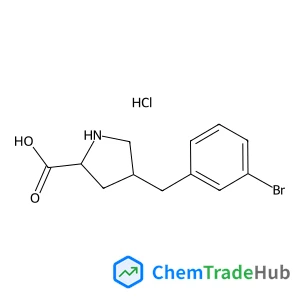
(2S,4R)-4-(3-Bromobenzyl)pyrrolidine-2-carboxylic acid hydrochloride
CAS番号:
1049734-10-2
分子式:
C12H15BrClNO2
Daniela Kerlé, Majid Namayandeh Jorabchi, Sebastian Wohlrab, Dietmar Paschek
We have determined the temperature dependence of the solvation behavior of a large collection of important light gases in imidazolium-based ionic liquids with the help of extensive molecular dynamics simulations. The motivation of our study is to unravel common features of the temperature dependent solvation under well controlled conditions, and to provide a guidance for cases, where experimental data from different sources disagree significantly. The solubility of molecular hydrogen, oxygen, nitrogen, methane, krypton, argon, neon and carbon dioxide in the imidazolium based ionic liquids of type 1-n-alkyl-3-methylimidazolium bis(trifluoromethylsulfonyl)imide ([Cnmim][NTf2]) with varying alkyl side chain lengths n = 2, 4, 6, 8 is computed for a temperature range between 300 K and 500 K at 1 bar. By applying Widom's particle insertion technique and Bennet's overlapping distribution method, we are able to determine the temperature dependent solvation free energies of those selected light gases in simulated imidazolium based ionic liquids with high statistical accuracy. Our simulations demonstrate that the magnitude of the solvation free energy of a gas molecule at a chosen reference temperature and that of its temperature-derivatives are intimately related to one another. We conclude that this “universal” behavior is rooted in a solvation entropy–enthalpy compensation effect, which seems to be a defining feature of the solvation of small molecules in ionic liquids. The observations lead to simple analytical relations, determining the temperature dependence of the solubility data based on the absolute solubility at a certain reference temperature. By comparing our results with available experimental data from many sources, we can show that our approach is particularly helpful for providing reliable estimates for the solvation behavior of very light gases, such as hydrogen, where conflicting experimental data exist.
Wei-Jie Chi, Ping-Ping Sun, Ze-Sheng Li
DOI: 10.1039/C6CP03316D
Jie Li, Tao Li, Yi Zhou, Weikang Wu, Leining Zhang, Hui Li
DOI: 10.1039/C6CP05007G
Aditi Bhattacherjee, Sanjay Wategaonkar
DOI: 10.1039/C6CP05469B
Manuel Salado, Laura Calio, Rüdiger Berger, Samrana Kazim, Shahzada Ahmad
DOI: 10.1039/C6CP03851D
Hsuan-Hsiao Yao, Hsu-Hsiang Cheng, Chao-Han Cheng, Cheng-Kai Lin, Jye-Shane Yang, I-Chia Chen
DOI: 10.1039/C6CP05514A
A. S. Rodin, Alexandra Carvalho, A. R. Rocha
DOI: 10.1039/C6CP05566D
Xiaofang Li, Changqian Wang, Bo Li, Yu Shao, Danzhen Li
DOI: 10.1039/C6CP04929J
Mariachiara Pastore, Thibaut Duchanois, Li Liu, Antonio Monari, Xavier Assfeld, Stefan Haacke, Philippe C. Gros
DOI: 10.1039/C6CP05535D
H. Ohoyama, T. Teramoto
DOI: 10.1039/C6CP03448A
F. A. Mackenzie-Rae, A. Karton, S. M. Saunders
DOI: 10.1039/C6CP04695A
4'-ブロモビフェニル-3-メトークシーディ.ActionBarは、冷暗所で、直射日光を避け、密栓の容器に保存し、遠隔場所に保管してください。温度は常温(0〜2...
2-異丙基フェニルヒドラジン塩酸塩は、CAS番号58928-82-8を有する化合物で、構造式はC11H14N2HClです。これは塩基性化合物であり、水に溶けやす...
5-(4-クロロフェニル)-4H-1,2,4-三氮唑-3-アミンは取り扱いに注意が必要です。PPEとして防塵マスク、ゴーグル、手袋を使用し、ドラフトチャンバーを...
去甲基雷贝拉唑硫醚は、ベンジミダゾール硫化物と3-メチル-4-ピリジノールの反応によって合成されます。具体的には、2-チオキシドベンジミダゾールと3-メチル-4...
2-ブロモ-5-フロロ-N-(2-フェノールメチル)ベンゼンウレアは、毒性や刺激性の実験データに基づき、適切な取扱いと防護措置を講じることで安全に使用できます。...
対甲苯磺酸酯-四聚乙二醇-四氢吡喃醚のCAS番号は86259-89-4です。この化合物は無色の液体で、分子量は約724.8です。高濃度では溶血性が報告されており...
2-(3-(二氟甲基)-4-氟苯基)-4,4,5,5-四甲基-1,3,2-二噁硼戊環は、室温で暗い場所に保管し、直射日光から遠ざけ、容器は密閉状態で保存してくだ...
この化合物の代替品には、ピロリミジン酸やその類似物、またピロリミジンカルボン酸の他の異性体があります。これらの代替品は、特定の化学反応や目的に応じて選択すること...
5-クロロベンゾ[1,3]二オキセイン-4-アミンはCAS番号379228-45-2に該当します。この化合物はGHS分類でH314(接触により急性毒性がある)と...

Physical Chemistry Chemical Physics (PCCP) is an international journal co-owned by 19 physical chemistry and physics societies from around the world. This journal publishes original, cutting-edge research in physical chemistry, chemical physics and biophysical chemistry. To be suitable for publication in PCCP, articles must include significant innovation and/or insight into physical chemistry; this is the most important criterion that reviewers and Editors will judge against when evaluating submissions. The journal has a broad scope and welcomes contributions spanning experiment, theory, computation and data science. Topical coverage includes spectroscopy, dynamics, kinetics, statistical mechanics, thermodynamics, electrochemistry, catalysis, surface science, quantum mechanics, quantum computing and machine learning. Interdisciplinary research areas such as polymers and soft matter, materials, nanoscience, energy, surfaces/interfaces, and biophysical chemistry are welcomed if they demonstrate significant innovation and/or insight into physical chemistry. Joined experimental/theoretical studies are particularly appreciated when complementary and based on up-to-date approaches.
![3-[4-(difluoromethoxy)phenyl]-2-({[(9H-fluoren-9-yl)methoxy]carbonyl}amino)propanoic acid structure](https://static.chemtradehub.com/structs/149/1496564-27-2-952e.webp "3-[4-(difluoromethoxy)phenyl]-2-({[(9H-fluoren-9-yl)methoxy]carbonyl}amino)propanoic acid structure")
![19-[Chloro(dideuterio)methyl]-19-deuterio-20,20-dideuteriooxyoctatriacontane-18,21-dione structure](https://static.chemtradehub.com/structs/124/1246818-85-8-6244.webp "19-[Chloro(dideuterio)methyl]-19-deuterio-20,20-dideuteriooxyoctatriacontane-18,21-dione structure")






