












![(R)-N-[(S)-1-[2-(Diphenylphosphino)phenyl]ethyl]-2-methylpropane-2-sulfinamide structure](https://static.chemtradehub.com/structs/159/1595319-98-4-33e7.webp "(R)-N-[(S)-1-[2-(Diphenylphosphino)phenyl]ethyl]-2-methylpropane-2-sulfinamide structure")
Impact of intrinsic framework flexibility for selective adsorption of sarin in non-aqueous solvents using metal–organic frameworks
文献情報
出版日
2020-02-28
DOI
10.1039/C9CP06788D
インパクトファクター
3.676
著者
Jongwoo Park, Mayank Agrawal, Dorina F. Sava Gallis, Jacob A. Harvey, Jeffery A. Greathouse, David S. Sholl
原文を見る
要旨
Molecular modeling of mixture adsorption in nanoporous materials can provide insight into the molecular-level details that underlie adsorptive separations. Modeling of adsorption often employs a rigid framework approximation for computational convenience. All real materials, however, have intrinsic flexibility due to thermal vibrations of their atoms. In this article, we examine quantitative predictions of the adsorption selectivity for a dilute concentration of a chemical warfare agent, sarin, from bulk mixtures with aqueous and non-aqueous (methanol, isopropyl alcohol) solvents using metal–organic frameworks (MOFs). These predictions were made in MOFs approximated as rigid and also in MOFs allowed to have intrinsic flexibility. Including framework flexibility appears to have important consequences for quantitative predictions of adsorption selectivity, particularly for sarin/water mixtures. Our observations suggest the intrinsic flexibility of MOFs can have a nontrivial impact on adsorption modeling of molecular mixtures, especially for mixtures containing polar species and molecules of different sizes.
関連文献
Proton conducting membranes for hydrogen and ammonia production
Guowei Weng, Kun Ouyang, Xuanhe Lin, Jian Xue, Haihui Wang
2021-08-24
Review Article
DOI: 10.1039/D1RE00207D
Extracting kinetic information in catalysis: an automated tool for the exploration of small data
Pedro S. F. Mendes, Sébastien Siradze, Laura Pirro, Joris W. Thybaut
2021-10-06
Paper
DOI: 10.1039/D1RE00215E
Process intensification of ozonolysis reactions using dedicated microstructured reactors
Dominique M. Roberge, Paul Hanselmann, Petteri Elsner
2021-08-18
Communication
DOI: 10.1039/D1RE00264C
Green and sustainable synthesis of poly(δ-valerolactone) with a TBD catalyzed ring-opening polymerization reaction
Kai Cheng, Shiyao Lu, Kai Wang, Guangsheng Luo
2021-10-29
Paper
DOI: 10.1039/D1RE00434D
Highly selective production of benzylamine from benzonitrile on metal-supported catalysts
Darío J. Segobia, Andrés F. Trasarti, Carlos R. Apesteguía
2021-08-13
Paper
DOI: 10.1039/D1RE00234A
One-pot three-step mechanically assisted synthesis and catalytic performance of tripodal metallic complexes
Raquel Viveiros, Teresa Casimiro
2021-07-20
Paper
DOI: 10.1039/D1RE00194A
Selective surface functionalization of polystyrene by inner-shell monochromatic irradiation and oxygen exposure
Daniel Eduardo Weibel, Felipe Kessler, Gunar Vingre da Silva Mota
2010-02-08
Paper
DOI: 10.1039/B9PY00342H
Machine learning based interpretation of microkinetic data: a Fischer–Tropsch synthesis case study
Pieter Janssens, Jeroen Poissonnier, Mirella Virginie, Andrei Y. Khodakov, Joris W. Thybaut
2021-10-12
Paper
DOI: 10.1039/D1RE00351H
Sequential double click reactions: a highly efficient post-functionalization method for optoelectronic polymers‡
Yongrong Li
2009-12-11
Communication
DOI: 10.1039/B9PY00238C
こちらもおすすめ
化合物よくある質問
2,3-スチオエポキシマドルを取り扱う際の実験室安全事項は何ですか?
取り扱いにはPPE(プロテクティブ・パーソナル・エイド)が必要で、防ぐ手袋と保護眼鏡を着用してください。ドラフトチャンバーの使用を推奨します。漏洩した場合は、適...
4267-80-52,3-Thioepoxy Madol
53981-25-22-Amino-6-fluorophen...
化合物よくある質問
BOC-S-3-アミニ-4-(4-メチオキシベンチル)-ブタン酸の代替品はありますか?
この化合物の代替品としては、BOC保護基を有さないアミノ酸やその他の保護基化合物が考えられます。また、メチオキシ基を有しない他の芳香族アミノ酸も代替品として挙げ...
126800-59-7(3S)-4-(4-Methoxyphe...
化合物よくある質問
Methyl 2-(chloromethyl)-3-nitrobenzoate(1218910-61-2)の代替品はありますか?
Methyl 2-(chloromethyl)-3-nitrobenzoate(1218910-61-2)の代替品としては、化学組成を変えることで効果を達成する...
1218910-61-2Methyl 2-(chlorometh...
化合物よくある質問
(2R)-2-アミノ-N-ベンジル-3-ヒドロキシプロパナミドを含む廃棄物はどのように処理すべきですか?
(2R)-2-アミノ-N-ベンジル-3-ヒドロキシプロパナミドを含む廃棄物は、適切な廃棄物管理ガイドラインに基づき処理する必要があります。まず、廃棄物を適切に収...
175481-39-7(2R)-2-amino-N-benzy...
化合物よくある質問
6,7-二氢-咪唑並[1,2-a]ピリドイン-8(5h)-酮はどのように合成されますか?
6,7-二氢-咪唑並[1,2-a]ピリドイン-8(5h)-酮は、2-ブロモフェニルアセトインとリン酸ハロゲン化物を反応させることで合成できます。この反応は高温で...
457949-09-66,7-Dihydroimidazo[1...
化合物よくある質問
エチル(3R)-3-ピロリジニル酢酸水和塩とは何ですか?
エチル(3R)-3-ピロリジニル酢酸水和塩は、CAS番号1332459-32-1の化合物で、(R)-乙基2-(ピロリジン-3-基)酢酸塩水和塩と呼ばれます。この...
1332459-32-1Ethyl (3R)-3-pyrroli...
化合物よくある質問
(2S)-{[(2-メチルエチルオキシ]カルボニル}アミノ)[2-(トリアフルオロメチルフェニル]エチカシック酸の物理化学的性質は何ですか?
(2S)-{[(2-メチルエチルオキシ]カルボニル}アミノ)[2-(トリアフルオロメチルフェニル]エチカシック酸のCAS番号は1203454-45-8です。この...
1203454-45-8(2S)-({[(2-Methyl-2-...
化合物よくある質問
2-ブロモ-1-(2-メチル-2-プロパニル)-4-ニトロベンゼンはどのように保存すればよいですか?
2-ブロモ-1-(2-メチル-2-プロパニル)-4-ニトロベンゼンは、直射日光を避けて暗所で、室温(約15℃〜25℃)、乾燥した場所に保存する必要があります。ま...
6310-17-42-Bromo-1-(2-methyl-...
化合物よくある質問
1-[(4-硝基フェニル)スルホニル]-1H-1,2,4-三唑の市場動向や研究トレンドはどうですか?
市場動向としては、1-[(4-硝基フェニル)スルホニル]-1H-1,2,4-三唑は主に農業用除草剤や合成化学製品の原料として利用されています。研究トレンドとして...
57777-84-11-[(4-Nitrophenyl)su...
掲載誌
Physical Chemistry Chemical Physics

CiteScore:
5.5
自己引用率:
10.3%
年間論文数:
3036
Physical Chemistry Chemical Physics (PCCP) is an international journal co-owned by 19 physical chemistry and physics societies from around the world. This journal publishes original, cutting-edge research in physical chemistry, chemical physics and biophysical chemistry. To be suitable for publication in PCCP, articles must include significant innovation and/or insight into physical chemistry; this is the most important criterion that reviewers and Editors will judge against when evaluating submissions. The journal has a broad scope and welcomes contributions spanning experiment, theory, computation and data science. Topical coverage includes spectroscopy, dynamics, kinetics, statistical mechanics, thermodynamics, electrochemistry, catalysis, surface science, quantum mechanics, quantum computing and machine learning. Interdisciplinary research areas such as polymers and soft matter, materials, nanoscience, energy, surfaces/interfaces, and biophysical chemistry are welcomed if they demonstrate significant innovation and/or insight into physical chemistry. Joined experimental/theoretical studies are particularly appreciated when complementary and based on up-to-date approaches.
おすすめ化合物
![5,10-Dihydroindeno[2,1-a]indene structure](https://static.chemtradehub.com/structs/654/6543-29-9-71ca.webp "5,10-Dihydroindeno[2,1-a]indene structure")
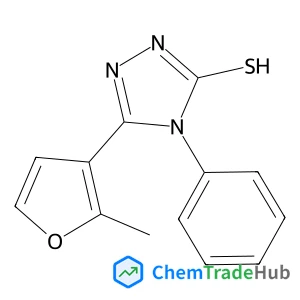
5-(2-Methyl-3-furyl)-4-phenyl-2,4-dihydro-3H-1,2,4-triazole-3-thione
CAS番号:
346464-59-3
分子式:
C13H11N3OS
![6,6-Dimethylbicyclo[3.1.1]hept-2-ene-2-carbaldehyde structure](https://static.chemtradehub.com/structs/564/564-94-3-e746.webp "6,6-Dimethylbicyclo[3.1.1]hept-2-ene-2-carbaldehyde structure")
おすすめサプライヤー




免責事項
このページに表示される学術雑誌情報は、参考および研究目的のみを目的としています。当社は雑誌出版社とは提携しておらず、投稿の取り扱いも行っておりません。出版に関するお問い合わせは、各雑誌出版社に直接ご連絡ください。
表示されている情報に誤りがある場合は、support@chemtradehub.com までご連絡ください。迅速に確認し、対応いたします。