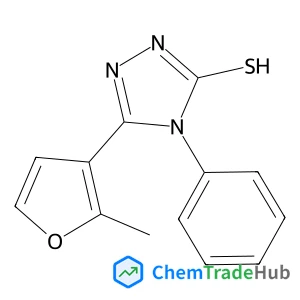
5-(2-Methyl-3-furyl)-4-phenyl-2,4-dihydro-3H-1,2,4-triazole-3-thione
CAS番号:
346464-59-3
分子式:
C13H11N3OS
Albin Antony, Poornesh P., I. V. Kityk, K. Ozga, J. Jedryka, G. Myronchuk, Suresh D. Kulkarni, Ganesh Sanjeev, Vikash Chandra Petwal, Vijay Pal Verma, Jishnu Dwivedi
Electron beam induced effects on defect engineering and structural, morphological and optical properties of Ga doped ZnO (GaZnO) nanostructures for improved ultrafast nonlinear optical properties are presented. A microstructural analysis was carried out based on the Scherrer, Williamson–Hall, and size–strain models. All three models reveal a peak broadening effect upon electron beam irradiation (EBI) and the crystallite size of the films shows a decrease of 30% compared to unirradiated nanostructures. The decrease in intensity, variation in the peak position and broadening of the Raman E2H mode confirm that the EBI treatment introduces disorder into the nanostructures. The interband gap emissions observed in photoluminescence spectra are primarily due to defect-related emissions originating from intrinsic defects such as Zni, Oi, VZn, VO, VZn+, VO+ and OZn. The O1s core-level spectra show that the peak related to oxygen vacancy defects is suppressed upon EBI. Surface morphology studies reveal that the nucleation barriers of GaZnO nanostructures are reduced upon irradiation treatment resulting in a coalescence mechanism. Third harmonic generation studies show that higher electron-beam doses lead to the occurrence of enhanced THG signals due to a drastic change in the occupation of localized defect levels. Thermally induced nonlinear optical studies depict an improved χ(3) of 1.71 × 10⁻³ esu upon irradiation due to enhanced FCA induced TPA mechanism and non-radiative transitions which indicates the credibility of the grown films in photonic devices.
Olivier Coulembier, Franck Meyer, Philippe Dubois
DOI: 10.1039/C0PY00013B
Shimin Kang, Jinxia Fu, Jianhao Liang, Suxia Chen, Lijun Lu, Rongrong Miao
DOI: 10.1039/D1RE00273B
Pieter Janssens, Jeroen Poissonnier, Mirella Virginie, Andrei Y. Khodakov, Joris W. Thybaut
DOI: 10.1039/D1RE00351H
Shuai Wang, Lidong Yang, Tianhan Zhu, Nan Jiang, Feng Li, Huan Wang, Chunlei Zhang, Hua Song
DOI: 10.1039/D1RE00302J
Basit Yameen, Mubarak Ali, Marta Álvarez, Reinhard Neumann, Wolfgang Ensinger, Wolfgang Knoll, Omar Azzaroni
DOI: 10.1039/B9PY00201D
Luke Forster, Simeng Wang, Armando Carlone, Carmine D'Agostino
DOI: 10.1039/D1RE00471A
Kai Cheng, Shiyao Lu, Kai Wang, Guangsheng Luo
DOI: 10.1039/D1RE00434D
Peter M. Budd, Neil B. McKeown
DOI: 10.1039/B9PY00319C
Jungang Yi, Xianghui Wu, Huadong Wu, Jia Guo
DOI: 10.1039/D1RE90046C
Guoqiang Ding
DOI: 10.1039/D1RE00208B
取り扱いにはPPE(プロテクティブ・パーソナル・エイド)が必要で、防ぐ手袋と保護眼鏡を着用してください。ドラフトチャンバーの使用を推奨します。漏洩した場合は、適...
この化合物の代替品としては、BOC保護基を有さないアミノ酸やその他の保護基化合物が考えられます。また、メチオキシ基を有しない他の芳香族アミノ酸も代替品として挙げ...
Methyl 2-(chloromethyl)-3-nitrobenzoate(1218910-61-2)の代替品としては、化学組成を変えることで効果を達成する...
(2R)-2-アミノ-N-ベンジル-3-ヒドロキシプロパナミドを含む廃棄物は、適切な廃棄物管理ガイドラインに基づき処理する必要があります。まず、廃棄物を適切に収...
6,7-二氢-咪唑並[1,2-a]ピリドイン-8(5h)-酮は、2-ブロモフェニルアセトインとリン酸ハロゲン化物を反応させることで合成できます。この反応は高温で...
エチル(3R)-3-ピロリジニル酢酸水和塩は、CAS番号1332459-32-1の化合物で、(R)-乙基2-(ピロリジン-3-基)酢酸塩水和塩と呼ばれます。この...
(2S)-{[(2-メチルエチルオキシ]カルボニル}アミノ)[2-(トリアフルオロメチルフェニル]エチカシック酸のCAS番号は1203454-45-8です。この...
2-ブロモ-1-(2-メチル-2-プロパニル)-4-ニトロベンゼンは、直射日光を避けて暗所で、室温(約15℃〜25℃)、乾燥した場所に保存する必要があります。ま...
市場動向としては、1-[(4-硝基フェニル)スルホニル]-1H-1,2,4-三唑は主に農業用除草剤や合成化学製品の原料として利用されています。研究トレンドとして...

Physical Chemistry Chemical Physics (PCCP) is an international journal co-owned by 19 physical chemistry and physics societies from around the world. This journal publishes original, cutting-edge research in physical chemistry, chemical physics and biophysical chemistry. To be suitable for publication in PCCP, articles must include significant innovation and/or insight into physical chemistry; this is the most important criterion that reviewers and Editors will judge against when evaluating submissions. The journal has a broad scope and welcomes contributions spanning experiment, theory, computation and data science. Topical coverage includes spectroscopy, dynamics, kinetics, statistical mechanics, thermodynamics, electrochemistry, catalysis, surface science, quantum mechanics, quantum computing and machine learning. Interdisciplinary research areas such as polymers and soft matter, materials, nanoscience, energy, surfaces/interfaces, and biophysical chemistry are welcomed if they demonstrate significant innovation and/or insight into physical chemistry. Joined experimental/theoretical studies are particularly appreciated when complementary and based on up-to-date approaches.