












NMR relaxation time measurements of solvent effects in an organocatalysed asymmetric aldol reaction over silica SBA-15 supported proline
文献情報
出版日
2022-01-06
DOI
10.1039/D1RE00471A
インパクトファクター
4.239
著者
Luke Forster, Simeng Wang, Armando Carlone, Carmine D'Agostino
原文を見る
要旨
Immobilisation of organocatalysts onto solid supports represents a very promising solution to tackle their low productivity by enabling their reuse. Herein, the use of NMR relaxation measurements, coupled with reaction screening, was used to investigate the effect of solvent interactions with the immobilised catalyst matrix on reactivity in an asymmetric organocatalysed aldol reaction. Important insights for the further development of such complex, yet promising catalytic systems are provided.
関連文献
Deciphering the cryptic role of a catalytic electron in a photochemical bond dissociation using excited state aromaticity markers
Ambar Banerjee, Debabrata Halder, Gaurab Ganguly, Ankan Paul
2016-08-12
Paper
DOI: 10.1039/C6CP03789E
Molecular mechanisms responsible for hydrate anti-agglomerant performance
Anh Phan, Tai Bui, Erick Acosta, Pushkala Krishnamurthy, Alberto Striolo
2016-07-07
Paper
DOI: 10.1039/C6CP03296F
Strong 1D localization and highly anisotropic electron–hole masses in heavy-halogen functionalized graphenes
Lukas Eugen Marsoner Steinkasserer, Alessandra Zarantonello, Beate Paulus
2016-09-05
Paper
DOI: 10.1039/C6CP05188J
Dichlorophosphanyl isocyanate – spectroscopy, conformation and molecular structure in the gas phase and the solid state
Dingqing Li, Jan Schwabedissen, Hans-Georg Stammler, Norbert W. Mitzel, Helge Willner, Xiaoqing Zeng
2016-09-01
Paper
DOI: 10.1039/C6CP05377G
Calculation of Raman parameters of real-size zigzag (n, 0) single-walled carbon nanotubes using finite-size models
Teobald Kupka, Michal Stachów, Leszek Stobiński, Jakub Kaminský
2016-08-11
Paper
DOI: 10.1039/C6CP04100K
Thermal contact resistance across a linear heterojunction within a hybrid graphene/hexagonal boron nitride sheet
Yang Hong, Jingchao Zhang, Xiao Cheng Zeng
2016-08-08
Communication
DOI: 10.1039/C6CP03933B
Unraveling the sub-nanoscopic structure at interphase in a poly(vinyl alcohol)–MOF nanocomposite, and its role in thermo-mechanical properties
S. K. Sharma, K. Sudarshan, P. K. Pujari
2016-08-16
Paper
DOI: 10.1039/C6CP04872B
On the cobalt and cobalt oxide electrodeposition from a glyceline deep eutectic solvent
Alan M. P. Sakita, Rodrigo Della Noce, Cecílio S. Fugivara, Assis V. Benedetti
2016-08-10
Paper
DOI: 10.1039/C6CP04068C
The study of electron transfer reactions in a dendrimeric assembly: proper utilization of dendrimer fluorescence
Somnath Koley, Subhadip Ghosh
2016-08-18
Communication
DOI: 10.1039/C6CP05054A
Flow-driven control of calcium carbonate precipitation patterns in a confined geometry
Gábor Schuszter, Fabian Brau, A. De Wit
2016-09-05
Paper
DOI: 10.1039/C6CP05067K
こちらもおすすめ
化合物よくある質問
2,3-スチオエポキシマドルを取り扱う際の実験室安全事項は何ですか?
取り扱いにはPPE(プロテクティブ・パーソナル・エイド)が必要で、防ぐ手袋と保護眼鏡を着用してください。ドラフトチャンバーの使用を推奨します。漏洩した場合は、適...
4267-80-52,3-Thioepoxy Madol
53981-25-22-Amino-6-fluorophen...
化合物よくある質問
BOC-S-3-アミニ-4-(4-メチオキシベンチル)-ブタン酸の代替品はありますか?
この化合物の代替品としては、BOC保護基を有さないアミノ酸やその他の保護基化合物が考えられます。また、メチオキシ基を有しない他の芳香族アミノ酸も代替品として挙げ...
126800-59-7(3S)-4-(4-Methoxyphe...
化合物よくある質問
Methyl 2-(chloromethyl)-3-nitrobenzoate(1218910-61-2)の代替品はありますか?
Methyl 2-(chloromethyl)-3-nitrobenzoate(1218910-61-2)の代替品としては、化学組成を変えることで効果を達成する...
1218910-61-2Methyl 2-(chlorometh...
化合物よくある質問
(2R)-2-アミノ-N-ベンジル-3-ヒドロキシプロパナミドを含む廃棄物はどのように処理すべきですか?
(2R)-2-アミノ-N-ベンジル-3-ヒドロキシプロパナミドを含む廃棄物は、適切な廃棄物管理ガイドラインに基づき処理する必要があります。まず、廃棄物を適切に収...
175481-39-7(2R)-2-amino-N-benzy...
化合物よくある質問
6,7-二氢-咪唑並[1,2-a]ピリドイン-8(5h)-酮はどのように合成されますか?
6,7-二氢-咪唑並[1,2-a]ピリドイン-8(5h)-酮は、2-ブロモフェニルアセトインとリン酸ハロゲン化物を反応させることで合成できます。この反応は高温で...
457949-09-66,7-Dihydroimidazo[1...
化合物よくある質問
エチル(3R)-3-ピロリジニル酢酸水和塩とは何ですか?
エチル(3R)-3-ピロリジニル酢酸水和塩は、CAS番号1332459-32-1の化合物で、(R)-乙基2-(ピロリジン-3-基)酢酸塩水和塩と呼ばれます。この...
1332459-32-1Ethyl (3R)-3-pyrroli...
化合物よくある質問
(2S)-{[(2-メチルエチルオキシ]カルボニル}アミノ)[2-(トリアフルオロメチルフェニル]エチカシック酸の物理化学的性質は何ですか?
(2S)-{[(2-メチルエチルオキシ]カルボニル}アミノ)[2-(トリアフルオロメチルフェニル]エチカシック酸のCAS番号は1203454-45-8です。この...
1203454-45-8(2S)-({[(2-Methyl-2-...
化合物よくある質問
2-ブロモ-1-(2-メチル-2-プロパニル)-4-ニトロベンゼンはどのように保存すればよいですか?
2-ブロモ-1-(2-メチル-2-プロパニル)-4-ニトロベンゼンは、直射日光を避けて暗所で、室温(約15℃〜25℃)、乾燥した場所に保存する必要があります。ま...
6310-17-42-Bromo-1-(2-methyl-...
化合物よくある質問
1-[(4-硝基フェニル)スルホニル]-1H-1,2,4-三唑の市場動向や研究トレンドはどうですか?
市場動向としては、1-[(4-硝基フェニル)スルホニル]-1H-1,2,4-三唑は主に農業用除草剤や合成化学製品の原料として利用されています。研究トレンドとして...
57777-84-11-[(4-Nitrophenyl)su...
掲載誌
Reaction Chemistry & Engineering

CiteScore:
0
自己引用率:
8.8%
年間論文数:
284
Reaction Chemistry & Engineering is an interdisciplinary journal reporting cutting-edge research focused on enhancing the understanding and efficiency of reactions. Reaction engineering leverages the interface where fundamental molecular chemistry meets chemical engineering and technology. Challenges in chemistry can be overcome by the application of new technologies, while engineers may find improved solutions for process development from the latest developments in reaction chemistry. Reaction Chemistry & Engineering is a unique forum for researchers whose interests span the broad areas of chemical engineering and chemical sciences to come together in solving problems of importance to wider society. All papers should be written to be approachable by readers across the engineering and chemical sciences. Papers that consider multiple scales, from the laboratory up to and including plant scale, are particularly encouraged.
おすすめ化合物
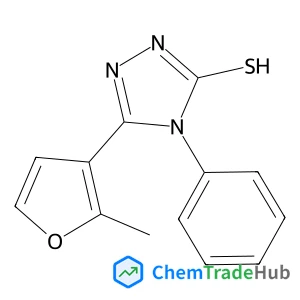
5-(2-Methyl-3-furyl)-4-phenyl-2,4-dihydro-3H-1,2,4-triazole-3-thione
CAS番号:
346464-59-3
分子式:
C13H11N3OS
おすすめサプライヤー




免責事項
このページに表示される学術雑誌情報は、参考および研究目的のみを目的としています。当社は雑誌出版社とは提携しておらず、投稿の取り扱いも行っておりません。出版に関するお問い合わせは、各雑誌出版社に直接ご連絡ください。
表示されている情報に誤りがある場合は、support@chemtradehub.com までご連絡ください。迅速に確認し、対応いたします。