












![N-[(Benzyloxy)carbonyl]serine structure](https://static.chemtradehub.com/structs/276/2768-56-1-77f7.webp "N-[(Benzyloxy)carbonyl]serine structure")
Bulk and surface DFT investigations of inorganic halide perovskites screened using machine learning and materials property databases
文献情報
出版日
2019-08-09
DOI
10.1039/C9CP03240A
インパクトファクター
3.676
著者
Deepak Jain, Suryanaman Chaube, Prerna Khullar, Sriram Goverapet Srinivasan, Beena Rai
原文を見る
要旨
In the recent past, there has been proliferation in high-throughput density functional theory and data-driven explorations of materials motivated by a need to reduce physical testing and costly computations for materials discovery. This has, in conjunction with the development of open-access materials property databases, encouraged accelerated and more streamlined discovery and screening of technologically relevant materials. In this work, we report our results on the screening and DFT studies of one such class of materials, i.e. ABX3 inorganic halide perovskites (A, B and X representing the monovalent, divalent and halide ions respectively) using a coupled machine-learning (ML) and density functional theory (DFT) approach. Utilizing the support vector machine algorithm, we predict the formability of 454 inorganic halide compounds in the perovskite phase. Compounds with a formation probability P ≥ 0.8 are further checked for thermodynamic stability in at least one of these three open materials databases – Materials Project (MP), Automatic FLOW for Materials Discovery (AFLOW) and Open Quantum Materials Database (OQMD). The shortlisted candidate perovskites are then considered for DFT computations. Taking input geometries from MP's structure predictor, the optimized lattice parameters and computed band gaps (BG) for all screened compounds are compared with predictions across all databases. Subsequently, detailed studies on low index surfaces are presented for two halide perovksites – RbSnCl3 and RbSnBr3 – having band-gaps in the favourable range for photovoltaics (PV). Different possible (100), (110) and (111) surface terminations are investigated for each of these compositions and the atomic relaxations, surface energies and electronic band structures are reported for each termination. To the best of our knowledge, no surface studies have been reported in the literature for any of the halide perovskites present in our database. These studies, therefore, are an important step towards gaining a fundamental understanding of the interfacial properties of perovskites, which can help facilitate further breakthroughs in the PV technology.
関連文献
Investigations on Zr incorporation into Li3V2(PO4)3/C cathode materials for lithium ion batteries
Hua-Bin Sun, Ying-Xian Zhou, Lu-Lu Zhang, Xue-Lin Yang, Xing-Zhong Cao, Hanu Arave, Hui Fang, Gan Liang
2017-01-13
Paper
DOI: 10.1039/C6CP07760A
A theoretical study of the potential energy surfaces for the double proton transfer reaction of model DNA base pairs
Chaozheng Li, Yonggang Yang, Donglin Li, Yufang Liu
2017-01-17
Paper
DOI: 10.1039/C6CP07716A
Computational prediction of high thermoelectric performance in p-type half-Heusler compounds with low band effective mass
Teng Fang, Shuqi Zheng, Tian Zhou, Lei Yan, Peng Zhang
2017-01-09
Paper
DOI: 10.1039/C6CP07897D
Correction: First-principles analysis of the spectroscopic limited maximum efficiency of photovoltaic absorber layers for CuAu-like chalcogenides and silicon
Marnik Bercx, Nasrin Sarmadian, Rolando Saniz, Bart Partoens, Dirk Lamoen
2017-02-10
Correction
DOI: 10.1039/C7CP90033C
Mechanism of activated chemiluminescence of cyclic peroxides: 1,2-dioxetanes and 1,2-dioxetanones
Ignacio Fdez. Galván, Daniel Roca-Sanjuán, Erick L. Bastos, Wilhelm J. Baader, Roland Lindh
2017-01-03
Paper
DOI: 10.1039/C6CP08154A
Suitability of N-propanoic acid spiropyrans and spirooxazines for use as sensitizing dyes in dye-sensitized solar cells
Noah M. Johnson, Yuriy Y. Smolin, Daniel Hagaman, Masoud Soroush, Kenneth K. S. Lau, Hai-Feng Ji
2017-01-04
Paper
DOI: 10.1039/C6CP07853B
Molecular aggregation of naphthalimide organic semiconductors assisted by amphiphilic and lipophilic interactions: a joint theoretical and experimental study
I. Arrechea-Marcos, M. J. Mancheño, M. C. Ruiz Delgado, M. M. Ramos, J. A. Quintana, J. M. Villalvilla, M. A. Díaz-García, J. T. López Navarrete, R. Ponce Ortiz, J. L. Segura
2017-02-03
Paper
DOI: 10.1039/C6CP06819G
Hydration of the simplest α-keto acid: a rotational spectroscopic and ab initio study of the pyruvic acid–water complex
Elijah G. Schnitzler, Nathan A. Seifert, Supriya Ghosh, Javix Thomas, Yunjie Xu, Wolfgang Jäger
2017-01-17
Paper
DOI: 10.1039/C6CP08741H
Ethane C–H bond activation on the Fe(iv)–oxo species in a Zn-based cluster of metal–organic frameworks: a density functional theory study
Sarawoot Impeng, Siwarut Siwaipram, Sareeya Bureekaew, Michael Probst
2017-01-09
Paper
DOI: 10.1039/C6CP07771D
こちらもおすすめ
化合物よくある質問
2-ブロモ-9,9-ジフェニル-9H-フルオレンの主な用途は何ですか?
2-溴-9,9-二苯基芴は、医薬品、工業材料、有機合成の研究分野で応用されます。特に、レーザー材料や機能性ポリマーの合成に使用されることがあります。また、蛍光色...
474918-32-62-Bromo-9,9-diphenyl...
化合物よくある質問
四氯化铱の市場動向や研究トレンドはどうですか?
四氯化铱の市場は研究開発分野で注目されており、特にナノ技術や金属有機框架(MOFs)の分野での需要が増加傾向にあります。価格は安定しており、中国や韓国での生産が...
207399-11-9Tetrachloroiridium h...
882-06-44-Nitrocinnamic acid
化合物よくある質問
1-(4-溴-3-氟苯基)-2-氯乙酮を含む廃棄物はどのように処理すべきですか?
1-(4-溴-3-氟苯基)-2-氯乙酮 (CAS番号: 1260857-14-4) の廃棄物は専門的な廃棄処理が必要です。まず、廃棄物は密閉された容器に収集し、...
1260857-14-41-(4-Bromo-3-fluorop...
化合物よくある質問
苦参酚Kとは何ですか?
苦参酚Kは、CAS番号101236-49-1を持つ化合物で、主に天然由来の生薬から抽出されます。この化合物は、抗炎症作用や抗癌作用を持つことが報告されています。
101236-49-1Kushenol K
化合物よくある質問
POTASSIUM (1-(TERTBUTOXYCARBONYL)AZETIDIN-3-YL)TRIFLUOROBORATE を含む廃棄物はどのように処理すべきですか?
POTASSIUM (1-(TERTBUTOXYCARBONYL)AZETIDIN-3-YL)TRIFLUOROBORATE を含む廃棄物は、まず安全なエント...
1430219-73-0Potassium (1-(tert-b...
化合物よくある質問
4-庚基-4’-联苯羧酸の市場動向や研究トレンドはどうですか?
4-庚基-4’-聯苯羧酸は、特殊化学品や合成化学の分野で用いられる化学物質ですが、市場動向としては、研究開発の進展とともに需要が増加しています。また、環境配慮型...
58573-94-74'-Heptyl-4-biphenyl...
化合物よくある質問
6-ブロモ-3-メトキシ-1-フェニル-1H-インドゾールを含む廃棄物はどのように処理すべきですか?
6-ブロモ-3-メトキシ-1-フェニル-1H-インドゾールを含む廃棄物は、適切な化学廃棄処理が必要です。通常、廃棄物は密閉容器に収集され、専門の廃棄処理業者に引...
1332527-03-36-Bromo-3-methoxy-1-...
化合物よくある質問
4,4-二甲基-2-吡咯烷酮はどの業界で使用されていますか?
4,4-二甲基-2-吡咯烷酮は医薬、ポリマー、センサー、半導体などの業界で広く使用されています。特に溶媒としての性能が高く評価されています。
66899-02-34,4-dimethylpyrrolid...
51312-42-6Sodium Phosphotungst...
掲載誌
Physical Chemistry Chemical Physics

CiteScore:
5.5
自己引用率:
10.3%
年間論文数:
3036
Physical Chemistry Chemical Physics (PCCP) is an international journal co-owned by 19 physical chemistry and physics societies from around the world. This journal publishes original, cutting-edge research in physical chemistry, chemical physics and biophysical chemistry. To be suitable for publication in PCCP, articles must include significant innovation and/or insight into physical chemistry; this is the most important criterion that reviewers and Editors will judge against when evaluating submissions. The journal has a broad scope and welcomes contributions spanning experiment, theory, computation and data science. Topical coverage includes spectroscopy, dynamics, kinetics, statistical mechanics, thermodynamics, electrochemistry, catalysis, surface science, quantum mechanics, quantum computing and machine learning. Interdisciplinary research areas such as polymers and soft matter, materials, nanoscience, energy, surfaces/interfaces, and biophysical chemistry are welcomed if they demonstrate significant innovation and/or insight into physical chemistry. Joined experimental/theoretical studies are particularly appreciated when complementary and based on up-to-date approaches.
おすすめ化合物
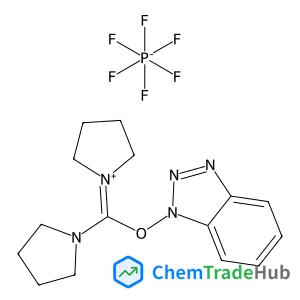
(1H-Benzotriazol-1-yloxy)(di-1-pyrrolidinyl)methylium hexafluorophosphate
CAS番号:
105379-24-6
分子式:
C15H21F6N5OP
おすすめサプライヤー





免責事項
このページに表示される学術雑誌情報は、参考および研究目的のみを目的としています。当社は雑誌出版社とは提携しておらず、投稿の取り扱いも行っておりません。出版に関するお問い合わせは、各雑誌出版社に直接ご連絡ください。
表示されている情報に誤りがある場合は、support@chemtradehub.com までご連絡ください。迅速に確認し、対応いたします。