












Novel structures of two-dimensional tungsten boride and their superconductivity
文献情報
出版日
2019-06-19
DOI
10.1039/C9CP02727K
インパクトファクター
3.676
著者
Zhansheng Lu
原文を見る
要旨
Two-dimensional (2D) superconductors, which can be widely applied in optoelectronic and microelectronic devices, have gained renewed attention in recent years. Based on the crystal structure prediction method and first-principles calculations, we obtain four novel 2D tungsten boride structures of tetr-, hex-, and tri-W2B2 and hex-WB4 and investigate their bonding types, electronic properties, phonon dispersions and electron–phonon coupling (EPC). The results show that both tetr- and hex-W2B2 are intrinsic phonon-mediated superconductors with a superconducting transition temperature (Tc) of 7.8 and 1.5 K, respectively, while tri-W2B2 and hex-WB4 are normal metals. We demonstrate that carrier doping as well as biaxial strain can soften the low-frequency phonon modes and enhance the strength of the EPC. While the Tc of tetr-W2B2 can be increased to 15.4 K under a compressive strain of −2%, the Tc of hex-W2B2 can be enhanced to 5.9 K by a tensile strain of +4%. With the inclusion of spin–orbit couping (SOC), the value of Tc decreases by 38.5% in our systems. Furthermore, we explore the stabilities and mechanical properties of tetr- and hex-W2B2 and indicate that they may be prepared by growing on ZnS(100) and ZnS(111), respectively. Our findings provide novel 2D superconducting materials and will stimulate more efforts in this filed.
関連文献
Structure–property analysis of julolidine-based nonlinear optical chromophores for the optimization of microscopic and macroscopic nonlinearity
Jieyun Wu, Wen Wang, Nan Wang, Juan He, Guowei Deng, Zhonghui Li, Xiaoling Zhang, Hongyan Xiao, Kaixin Chen
2018-08-28
Paper
DOI: 10.1039/C8CP04470H
Computational investigation of gas detection and selectivity on TiS3 nanoflakes supported by experimental evidence
Masoud Aryanpour, Nassim Rafiefard, Seyed Hossein Hosseini-Shokouh, Somayeh Fardindoost
2018-09-11
Paper
DOI: 10.1039/C8CP05026K
Polyamidoxime chain length drives emergent metal-binding phenomena‡
L. D. Earl, C. Do, Y. Wang, C. W. Abney
2018-09-27
Paper
DOI: 10.1039/C8CP02198H
Electron transfer mediates vibrational relaxation of CO in collisions with Ag(111)
Mareike Wallrabe
2018-11-09
Paper
DOI: 10.1039/C8CP06041J
On-the-fly kinetics of hydrogen abstraction from polycyclic aromatic hydrocarbons by methyl/ethyl radicals
Artur Ratkiewicz, An Le, Minh v. Duong, Thanh N. Truong, Lam K. Huynh
2018-08-22
Paper
DOI: 10.1039/C8CP03718C
Pressure-induced conduction band convergence in the thermoelectric ternary chalcogenide CuBiS2
Najebah M. Alsaleh, Elvis Shoko, Udo Schwingenschlögl
2018-12-13
Paper
DOI: 10.1039/C8CP05818K
Origin of high thermoelectric performance with a wide range of compositions for BixSb2−xTe3 single quintuple layers
Zhen Li, Siyu Han, Yuanchun Pan, Jian Zhou, Huibin Xu
2018-12-10
Paper
DOI: 10.1039/C8CP06534A
Theoretical insights into photo-induced electron transfer at BiOX (X = F, Cl, Br, I) (001) surfaces and interfaces
Tan Li, Xiaochao Zhang, Changming Zhang, Rui Li, Jianxin Liu, Rui Lv, Hui Zhang, Peide Han, Caimei Fan, Zhanfeng Zheng
2018-12-06
Paper
DOI: 10.1039/C8CP05671D
Charge percolation in redox-active thin membrane hybrids of mesoporous silica and poly(viologens)
Simón Saint-André, Federico Albanese
2019-01-08
Paper
DOI: 10.1039/C8CP07192F
Impact of H-termination on the nitrogen reduction reaction of molybdenum carbide as an electrochemical catalyst
Qinye Li, Siyao Qiu, Lizhong He, Xiwang Zhang
2018-08-24
Paper
DOI: 10.1039/C8CP04474K
こちらもおすすめ
化合物よくある質問
四氢-3-呋喃羧酰胺を含む廃棄物はどのように処理すべきですか?
四氢-3-呋喃羧酰胺を含む廃棄物の処理は、まず安全に収集し、化学的処理または専門廃棄処理を行うことが推奨されます。高温焼却は一般的な選択肢ですが、環境保護の観点...
871677-92-8Tetrahydro-3-furanca...
化合物よくある質問
DIMETHYL 3-AMINO-2,5-THIOPHENEDICARBOXYLATEについて「に適用される法規ガイドラインは何ですか」
DIMETHYL 3-AMINO-2,5-THIOPHENEDICARBOXYLATE(CAS番号: 785803-74-9)は、GHS( Globally H...
785803-74-9Dimethyl 3-amino-2,5...
化合物よくある質問
5-フェニル-2,2'-ビピリジンはどのように合成されますか?
5-フェニル-2,2'-ビピリジンは、ピリジン環とフェニル基を有する化合物から合成されます。一般的な合成方法は、4-ブロミノ苯と2,2'-ビピリジンの窒素上的ウ...
156972-80-45-Phenyl-2,2'-bipyri...
化合物よくある質問
三溴甲基苯砜とは何ですか?
三溴甲基苯砜はCAS番号17025-47-7の化合物で、(Tribromomethyl)sulfonyl]benzeneと呼ばれています。この物質は、芳香族化合...
17025-47-7[(Tribromomethyl)sul...
化合物よくある質問
四氢吡喃-4,4-二甲酸二甲酯を含む廃棄物はどのように処理すべきですか?
四氢吡喃-4,4-二甲酸二甲酯の廃棄物は、専門の廃棄処理業者に委託して安全に処理することが推奨されます。具体的には、反応性の点から常温で保存し、容器は密閉状態で...
149777-00-4Dimethyl tetrahydro-...
化合物よくある質問
N-叔丁氧羰基-N-甲乙二胺はどのように合成されますか?
N-叔丁氧羰基-N-甲乙二胺は、N-叔丁氧羰基アミンとプロピニルアミンのジアミン反応により合成されます。反応は無機触媒なしで行え、選択性と収率は良好です。
121492-06-62-Methyl-2-propanyl ...
化合物よくある質問
1,2-プロパンジオール-D6はどのように合成されますか?
1,2-プロパンジオール-D6は、プロパン-1,2-ジオールをD6同位体と交換反応を行うことで合成されます。この反応は触媒を必要とし、選択性と収率が良好です。
52910-80-21,2-Propane-d6-diol
化合物よくある質問
4,4'-異プロピルジキレートとは何ですか?
4,4'-異プロピルジキレートは、CAS番号7418-16-8の化合物で、4,4'-(2,2-プロパネディイル)ジシクロヘキサンカーボン酸は、白色の粉末またはク...
7418-16-84,4'-(2,2-Propanediy...
化合物よくある質問
2-メチル-2-プロパンチル (2S)-4-酸化-2-(1,3-チアゾリジン-3-イルカルベニル)-1-ピロリジンカルボキシレートの主な用途は何ですか?
この化合物は主に医薬品の開発に関与しており、特に抗炎症薬や神経保護剤の研究に利用されます。また、有機合成の中間体として工業製品の製造にも応用されることがあります...
401564-36-12-Methyl-2-propanyl ...
化合物よくある質問
ナトリウム5'-O-{ヘキシロキシ[(ヘキシロキシフォスフィニルオキシ)フィロホスフィル]アデノシン}を含む廃棄物はどのように処理すべきですか?
ナトリウム5'-O-{ヘキシロキシ[(ヘキシロキシフォスフィニルオキシ)フィロホスフィル]アデノシン}を含む廃棄物は、適切な化学廃棄処理施設に引き渡す必要があり...
1172-42-5Sodium 5'-O-{hydroxy...
掲載誌
Physical Chemistry Chemical Physics

CiteScore:
5.5
自己引用率:
10.3%
年間論文数:
3036
Physical Chemistry Chemical Physics (PCCP) is an international journal co-owned by 19 physical chemistry and physics societies from around the world. This journal publishes original, cutting-edge research in physical chemistry, chemical physics and biophysical chemistry. To be suitable for publication in PCCP, articles must include significant innovation and/or insight into physical chemistry; this is the most important criterion that reviewers and Editors will judge against when evaluating submissions. The journal has a broad scope and welcomes contributions spanning experiment, theory, computation and data science. Topical coverage includes spectroscopy, dynamics, kinetics, statistical mechanics, thermodynamics, electrochemistry, catalysis, surface science, quantum mechanics, quantum computing and machine learning. Interdisciplinary research areas such as polymers and soft matter, materials, nanoscience, energy, surfaces/interfaces, and biophysical chemistry are welcomed if they demonstrate significant innovation and/or insight into physical chemistry. Joined experimental/theoretical studies are particularly appreciated when complementary and based on up-to-date approaches.
おすすめ化合物
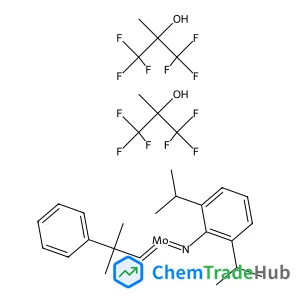
2,6-Diisopropylphenylimidoneophylidene molybdenum(VI) bis(hexafluoro-t-butoxide)
CAS番号:
139220-25-0
分子式:
C30H37F12MoNO2
おすすめサプライヤー




免責事項
このページに表示される学術雑誌情報は、参考および研究目的のみを目的としています。当社は雑誌出版社とは提携しておらず、投稿の取り扱いも行っておりません。出版に関するお問い合わせは、各雑誌出版社に直接ご連絡ください。
表示されている情報に誤りがある場合は、support@chemtradehub.com までご連絡ください。迅速に確認し、対応いたします。