


On-the-fly kinetics of hydrogen abstraction from polycyclic aromatic hydrocarbons by methyl/ethyl radicals
文献情報
出版日
2018-08-22
DOI
10.1039/C8CP03718C
インパクトファクター
3.676
著者
Artur Ratkiewicz, An Le, Minh v. Duong, Thanh N. Truong, Lam K. Huynh
原文を見る
要旨
This work provides a rigorous procedure, within the framework of the Reaction Class Transition State Theory (RC-TST) and the Structure–Activity Relationship (SAR), for predicting reliable thermal rate constants on-the-fly for hydrogen abstraction reactions by methyl/ethyl radicals from Polycyclic Aromatic Hydrocarbons (PAHs) in a temperature range of 300–3000 K. All necessary RC-TST parameters were derived from ab initio calculations for a representative set of 36 reactions on which different error analyses and comparisons with available literature data were carried out. In addition to the good agreement between the RC-TST rate constants and the literature data, the detailed error analyses show that RC-TST/SAR, utilizing either the Linear Energy Relationship (LER) where only the reaction energy is needed or Barrier Height Grouping (BHG) where no additional data is needed, can predict the thermal rate constants for any reaction in the title reaction class with an average systematic error of less than 50% when compared to the explicit rate calculations. Therefore, the constructed RC-TST procedure can be confidently used to obtain reliable rate constants on the fly in an attempt to effectively construct detailed kinetic mechanisms for PAH-related fuels.
おすすめジャーナル

Russian Journal of Bioorganic Chemistry

Russian Journal of Organic Chemistry

Crystallography Reports

Russian Journal of General Chemistry

Chemical Communications

Current Opinion in Colloid & Interface Science

Organic Process Research & Development

Chemistry Education Research and Practice

Saudi Pharmaceutical Journal

Russian Chemical Bulletin
関連文献
Reply to the ‘Comment on “Perturbation theory of scattering for grazing-incidence fast-atom diffraction”’ by G. A. Bocan, H. Breiss, S. Szilasi, A. Momeni, E. M. S. Casagrande, E. A. Sánchez, M. S. Gravielle and H. Khemliche, Phys. Chem. Chem. Phys., 2023, 25, DOI: 10.1039/D3CP02486E
W. Allison, S. Miret-Artés, E. Pollak
2023-12-04
Comment
DOI: 10.1039/D3CP04559E
Elucidating TH301's influence on the torsion angle of CRY1 W399 using replica exchange with solute tempering (REST) molecular dynamics (MD) simulations
2023-11-21
Paper
DOI: 10.1039/D3CP04092E
Styrylpyrimidine chromophores with bulky electron-donating substituents: experimental and theoretical investigation
Maxime Hodée, Julien Massue, Sylvain Achelle, Arnaud Fihey, Gilles Ulrich, Françoise Robin-le Guen, Claudine Katan
2023-11-15
Paper
DOI: 10.1039/D3CP03705C
Issues on DFT+U calculations of organic diradicals
Kohei Tada, Yasutaka Kitagawa
2023-11-20
Paper
DOI: 10.1039/D3CP04187E
The intrinsically low lattice thermal conductivity of monolayer T-Au6X2 (X = S, Se and Te)
Yupin Ji, Xihao Chen, Zhehao Sun, Chen Shen, Ning Wang
2023-11-06
Paper
DOI: 10.1039/D3CP03580H
Microwave digestion procedures for environmental matrices . Critical Review
Paper
DOI: 10.1039/A800776D
Electronic, optoelectronic, and thermoelectric properties of single molecular devices of 2D fullerenes with zigzag graphene nanoribbons as electrodes
Ping Zhou, Guohao Li, Mengtao Sun
2023-10-31
Paper
DOI: 10.1039/D3CP04725C
High-performance and self-powered photodetectors from an S-scheme Cs2SnI2Cl2/Cs2TiI6 heterojunction: a DFT+NAMD study
Ruiqin Li
2023-11-15
Paper
DOI: 10.1039/D3CP04415G
Graphene-edge-supported iron dual-atom for oxygen reduction electrocatalysts
Nadya Amalia, Fiki T. Akbar, Hadi T. Yudistira, Nadhratun N. Mobarak
2023-11-14
Paper
DOI: 10.1039/D3CP03642A
こちらもおすすめ
化合物よくある質問
6- bromo-1-cyclopropyl-1H-benzimidazoleの市場動向や研究トレンドはどうですか?
6- bromo-1-cyclopropyl-1H-benzimidazoleは、抗炎症、抗ウイルス作用を持つことが報告されており、新薬開発の研究対象として注目...
1416713-53-56-Bromo-1-cyclopropy...
化合物よくある質問
環氧プロpanol-d5を取り扱う際の実験室安全事項は何ですか?
取り扱う際には、防護眼鏡と手袋を使用し、ドラフトチャンバー内で操作することを推奨します。漏洩時には適切な手順で処理し、安全データシートを常に参照してください。
1246819-20-4Glycidol-d5
化合物よくある質問
2,2’-ジメチル-3,3’-ビピリジンはどのように合成されますか?
2,2’-ジメチル-3,3’-ビピリジンは、ピリジンと2-メチルアクリルアミドを有機合成反応で合成します。この反応では、ピリジンと2-メチルアクリルアミドを含有...
86156-55-02,2’-Dimethyl-3,3’-b...
化合物よくある質問
6-甲基ピリジン-2-ボリック酸の主な用途は何ですか?
6-甲基ピリジン-2-ボリック酸は、合成化学、医薬品合成、以及研究用途などに広く使用され、特に組換えDNA技術や分子生物学の研究において重要な役割を果たします。
372963-50-3(6-Methyl-2-pyridiny...
化合物よくある質問
(R)-3-(1-甲基-2-氧環己基)プロpano酸メチルは安全ですか?
(R)-3-(1-甲基-2-氧環己基)プロpano酸メチルは一定の安全性がありますが、直接的な皮膚接触や吸入は避けるべきです。使用する際は適切な個々の安全データ...
94089-47-1methyl 3-[(1R)-1-met...
化合物よくある質問
ketorolacはどのように保存すればよいですか?
ketorolacは、密封して遮光容器に保管し、直射日光や高温を避けて保存してください。温度は常温で保存し、湿度をなるべく低く保つことが推奨されます。
74103-06-3rac Ketorolac
化合物よくある質問
L-2,3-二氨基丙酸二盐酸盐を取り扱う際の実験室安全事項は何ですか?
L-2,3-二氨基丙酸二盐酸盐は腐食性が強く、皮膚や粘膜に刺激を与える可能性があります。取り扱う際は、防塵マスク、ゴーグル、手袋を使用し、適切な排気設備を使用し...
19777-68-5(S)-2,3-Diaminopropa...
化合物よくある質問
2-(4-溴ピリジン-2-基)乙腈の物理化学的性質は何ですか?
2-(4-溴ピリジン-2-基)乙腈のCAS番号は312325-73-8です。主に結晶形態で存在し、分子量は159.01 g/molです。この化合物は水に溶けやす...
312325-73-8(4-Bromo-2-pyridinyl...
化合物よくある質問
3-フローロ-[1,1-ベンジレン]-3,4-ジカルボン酸を取り扱う際の実験室安全事項は何ですか?
この化合物は毒性は低いですが、直接的な接触や吸入に注意が必要です。PPE(個人防護具)を着用し、ドラフトチャンバーを使用して操作することを推奨します。また、漏洩...
1261915-32-53'-Fluoro-[1,1'-biph...
化合物よくある質問
3-(1-氧代-1,3-二氢-2H-2-异吲哚)丙酸の主な用途は何ですか?
3-(1-氧代-1,3-二氢-2H-2-异吲哚)丙酸は、薬理学研究や医薬品製造において広く用いられる化合物です。また、工業的な用途でも一部の化学反応の触媒や助剤...
83747-30-23-(1-Oxo-1,3-dihydro...
掲載誌
Physical Chemistry Chemical Physics

CiteScore:
5.5
自己引用率:
10.3%
年間論文数:
3036
Physical Chemistry Chemical Physics (PCCP) is an international journal co-owned by 19 physical chemistry and physics societies from around the world. This journal publishes original, cutting-edge research in physical chemistry, chemical physics and biophysical chemistry. To be suitable for publication in PCCP, articles must include significant innovation and/or insight into physical chemistry; this is the most important criterion that reviewers and Editors will judge against when evaluating submissions. The journal has a broad scope and welcomes contributions spanning experiment, theory, computation and data science. Topical coverage includes spectroscopy, dynamics, kinetics, statistical mechanics, thermodynamics, electrochemistry, catalysis, surface science, quantum mechanics, quantum computing and machine learning. Interdisciplinary research areas such as polymers and soft matter, materials, nanoscience, energy, surfaces/interfaces, and biophysical chemistry are welcomed if they demonstrate significant innovation and/or insight into physical chemistry. Joined experimental/theoretical studies are particularly appreciated when complementary and based on up-to-date approaches.
おすすめ化合物
![2-{[(1R,2S)-2-Aminocyclohexyl]amino}-4-{[3-(2H-1,2,3-triazol-2-yl)phenyl]amino}-5-pyrimidinecarboxamide structure](https://static.chemtradehub.com/structs/137/1370261-96-3-40df.webp "2-{[(1R,2S)-2-Aminocyclohexyl]amino}-4-{[3-(2H-1,2,3-triazol-2-yl)phenyl]amino}-5-pyrimidinecarboxamide structure")
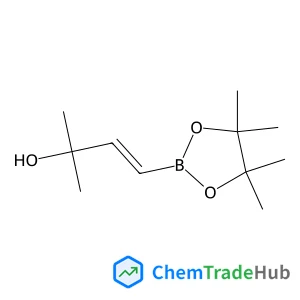
(E)-2-methyl-4-(4,4,5,5-tetramethyl-1,3,2-dioxaborolan-2-yl)but-3-en-2-ol
CAS番号:
581802-26-8
分子式:
C11H21BO3
![4-[(3-Chloro-2-fluorophenyl)amino]-7-methoxy-6-quinazolinyl acetate structure](https://static.chemtradehub.com/structs/740/740081-22-5-f58f.webp "4-[(3-Chloro-2-fluorophenyl)amino]-7-methoxy-6-quinazolinyl acetate structure")
4-[(3-Chloro-2-fluorophenyl)amino]-7-methoxy-6-quinazolinyl acetate
CAS番号:
740081-22-5
分子式:
C17H13ClFN3O3
おすすめサプライヤー


免責事項
このページに表示される学術雑誌情報は、参考および研究目的のみを目的としています。当社は雑誌出版社とは提携しておらず、投稿の取り扱いも行っておりません。出版に関するお問い合わせは、各雑誌出版社に直接ご連絡ください。
表示されている情報に誤りがある場合は、support@chemtradehub.com までご連絡ください。迅速に確認し、対応いたします。