












Mechanistic study of the ATP hydrolysis reaction in dynein motor protein
文献情報
出版日
2019-12-13
DOI
10.1039/C9CP02194A
インパクトファクター
3.676
著者
Rabindra Nath Manna, Mandira Dutta, Biman Jana
原文を見る
要旨
Dynein, a large and complex motor protein, harnesses energy from adenosine triphosphate (ATP) hydrolysis to regulate essential cellular activities. The ATP hydrolysis mechanism for the dynein motor is still shrouded in mystery. Herein, molecular dynamics simulations of a dynein motor disclosed that two water molecules are present close to the γ-phosphate of ATP and Glu1742 at the AAA1 site of dynein. We have proposed three possible mechanisms for the ATP hydrolysis. We divulge by using a quantum mechanics/molecular mechanics (QM/MM) study that two water molecules and Glu1742 are crucial for facilitating the ATP hydrolysis reaction in dynein. Moreover, the ATP hydrolysis step is initiated by the activation of lytic water (W1) by Glu1742 through relay proton transfers with the help of auxiliary water (W2) yielding HPO42− and ADP, as a product. In the next step, a proton is shifted back from Glu1742 to generate inorganic phosphate (H2PO4−) via another relay proton transfer event. The overall activation barrier for the Glu1742 assisted ATP hydrolysis is found to be the most favourable pathway compared to other plausible pathways. We also unearthed that ATP hydrolysis in dynein follows a so-called associative-like pathway in its rate-limiting step. Our study ascertained the important indirect roles of the two amino acids (such as Arg2109, Asn1792) and Mg2+ ion in the ATP hydrolysis of dynein. Additionally, multiple sequence alignment of the different organisms of dynein motors has conveyed the evolutionary importance of the Glu1742, Asn1742, and Arg2109 residues, respectively. As similar mechanisms are also prevalent in other motors, and GTPase and ATPase enzymes, the present finding spells out the definitive requirement of a proton relay process through an extended water-chain as one of the key components in an enzymatic ATP hydrolysis reaction.
関連文献
Synthesis and properties of helically-folded poly(arylenediethynylene)s
Michihisa Toya
2021-05-10
Paper
DOI: 10.1039/D1PY00144B
A dual stimuli responsive natural polymer based superabsorbent hydrogel engineered through a novel cross-linker
Safiya Nisar, Sonal Chauhan, Gurmeet Singh, Virender Singh, Sunita Rattan
2021-03-23
Paper
DOI: 10.1039/D0PY01729A
Purpurin derivatives as visible-light photosensitizers for 3D printing and valuable biological applications
Pauline Sautrot-Ba, Vlasta Brezová, Jean-Pierre Malval, Annalisa Chiappone, Louise Breloy, Samir Abbad-Andaloussi, Davy-Louis Versace
2021-03-24
Paper
DOI: 10.1039/D1PY00126D
Synthesis of thermo-sensitive polymers with super narrow molecular weight distributions: PET-RAFT polymerization of N-isopropyl acrylamide mediated by cross-linked zinc porphyrins with high active site loadings
Fanfan Li, Yi Yu, Hanyu Lv, Guiting Cai, Yanwu Zhang
2021-03-22
Paper
DOI: 10.1039/D0PY01643H
Morphological modulation of azobenzene-containing tubular polymersomes
Lishan Li, Yiwen Li, Shuyuan Wang, Liandong Ye, Wei Zhang, Nianchen Zhou, Zhengbiao Zhang, Xiulin Zhu
2021-04-26
Paper
DOI: 10.1039/D1PY00099C
Oxygen tolerant, photoinduced controlled radical polymerization approach for the synthesis of giant amphiphiles
Alexis Theodorou, Petros Mandriotis, Athina Anastasaki, Kelly Velonia
2021-03-18
Paper
DOI: 10.1039/D0PY01608J
High molar mass poly(ricinoleic acid) via entropy-driven ring-opening metathesis polymerization
Marc A. Hillmyer
2021-03-23
Paper
DOI: 10.1039/D1PY00185J
Impact of side reactions on molar mass distribution, unsaturation level and branching density in solution free radical polymerization of n-butyl acrylate under well-defined lab-scale reactor conditions
Mariya Edeleva, Yoshi W. Marien, Paul H. M. Van Steenberge
2021-03-10
Paper
DOI: 10.1039/D1PY00151E
Mediating covalent crosslinking of single-chain nanoparticles through solvophobicity in organic solvents
Georg M. Scheutz, Justine Elgoyhen, Kyle C. Bentz, Hao Sun, Junpeng Zhao, Daniel A. Savin, Brent S. Sumerlin
2021-07-27
Communication
DOI: 10.1039/D1PY00780G
The synthesis of thermoresponsive POSS-based eight-arm star poly(N-isopropylacrylamide): A comparison between Z-RAFT and R-RAFT strategies
Bo Pang, Rui Liu, Guang Han, Wei Wang
2021-03-02
Paper
DOI: 10.1039/D1PY00087J
こちらもおすすめ
化合物よくある質問
2-ブロモ-9,9-ジフェニル-9H-フルオレンの主な用途は何ですか?
2-溴-9,9-二苯基芴は、医薬品、工業材料、有機合成の研究分野で応用されます。特に、レーザー材料や機能性ポリマーの合成に使用されることがあります。また、蛍光色...
474918-32-62-Bromo-9,9-diphenyl...
化合物よくある質問
四氯化铱の市場動向や研究トレンドはどうですか?
四氯化铱の市場は研究開発分野で注目されており、特にナノ技術や金属有機框架(MOFs)の分野での需要が増加傾向にあります。価格は安定しており、中国や韓国での生産が...
207399-11-9Tetrachloroiridium h...
882-06-44-Nitrocinnamic acid
化合物よくある質問
1-(4-溴-3-氟苯基)-2-氯乙酮を含む廃棄物はどのように処理すべきですか?
1-(4-溴-3-氟苯基)-2-氯乙酮 (CAS番号: 1260857-14-4) の廃棄物は専門的な廃棄処理が必要です。まず、廃棄物は密閉された容器に収集し、...
1260857-14-41-(4-Bromo-3-fluorop...
化合物よくある質問
苦参酚Kとは何ですか?
苦参酚Kは、CAS番号101236-49-1を持つ化合物で、主に天然由来の生薬から抽出されます。この化合物は、抗炎症作用や抗癌作用を持つことが報告されています。
101236-49-1Kushenol K
化合物よくある質問
POTASSIUM (1-(TERTBUTOXYCARBONYL)AZETIDIN-3-YL)TRIFLUOROBORATE を含む廃棄物はどのように処理すべきですか?
POTASSIUM (1-(TERTBUTOXYCARBONYL)AZETIDIN-3-YL)TRIFLUOROBORATE を含む廃棄物は、まず安全なエント...
1430219-73-0Potassium (1-(tert-b...
化合物よくある質問
4-庚基-4’-联苯羧酸の市場動向や研究トレンドはどうですか?
4-庚基-4’-聯苯羧酸は、特殊化学品や合成化学の分野で用いられる化学物質ですが、市場動向としては、研究開発の進展とともに需要が増加しています。また、環境配慮型...
58573-94-74'-Heptyl-4-biphenyl...
化合物よくある質問
6-ブロモ-3-メトキシ-1-フェニル-1H-インドゾールを含む廃棄物はどのように処理すべきですか?
6-ブロモ-3-メトキシ-1-フェニル-1H-インドゾールを含む廃棄物は、適切な化学廃棄処理が必要です。通常、廃棄物は密閉容器に収集され、専門の廃棄処理業者に引...
1332527-03-36-Bromo-3-methoxy-1-...
化合物よくある質問
4,4-二甲基-2-吡咯烷酮はどの業界で使用されていますか?
4,4-二甲基-2-吡咯烷酮は医薬、ポリマー、センサー、半導体などの業界で広く使用されています。特に溶媒としての性能が高く評価されています。
66899-02-34,4-dimethylpyrrolid...
51312-42-6Sodium Phosphotungst...
掲載誌
Physical Chemistry Chemical Physics

CiteScore:
5.5
自己引用率:
10.3%
年間論文数:
3036
Physical Chemistry Chemical Physics (PCCP) is an international journal co-owned by 19 physical chemistry and physics societies from around the world. This journal publishes original, cutting-edge research in physical chemistry, chemical physics and biophysical chemistry. To be suitable for publication in PCCP, articles must include significant innovation and/or insight into physical chemistry; this is the most important criterion that reviewers and Editors will judge against when evaluating submissions. The journal has a broad scope and welcomes contributions spanning experiment, theory, computation and data science. Topical coverage includes spectroscopy, dynamics, kinetics, statistical mechanics, thermodynamics, electrochemistry, catalysis, surface science, quantum mechanics, quantum computing and machine learning. Interdisciplinary research areas such as polymers and soft matter, materials, nanoscience, energy, surfaces/interfaces, and biophysical chemistry are welcomed if they demonstrate significant innovation and/or insight into physical chemistry. Joined experimental/theoretical studies are particularly appreciated when complementary and based on up-to-date approaches.
おすすめ化合物
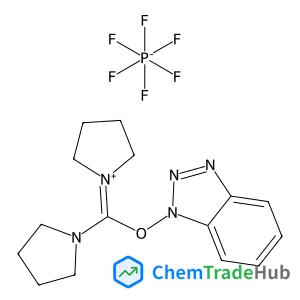
(1H-Benzotriazol-1-yloxy)(di-1-pyrrolidinyl)methylium hexafluorophosphate
CAS番号:
105379-24-6
分子式:
C15H21F6N5OP
おすすめサプライヤー






免責事項
このページに表示される学術雑誌情報は、参考および研究目的のみを目的としています。当社は雑誌出版社とは提携しておらず、投稿の取り扱いも行っておりません。出版に関するお問い合わせは、各雑誌出版社に直接ご連絡ください。
表示されている情報に誤りがある場合は、support@chemtradehub.com までご連絡ください。迅速に確認し、対応いたします。