












Localised contacts lead to nanosecond hinge motions in dimeric bovine serum albumin
文献情報
出版日
2019-06-10
DOI
10.1039/C9CP01847F
インパクトファクター
3.676
著者
Ralf Biehl, Olaf Holderer, Dieter Richter
原文を見る
要旨
Domain motions in proteins are crucial for biological function. In the present manuscript, we present a neutron spin-echo spectroscopy (NSE) study of native bovine serum albumin (BSA) in solution. NSE allows to probe both global and internal dynamics of the BSA monomer and dimer equilibrium that is formed in solution. Using a model independent approach, we were able to identify an internal dynamic process in BSA that is visible in addition to global rigid-body diffusion of the BSA monomer and dimer mixture. The observed internal protein motion is characterised by a relaxation time of 43 ns. The overdamped Brownian oscillator was considered as an alternative analytical theory that was able to describe the internal process as first-order approximation. More detailed information on the physical nature of the internal protein motion was extracted from the q-dependent internal diffusion coefficients ΔDeff(q) that were detected by NSE in addition to global rigid-body translational and rotational diffusion. The ΔDeff(q) were interpreted using normal mode analysis based on the available crystal structures of the BSA monomer and dimer as structural test models. Normal mode analysis demonstrates that the observed internal dynamic process can be attributed to bending motion of the BSA dimer. The native BSA monomer does not show any internal dynamics on the time- and length-scales probed by NSE. An intermolecular disulphide bridge or a direct structural contact between the BSA monomers forms a localised link acting as a molecular hinge in the BSA dimer. The effect of that hinge on the observed motion of BSA in the used dimeric structural model is discussed in terms of normal modes in a molecular picture.
関連文献
The electronic structure and stability of germanium tubes Ge30H12 and Ge33H12
Long Van Duong, Miquel Solà, Hadi Behzadi, Mohammad Jafar Momeni
2018-08-24
Paper
DOI: 10.1039/C8CP03737J
Influence of Cu adatoms on the molecular assembly of 4,4′-bipyridine on Cu(111)
M.-A. Dubois, O. Guillermet, S. Gauthier, G. Zhan, Y. Makoudi, F. Palmino, X. Bouju, A. Rochefort
2018-05-07
Paper
DOI: 10.1039/C8CP01184B
Bi2Se3 topological insulator at the 2D-limit: role of halide-doping on Dirac point
Salma Khatun, Hrishikesh Bhunia, Amlan J. Pal
2018-06-08
Paper
DOI: 10.1039/C8CP02604A
Theoretical study on the optical and electronic properties of graphene quantum dots doped with heteroatoms
Jianguang Feng, Hongzhou Dong, Beili Pang, Feifei Shao, ChunKai Zhang, Liyan Yu
2018-05-02
Paper
DOI: 10.1039/C8CP01403E
Nonstoichiometric oxides as a continuous homologous series: linear free-energy relationship in oxygen exchange
Alexander P. Nemudry
2018-06-09
Paper
DOI: 10.1039/C8CP02924E
Constructing organic superacids from superhalogens is a rational route as verified by DFT calculations
Fu-Qiang Zhou, Ru-Fang Zhao, Jin-Feng Li, Wen-Hua Xu, Chao-Chao Li, Lan Luo, Jian-Li Li, Bing Yin
2019-01-04
Paper
DOI: 10.1039/C8CP07313A
Model – free approach to quadrupole spin relaxation in solid 209Bi-aryl compounds
Danuta Kruk, Christian Goesweiner, Elzbieta Masiewicz, Evrim Umut, Carina Sampl, Hermann Scharfetter
2018-09-04
Paper
DOI: 10.1039/C8CP03848A
Cu(i) vs. Ru(ii) photosensitizers: elucidation of electron transfer processes within a series of structurally related complexes containing an extended π-system
Philipp Traber, Linda Zedler, Stephan Kupfer, Stefanie Gräfe, Martin Schulz, Wolfgang Frey, Michael Karnahl
2018-09-11
Paper
DOI: 10.1039/C8CP04595J
こちらもおすすめ
化合物よくある質問
2-ブロモ-9,9-ジフェニル-9H-フルオレンの主な用途は何ですか?
2-溴-9,9-二苯基芴は、医薬品、工業材料、有機合成の研究分野で応用されます。特に、レーザー材料や機能性ポリマーの合成に使用されることがあります。また、蛍光色...
474918-32-62-Bromo-9,9-diphenyl...
化合物よくある質問
四氯化铱の市場動向や研究トレンドはどうですか?
四氯化铱の市場は研究開発分野で注目されており、特にナノ技術や金属有機框架(MOFs)の分野での需要が増加傾向にあります。価格は安定しており、中国や韓国での生産が...
207399-11-9Tetrachloroiridium h...
882-06-44-Nitrocinnamic acid
化合物よくある質問
1-(4-溴-3-氟苯基)-2-氯乙酮を含む廃棄物はどのように処理すべきですか?
1-(4-溴-3-氟苯基)-2-氯乙酮 (CAS番号: 1260857-14-4) の廃棄物は専門的な廃棄処理が必要です。まず、廃棄物は密閉された容器に収集し、...
1260857-14-41-(4-Bromo-3-fluorop...
化合物よくある質問
苦参酚Kとは何ですか?
苦参酚Kは、CAS番号101236-49-1を持つ化合物で、主に天然由来の生薬から抽出されます。この化合物は、抗炎症作用や抗癌作用を持つことが報告されています。
101236-49-1Kushenol K
化合物よくある質問
POTASSIUM (1-(TERTBUTOXYCARBONYL)AZETIDIN-3-YL)TRIFLUOROBORATE を含む廃棄物はどのように処理すべきですか?
POTASSIUM (1-(TERTBUTOXYCARBONYL)AZETIDIN-3-YL)TRIFLUOROBORATE を含む廃棄物は、まず安全なエント...
1430219-73-0Potassium (1-(tert-b...
化合物よくある質問
4-庚基-4’-联苯羧酸の市場動向や研究トレンドはどうですか?
4-庚基-4’-聯苯羧酸は、特殊化学品や合成化学の分野で用いられる化学物質ですが、市場動向としては、研究開発の進展とともに需要が増加しています。また、環境配慮型...
58573-94-74'-Heptyl-4-biphenyl...
化合物よくある質問
6-ブロモ-3-メトキシ-1-フェニル-1H-インドゾールを含む廃棄物はどのように処理すべきですか?
6-ブロモ-3-メトキシ-1-フェニル-1H-インドゾールを含む廃棄物は、適切な化学廃棄処理が必要です。通常、廃棄物は密閉容器に収集され、専門の廃棄処理業者に引...
1332527-03-36-Bromo-3-methoxy-1-...
化合物よくある質問
4,4-二甲基-2-吡咯烷酮はどの業界で使用されていますか?
4,4-二甲基-2-吡咯烷酮は医薬、ポリマー、センサー、半導体などの業界で広く使用されています。特に溶媒としての性能が高く評価されています。
66899-02-34,4-dimethylpyrrolid...
51312-42-6Sodium Phosphotungst...
掲載誌
Physical Chemistry Chemical Physics

CiteScore:
5.5
自己引用率:
10.3%
年間論文数:
3036
Physical Chemistry Chemical Physics (PCCP) is an international journal co-owned by 19 physical chemistry and physics societies from around the world. This journal publishes original, cutting-edge research in physical chemistry, chemical physics and biophysical chemistry. To be suitable for publication in PCCP, articles must include significant innovation and/or insight into physical chemistry; this is the most important criterion that reviewers and Editors will judge against when evaluating submissions. The journal has a broad scope and welcomes contributions spanning experiment, theory, computation and data science. Topical coverage includes spectroscopy, dynamics, kinetics, statistical mechanics, thermodynamics, electrochemistry, catalysis, surface science, quantum mechanics, quantum computing and machine learning. Interdisciplinary research areas such as polymers and soft matter, materials, nanoscience, energy, surfaces/interfaces, and biophysical chemistry are welcomed if they demonstrate significant innovation and/or insight into physical chemistry. Joined experimental/theoretical studies are particularly appreciated when complementary and based on up-to-date approaches.
おすすめ化合物
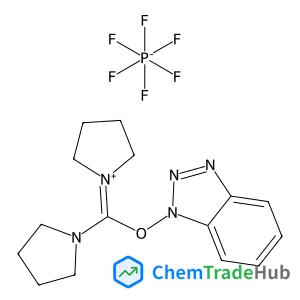
(1H-Benzotriazol-1-yloxy)(di-1-pyrrolidinyl)methylium hexafluorophosphate
CAS番号:
105379-24-6
分子式:
C15H21F6N5OP

おすすめサプライヤー





免責事項
このページに表示される学術雑誌情報は、参考および研究目的のみを目的としています。当社は雑誌出版社とは提携しておらず、投稿の取り扱いも行っておりません。出版に関するお問い合わせは、各雑誌出版社に直接ご連絡ください。
表示されている情報に誤りがある場合は、support@chemtradehub.com までご連絡ください。迅速に確認し、対応いたします。