












Proton transport properties of proton-conducting phosphate glasses at their glass transition temperatures
文献情報
出版日
2019-05-09
DOI
10.1039/C9CP01502G
インパクトファクター
3.676
著者
Takahisa Omata, Satoshi Tsukuda, Tomohiro Ishiyama, Junji Nishii, Toshiharu Yamashita, Hiroshi Kawazoe
原文を見る
要旨
The proton transport properties of 32 kinds of proton-conducting phosphate glasses with broad ranges of glass transition temperature, proton conductivity, and the proton carrier concentration were studied. Almost constant proton mobility of around 2 × 10⁻⁸ cm2 V−1 s−1 at the glass transition temperature, corresponding to a diffusion coefficient of approximately 4 × 10⁻¹⁰ cm2 s−1, was found for the glasses. The reason why the diffusion coefficient of protons is almost constant in various proton-conducting phosphate glasses was discussed based on the role of the protons as a cross-linker within the phosphate framework via hydrogen bonding. We evaluated the highest proton conductivity of the phosphate glasses and melts based on the almost constant mobility at their glass transition temperatures and obtained a highest expected proton conductivity of 7.5 × 10⁻³ S cm−1 at 300 °C. The potential of proton-conducting phosphate glasses as electrolytes in intermediate temperature fuel cells was also discussed.
関連文献
Density functional theory for strongly-interacting electrons: perspectives for physics and chemistry
Paola Gori-Giorgi, Michael Seidl
2010-10-01
Perspective
DOI: 10.1039/C0CP01061H
Synthesis and aggregation properties of dissymmetric phytanyl-gemini surfactants for use as improved DNA transfection vectors
Haitang Wang, Shawn D. Wettig
2010-10-28
Paper
DOI: 10.1039/C0CP00146E
Infrared spectra and quantum chemical characterization of weakly bound clusters of the benzoyl cation with Ar and H2O
Alexander Patzer, Shamik Chakraborty, Otto Dopfer
2010-08-16
Paper
DOI: 10.1039/C0CP00696C
Combined XRD and infrared studies of pyridinium species in (PyH)3[PW12O40] single crystals
Céline Pichon, Pierre Mialane, Jérôme Marrot, Claude Binet, Alexandre Vimont, Arnaud Travert, Jean-Claude Lavalley
2010-10-28
Paper
DOI: 10.1039/C0CP00446D
Solvation structure of coronene–transition metal complex: a RISM-SCF study
Hirofumi Sato, Chisa Kikumori, Shigeyoshi Sakaki
2010-11-19
Paper
DOI: 10.1039/C0CP01464H
Geometric correlations and infrared spectrum of adenine–uracilhydrogen bonds in CDCl3 solution
Yun-an Yan, Oliver Kühn
2010-08-17
Paper
DOI: 10.1039/C0CP00009D
Tautomers of extended reduced pyrazinacenes: a density-functional-theory based study
Roberto Scipioni, Jonathan P. Hill, Gary J. Richards, Toshiyuki Mori, Katsuhiko Ariga, Takahisa Ohno
2010-12-06
Paper
DOI: 10.1039/C0CP01245A
Local defects enhanced dehydrogenation kinetics of the NaBH4-added Li–Mg–N–H system
Chu Liang, Yongfeng Liu, Ying Jiang, Zhijun Wei, Mingxia Gao, Hongge Pan, Qidong Wang
2010-10-28
Paper
DOI: 10.1039/C0CP00340A
Can Na2[B12H12] be a decomposition product of NaBH4?
Riccarda Caputo, Sebastiano Garroni, David Olid, Francesc Teixidor, Santiago Suriñach, Maria Dolors Baró
2010-10-21
Paper
DOI: 10.1039/C0CP00877J
こちらもおすすめ
化合物よくある質問
オステニ二甲磺酸塩に適用される法規ガイドラインは何ですか?
オステニ二甲磺酸塩は、GHS分類に基づき corrosive 物質として分類されます。REACH規則では、該当物質の登録が要求される可能性があります。また、FD...
2070014-82-1N-(2-{[2-(Dimethylam...
化合物よくある質問
環丁基肼盐酸盐は安全ですか?
環丁基肼盐酸盐は毒性があり、吸入や皮膚接触は有害です。使用時の安全対策として、密閉システムを使用し、適切な排気設備を備えた場所で作業することが推奨されます。
1156980-49-2Cyclobutylhydrazine ...
化合物よくある質問
N-(4-パリドン基ソニルフェニル)硫代イソシアネートを取り扱う際の実験室安全事項は何ですか?
N-(4-パリドン基ソニルフェニル)硫代イソシアネートは高毒性で、皮膚や吸入による毒性があります。取り扱う際は防毒マスク、保護用手袋、保護眼鏡などのPPEを着用...
7356-55-01-[(4-Isothiocyanato...
化合物よくある質問
5-ヒドロキシ-1,3-ジヒドロ-2H-インドン-2-酮の物理化学的性質は何ですか?
CAS番号3416-18-0の5-ヒドロキシ-1,3-ジヒドロ-2H-インドン-2-酮は、結晶性の白色粉末です。分子量は228.25であり、 aqueous m...
3416-18-05-Hydroxy-1,3-dihydr...
化合物よくある質問
O-苄基-D-丝氨醇はどのように合成されますか?
O-苄基-D-丝氨醇は、D-アミノ酸とベンゼン環の経由で合成されます。触媒としてジメチルアミノピリジンが使用され、選択性は高いです。一般的な収率は約90%です。
58577-88-1(s)-2-Amino-3-benzyl...
化合物よくある質問
ナトリウム3-ヒドロキシbutano酸とは何ですか?
ナトリウム3-ヒドロキシbutano酸は、CAS番号13613-65-5で登録されている化合物です。この化合物は、(3R)-3-ヒドロキシbutano酸とナトリ...
13613-65-5sodium;(3R)-3-hydrox...
化合物よくある質問
1-(二苯甲基)-4-甲基ベンゼンの物理化学的性質は何ですか?
CAS番号603-37-2の1-(二苯甲基)-4-甲基ベンゼンは、結晶性の固体で、分子量は244.28であり、水中的には微溶です。この化合物は有機反応において中...
603-37-21-(Diphenylmethyl)-4...
化合物よくある質問
ネアミン塩酸塩の物理化学的性質は何ですか?
ネアミン塩酸塩の分子量は321.19であり、結晶性の白色粉末です。この化合物は水に溶けやすく、pHが低くなると不溶性になります。反応活性は高く、水溶液中の酸化還...
15446-43-2NEAMINE HYDROCHLORID...
化合物よくある質問
偶氮二甲酰二哌啶の主な用途は何ですか?
偶氮二甲酰二哌啶は、医薬品、染料、高 Então 剤、触媒、溶媒、量論試薬など、様々な分野で使用されています。特に、高 Enough 反応において、グリコール酸...
10465-81-3(E)-1,2-Diazenediylb...
664969-54-44-[(2E)-3-Phenyl-2-p...
掲載誌
Physical Chemistry Chemical Physics

CiteScore:
5.5
自己引用率:
10.3%
年間論文数:
3036
Physical Chemistry Chemical Physics (PCCP) is an international journal co-owned by 19 physical chemistry and physics societies from around the world. This journal publishes original, cutting-edge research in physical chemistry, chemical physics and biophysical chemistry. To be suitable for publication in PCCP, articles must include significant innovation and/or insight into physical chemistry; this is the most important criterion that reviewers and Editors will judge against when evaluating submissions. The journal has a broad scope and welcomes contributions spanning experiment, theory, computation and data science. Topical coverage includes spectroscopy, dynamics, kinetics, statistical mechanics, thermodynamics, electrochemistry, catalysis, surface science, quantum mechanics, quantum computing and machine learning. Interdisciplinary research areas such as polymers and soft matter, materials, nanoscience, energy, surfaces/interfaces, and biophysical chemistry are welcomed if they demonstrate significant innovation and/or insight into physical chemistry. Joined experimental/theoretical studies are particularly appreciated when complementary and based on up-to-date approaches.
おすすめ化合物
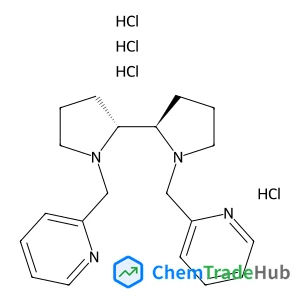
(2R,2'R)-1,1'-Bis(2-pyridinylmethyl)-2,2'-bipyrrolidine tetrahydrochloride
CAS番号:
1228077-88-0
分子式:
C20H30Cl4N4
![Ethanone, 1-[4-chloro-2-(methylthio)-5-pyrimidinyl]- structure](https://static.chemtradehub.com/structs/661/66116-82-3-863e.webp "Ethanone, 1-[4-chloro-2-(methylthio)-5-pyrimidinyl]- structure")
おすすめサプライヤー





免責事項
このページに表示される学術雑誌情報は、参考および研究目的のみを目的としています。当社は雑誌出版社とは提携しておらず、投稿の取り扱いも行っておりません。出版に関するお問い合わせは、各雑誌出版社に直接ご連絡ください。
表示されている情報に誤りがある場合は、support@chemtradehub.com までご連絡ください。迅速に確認し、対応いたします。