












Geometric correlations and infrared spectrum of adenine–uracilhydrogen bonds in CDCl3 solution
文献情報
出版日
2010-08-17
DOI
10.1039/C0CP00009D
インパクトファクター
3.676
著者
Yun-an Yan, Oliver Kühn
原文を見る
要旨
Hybrid QM/MM molecular dynamics simulations have been carried out for the Watson–Crick base pair of 9-ethyl-8-phenyladenine and 1-cyclohexyluracil in deuterochloroform solution at room temperature. Trajectories are analyzed paying special attention to the geometric correlations within the N–H⋯N and N–H⋯O hydrogen bonds in the base pair. Even though the two hydrogen bonds are only approximately linear and the heterocycles are tilted with respect to each other, hydrogen bond and N–H lengths follow a simple empirical correlation based on Pauling's valence bond order model. In order to describe the IR line shape of the two NH-stretching vibrations, the correlation between their fundamental transition frequencies and the hydrogen bond lengths is exploited. This facilitates efficient evaluation of the fluctuating transition frequencies along the QM/MM trajectory which allows the determination of the line shape function.
関連文献
Nanoparticle counting: towards accurate determination of the molar concentration
Jing Shang, Xiaohu Gao
2014-08-07
Tutorial Review
DOI: 10.1039/C4CS00128A
Compartmental ligand approach for constructing 3d–4f heterometallic [CuII5LnIII2] clusters: synthesis and magnetostructural properties
Bin Liu
2017-02-24
Paper
DOI: 10.1039/C6CE02519F
Sulfur stereogenic centers in transition-metal-catalyzed asymmetric C–H functionalization: generation and utilization
Wentan Liu, Jie Ke, Chuan He
2021-07-07
Perspective
DOI: 10.1039/D1SC02614C
Constructing bulk-contact inside single crystals of organic semiconductors through gel incorporation
2015-12-23
Paper
DOI: 10.1039/C5CE02383A
A new small molecule gelator and 3D framework ligator of lead(ii)
Jane V. Knichal, William J. Gee, Andrew D. Burrows, Paul R. Raithby, Chick C. Wilson
2015-08-24
Paper
DOI: 10.1039/C5CE01689D
Splitting growth of novel CuO straw sheaves and their improved photocatalytic activity due to exposed active {110} facets and crystallinity
Yunxuan Zhao, Huaxia Shi, Mingdong Chen, Fei Teng
2014-01-10
Paper
DOI: 10.1039/C3CE42271B
A redox stable Pd-doped perovskite for SOFC applications
Andrea Marcucci, Francesca Zurlo, Isabella Natali Sora, Stefano Casciardi, Silvia Licoccia, Elisabetta Di Bartolomeo
2019-02-04
Paper
DOI: 10.1039/C8TA10645B
Template-assisted generation of three-dimensionally branched titaniananotubes on a substrate
Kevin R. Moonoosawmy, Martha Es-Souni, Robert Minch, Matthias Dietze, Mohammed Es-Souni
2011-10-26
Paper
DOI: 10.1039/C1CE06064C
こちらもおすすめ
化合物よくある質問
オステニ二甲磺酸塩に適用される法規ガイドラインは何ですか?
オステニ二甲磺酸塩は、GHS分類に基づき corrosive 物質として分類されます。REACH規則では、該当物質の登録が要求される可能性があります。また、FD...
2070014-82-1N-(2-{[2-(Dimethylam...
化合物よくある質問
環丁基肼盐酸盐は安全ですか?
環丁基肼盐酸盐は毒性があり、吸入や皮膚接触は有害です。使用時の安全対策として、密閉システムを使用し、適切な排気設備を備えた場所で作業することが推奨されます。
1156980-49-2Cyclobutylhydrazine ...
化合物よくある質問
N-(4-パリドン基ソニルフェニル)硫代イソシアネートを取り扱う際の実験室安全事項は何ですか?
N-(4-パリドン基ソニルフェニル)硫代イソシアネートは高毒性で、皮膚や吸入による毒性があります。取り扱う際は防毒マスク、保護用手袋、保護眼鏡などのPPEを着用...
7356-55-01-[(4-Isothiocyanato...
化合物よくある質問
5-ヒドロキシ-1,3-ジヒドロ-2H-インドン-2-酮の物理化学的性質は何ですか?
CAS番号3416-18-0の5-ヒドロキシ-1,3-ジヒドロ-2H-インドン-2-酮は、結晶性の白色粉末です。分子量は228.25であり、 aqueous m...
3416-18-05-Hydroxy-1,3-dihydr...
化合物よくある質問
O-苄基-D-丝氨醇はどのように合成されますか?
O-苄基-D-丝氨醇は、D-アミノ酸とベンゼン環の経由で合成されます。触媒としてジメチルアミノピリジンが使用され、選択性は高いです。一般的な収率は約90%です。
58577-88-1(s)-2-Amino-3-benzyl...
化合物よくある質問
ナトリウム3-ヒドロキシbutano酸とは何ですか?
ナトリウム3-ヒドロキシbutano酸は、CAS番号13613-65-5で登録されている化合物です。この化合物は、(3R)-3-ヒドロキシbutano酸とナトリ...
13613-65-5sodium;(3R)-3-hydrox...
化合物よくある質問
1-(二苯甲基)-4-甲基ベンゼンの物理化学的性質は何ですか?
CAS番号603-37-2の1-(二苯甲基)-4-甲基ベンゼンは、結晶性の固体で、分子量は244.28であり、水中的には微溶です。この化合物は有機反応において中...
603-37-21-(Diphenylmethyl)-4...
化合物よくある質問
ネアミン塩酸塩の物理化学的性質は何ですか?
ネアミン塩酸塩の分子量は321.19であり、結晶性の白色粉末です。この化合物は水に溶けやすく、pHが低くなると不溶性になります。反応活性は高く、水溶液中の酸化還...
15446-43-2NEAMINE HYDROCHLORID...
化合物よくある質問
偶氮二甲酰二哌啶の主な用途は何ですか?
偶氮二甲酰二哌啶は、医薬品、染料、高 Então 剤、触媒、溶媒、量論試薬など、様々な分野で使用されています。特に、高 Enough 反応において、グリコール酸...
10465-81-3(E)-1,2-Diazenediylb...
664969-54-44-[(2E)-3-Phenyl-2-p...
掲載誌
Physical Chemistry Chemical Physics

CiteScore:
5.5
自己引用率:
10.3%
年間論文数:
3036
Physical Chemistry Chemical Physics (PCCP) is an international journal co-owned by 19 physical chemistry and physics societies from around the world. This journal publishes original, cutting-edge research in physical chemistry, chemical physics and biophysical chemistry. To be suitable for publication in PCCP, articles must include significant innovation and/or insight into physical chemistry; this is the most important criterion that reviewers and Editors will judge against when evaluating submissions. The journal has a broad scope and welcomes contributions spanning experiment, theory, computation and data science. Topical coverage includes spectroscopy, dynamics, kinetics, statistical mechanics, thermodynamics, electrochemistry, catalysis, surface science, quantum mechanics, quantum computing and machine learning. Interdisciplinary research areas such as polymers and soft matter, materials, nanoscience, energy, surfaces/interfaces, and biophysical chemistry are welcomed if they demonstrate significant innovation and/or insight into physical chemistry. Joined experimental/theoretical studies are particularly appreciated when complementary and based on up-to-date approaches.
おすすめ化合物
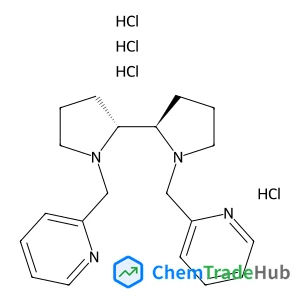
(2R,2'R)-1,1'-Bis(2-pyridinylmethyl)-2,2'-bipyrrolidine tetrahydrochloride
CAS番号:
1228077-88-0
分子式:
C20H30Cl4N4
おすすめサプライヤー



免責事項
このページに表示される学術雑誌情報は、参考および研究目的のみを目的としています。当社は雑誌出版社とは提携しておらず、投稿の取り扱いも行っておりません。出版に関するお問い合わせは、各雑誌出版社に直接ご連絡ください。
表示されている情報に誤りがある場合は、support@chemtradehub.com までご連絡ください。迅速に確認し、対応いたします。