












Theoretical insight into the photophysical properties of long-lifetime Ir(iii) and Rh(iii) complexes for two-photon photodynamic therapy
文献情報
出版日
2019-03-20
DOI
10.1039/C9CP00512A
インパクトファクター
3.676
著者
Xue Yin, Xiao-Yong Lai, Xin Wang, Ying-Tao Liu
原文を見る
要旨
Two-photon photodynamic therapy (TP-PDT) plays crucial roles in curing tumors because it involves deep penetration of drugs into the tissue and has minimal damage to the surrounding cells. Our theoretical study was aimed at providing fresh insights into photosensitizers, such as [Ir(N^C)2(N^N)]+ (N^C = 2-phenylpyridine, N^N = bis-benzimidazole) and [Rh(N^C)2(N^N)]+, to treat cancer via the TP-PDT route. To better understand the properties of the complexes [Ir(N^C)2(N^N)]+ and [Rh(N^C)2(N^N)]+, the one-photon and two-photon absorption electronic spectra, energy gap (ΔES–T), strength of two-photon absorption cross-section (δ), spin–orbit matrix element (〈S1|ĤSO|Tj〉), and phosphorescence lifetimes (τ) were calculated by DFT and TD-DFT. The calculation results suggested that both complexes met the criteria (i.e. an efficient ISC process, enough energy to produce 1O2 and phototherapeutic window of the absorption wavelength) of photosensitizers; importantly, the designed complex [Rh(N^C)2(N^N)]+ had better performance than [Ir(N^C)2(N^N)]+, especially in the long-lived triplet excited state. It is expected that our research can make quite a few contributions to the development of photosensitizers and establish some guidelines for experiments based on TP-PDT.
関連文献
A novel chiral porous metal–organic framework: asymmetric ring opening reaction of epoxide with amine in the chiral open space
Koichi Tanaka, Shinji Oda, Motoo Shiro
2007-12-17
Communication
DOI: 10.1039/B714083E
m-Benziporphodimethene: a new porphyrin analogue fluorescence zinc(ii) sensor
Chen-Hsiung Hung, Gao-Fong Chang, Anil Kumar, Geng-Fong Lin, Wei-Min Ching, Eric Wei-Guang Diau
2007-12-21
Communication
DOI: 10.1039/B714412A
Diastereoselective diaza-Cope rearrangement reaction
Hyunwoo Kim, Doo Seoung Choi, Cindy Pai-Hui Yen, Alan J. Lough, Choong Eui Song, Jik Chin
2008-01-23
Communication
DOI: 10.1039/B716253G
Synergistic effect of binary component ligands in chiral catalyst library engineering for enantioselective reactions
2008-01-21
Feature Article
DOI: 10.1039/B710668H
Ionic liquids as novel guests for cucurbit[6]uril in neutral water
Li Liu, Nan Zhao, Oren A. Scherman
2008-01-02
Communication
DOI: 10.1039/B716889F
Elusive AuF in the solid state as accessed via high pressure comproportionation‡
Dominik Kurzydłowski
2008-01-03
Communication
DOI: 10.1039/B716705A
Synthesis of a stable radical anion via the one electron reduction of a 1,1-bis-phosphinosulfide alkene derivative
Thibault Cantat, Frédéric Biaso, Aurélien Momin, Louis Ricard, Michel Geoffroy, Nicolas Mézailles, Pascal Le Floch
2007-12-19
Communication
DOI: 10.1039/B715380E
STEM characterization on silicananowires with new mesopore structures by space-confined self-assembly within nano-scale channels
Michael Z. Hu, Donglu Shi, Douglas Blom
2008-01-23
Communication
DOI: 10.1039/B717461F
こちらもおすすめ
化合物よくある質問
6- bromo-1-cyclopropyl-1H-benzimidazoleの市場動向や研究トレンドはどうですか?
6- bromo-1-cyclopropyl-1H-benzimidazoleは、抗炎症、抗ウイルス作用を持つことが報告されており、新薬開発の研究対象として注目...
1416713-53-56-Bromo-1-cyclopropy...
化合物よくある質問
環氧プロpanol-d5を取り扱う際の実験室安全事項は何ですか?
取り扱う際には、防護眼鏡と手袋を使用し、ドラフトチャンバー内で操作することを推奨します。漏洩時には適切な手順で処理し、安全データシートを常に参照してください。
1246819-20-4Glycidol-d5
化合物よくある質問
2,2’-ジメチル-3,3’-ビピリジンはどのように合成されますか?
2,2’-ジメチル-3,3’-ビピリジンは、ピリジンと2-メチルアクリルアミドを有機合成反応で合成します。この反応では、ピリジンと2-メチルアクリルアミドを含有...
86156-55-02,2’-Dimethyl-3,3’-b...
化合物よくある質問
6-甲基ピリジン-2-ボリック酸の主な用途は何ですか?
6-甲基ピリジン-2-ボリック酸は、合成化学、医薬品合成、以及研究用途などに広く使用され、特に組換えDNA技術や分子生物学の研究において重要な役割を果たします。
372963-50-3(6-Methyl-2-pyridiny...
化合物よくある質問
(R)-3-(1-甲基-2-氧環己基)プロpano酸メチルは安全ですか?
(R)-3-(1-甲基-2-氧環己基)プロpano酸メチルは一定の安全性がありますが、直接的な皮膚接触や吸入は避けるべきです。使用する際は適切な個々の安全データ...
94089-47-1methyl 3-[(1R)-1-met...
化合物よくある質問
ketorolacはどのように保存すればよいですか?
ketorolacは、密封して遮光容器に保管し、直射日光や高温を避けて保存してください。温度は常温で保存し、湿度をなるべく低く保つことが推奨されます。
74103-06-3rac Ketorolac
化合物よくある質問
L-2,3-二氨基丙酸二盐酸盐を取り扱う際の実験室安全事項は何ですか?
L-2,3-二氨基丙酸二盐酸盐は腐食性が強く、皮膚や粘膜に刺激を与える可能性があります。取り扱う際は、防塵マスク、ゴーグル、手袋を使用し、適切な排気設備を使用し...
19777-68-5(S)-2,3-Diaminopropa...
化合物よくある質問
2-(4-溴ピリジン-2-基)乙腈の物理化学的性質は何ですか?
2-(4-溴ピリジン-2-基)乙腈のCAS番号は312325-73-8です。主に結晶形態で存在し、分子量は159.01 g/molです。この化合物は水に溶けやす...
312325-73-8(4-Bromo-2-pyridinyl...
化合物よくある質問
3-フローロ-[1,1-ベンジレン]-3,4-ジカルボン酸を取り扱う際の実験室安全事項は何ですか?
この化合物は毒性は低いですが、直接的な接触や吸入に注意が必要です。PPE(個人防護具)を着用し、ドラフトチャンバーを使用して操作することを推奨します。また、漏洩...
1261915-32-53'-Fluoro-[1,1'-biph...
化合物よくある質問
3-(1-氧代-1,3-二氢-2H-2-异吲哚)丙酸の主な用途は何ですか?
3-(1-氧代-1,3-二氢-2H-2-异吲哚)丙酸は、薬理学研究や医薬品製造において広く用いられる化合物です。また、工業的な用途でも一部の化学反応の触媒や助剤...
83747-30-23-(1-Oxo-1,3-dihydro...
掲載誌
Physical Chemistry Chemical Physics

CiteScore:
5.5
自己引用率:
10.3%
年間論文数:
3036
Physical Chemistry Chemical Physics (PCCP) is an international journal co-owned by 19 physical chemistry and physics societies from around the world. This journal publishes original, cutting-edge research in physical chemistry, chemical physics and biophysical chemistry. To be suitable for publication in PCCP, articles must include significant innovation and/or insight into physical chemistry; this is the most important criterion that reviewers and Editors will judge against when evaluating submissions. The journal has a broad scope and welcomes contributions spanning experiment, theory, computation and data science. Topical coverage includes spectroscopy, dynamics, kinetics, statistical mechanics, thermodynamics, electrochemistry, catalysis, surface science, quantum mechanics, quantum computing and machine learning. Interdisciplinary research areas such as polymers and soft matter, materials, nanoscience, energy, surfaces/interfaces, and biophysical chemistry are welcomed if they demonstrate significant innovation and/or insight into physical chemistry. Joined experimental/theoretical studies are particularly appreciated when complementary and based on up-to-date approaches.
おすすめ化合物
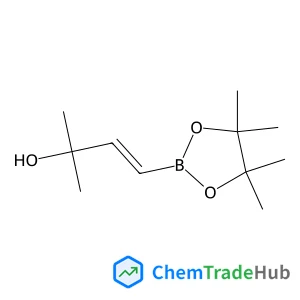
(E)-2-methyl-4-(4,4,5,5-tetramethyl-1,3,2-dioxaborolan-2-yl)but-3-en-2-ol
CAS番号:
581802-26-8
分子式:
C11H21BO3
おすすめサプライヤー





免責事項
このページに表示される学術雑誌情報は、参考および研究目的のみを目的としています。当社は雑誌出版社とは提携しておらず、投稿の取り扱いも行っておりません。出版に関するお問い合わせは、各雑誌出版社に直接ご連絡ください。
表示されている情報に誤りがある場合は、support@chemtradehub.com までご連絡ください。迅速に確認し、対応いたします。