












STEM characterization on silicananowires with new mesopore structures by space-confined self-assembly within nano-scale channels
文献情報
出版日
2008-01-23
DOI
10.1039/B717461F
インパクトファクター
6.222
著者
Michael Z. Hu, Donglu Shi, Douglas Blom
原文を見る
要旨
“Critical” channel diameters were found (below which space confinement takes effect, leading to more uniform and ordered mesopore structures) in the study of evaporation-induced co-assembly of triblock-copolymer (P123) and silica molecular precursors (TEOS, tetraethyl orthosilicate) by employing channels in anodized aluminum oxide (AAO, 13–200 nm channel diameter) and in track-etched polycarbonate (EPC, 10–80 nm channel diameter) and for the first time we have observed a new mesopore structure (i.e., packed hollow spheres) in silica nanowires formed in AAO channels with diameters from 30 to 80 nm.
関連文献
Iridium-catalyzed enantioselective hydrogenation of vinyl boronates
Alexander Paptchikhine, Pradeep Cheruku, Mattias Engman, Pher G. Andersson
2009-09-15
Communication
DOI: 10.1039/B912590F
Insertion reactions of a two-coordinate iron diaryl with dioxygen and carbon monoxide
Chengbao Ni, Philip P. Power
2009-08-17
Communication
DOI: 10.1039/B912312A
Electrochemical patterning of gold nanoparticles on transparent single-walled carbon nanotube films
Minh-Phuong Ngoc Bui, Sangyeop Lee, Kwi Nam Han, Xuan-Hung Pham, Cheng Ai Li, Jaebum Choo, Gi Hun Seong
2009-08-10
Communication
DOI: 10.1039/B906939A
An organocatalytic enantioselective ring-reorganization domino sequence of methyleneindolinones with 2-aminomalonates
Zhen-Zhen Xie, Lan Zheng, Zhi-Peng Ye, Zhi-Xiong Deng, Qing-Lan Zhao, Jun-An Xiao, Kai Chen, Hao-Yue Xiang, Xiao-Qing Chen, Hua Yang
2020-12-17
Research Article
DOI: 10.1039/D0QO01364A
Two diamino-substituted lithiocarbanions in one molecule
Ina Kamps, Andreas Mix, Raphael J. F. Berger, Beate Neumann, Hans-Georg Stammler, Norbert W. Mitzel
2009-08-20
Communication
DOI: 10.1039/B909561F
Chemical etching with tetrafluoroborate: a facile method for resizing of CdTe nanocrystals under mild conditions
Jianbo Liu, Xiaohai Yang, Kemin Wang, Dong Wang, Pengfei Zhang
2009-08-25
Communication
DOI: 10.1039/B910752E
Role of complementary H-bonding interaction of a cyanurate in the self-assembly and gelation of melamine linked tri(p-phenyleneethynylene)s
Sankarapillai Mahesh, Rajasekaran Thirumalai, Akihide Kitamura, Ayyappanpillai Ajayaghosh
2009-09-14
Communication
DOI: 10.1039/B912392J
Molybdenum magnetic shielding and quadrupolar tensors for a series of molybdate salts: a solid-state 95Mo NMR study
Michelle A. M. Forgeron, Roderick E. Wasylishen
2007-11-21
Paper
DOI: 10.1039/B713276J
こちらもおすすめ
化合物よくある質問
6- bromo-1-cyclopropyl-1H-benzimidazoleの市場動向や研究トレンドはどうですか?
6- bromo-1-cyclopropyl-1H-benzimidazoleは、抗炎症、抗ウイルス作用を持つことが報告されており、新薬開発の研究対象として注目...
1416713-53-56-Bromo-1-cyclopropy...
化合物よくある質問
環氧プロpanol-d5を取り扱う際の実験室安全事項は何ですか?
取り扱う際には、防護眼鏡と手袋を使用し、ドラフトチャンバー内で操作することを推奨します。漏洩時には適切な手順で処理し、安全データシートを常に参照してください。
1246819-20-4Glycidol-d5
化合物よくある質問
2,2’-ジメチル-3,3’-ビピリジンはどのように合成されますか?
2,2’-ジメチル-3,3’-ビピリジンは、ピリジンと2-メチルアクリルアミドを有機合成反応で合成します。この反応では、ピリジンと2-メチルアクリルアミドを含有...
86156-55-02,2’-Dimethyl-3,3’-b...
化合物よくある質問
6-甲基ピリジン-2-ボリック酸の主な用途は何ですか?
6-甲基ピリジン-2-ボリック酸は、合成化学、医薬品合成、以及研究用途などに広く使用され、特に組換えDNA技術や分子生物学の研究において重要な役割を果たします。
372963-50-3(6-Methyl-2-pyridiny...
化合物よくある質問
(R)-3-(1-甲基-2-氧環己基)プロpano酸メチルは安全ですか?
(R)-3-(1-甲基-2-氧環己基)プロpano酸メチルは一定の安全性がありますが、直接的な皮膚接触や吸入は避けるべきです。使用する際は適切な個々の安全データ...
94089-47-1methyl 3-[(1R)-1-met...
化合物よくある質問
ketorolacはどのように保存すればよいですか?
ketorolacは、密封して遮光容器に保管し、直射日光や高温を避けて保存してください。温度は常温で保存し、湿度をなるべく低く保つことが推奨されます。
74103-06-3rac Ketorolac
化合物よくある質問
L-2,3-二氨基丙酸二盐酸盐を取り扱う際の実験室安全事項は何ですか?
L-2,3-二氨基丙酸二盐酸盐は腐食性が強く、皮膚や粘膜に刺激を与える可能性があります。取り扱う際は、防塵マスク、ゴーグル、手袋を使用し、適切な排気設備を使用し...
19777-68-5(S)-2,3-Diaminopropa...
化合物よくある質問
2-(4-溴ピリジン-2-基)乙腈の物理化学的性質は何ですか?
2-(4-溴ピリジン-2-基)乙腈のCAS番号は312325-73-8です。主に結晶形態で存在し、分子量は159.01 g/molです。この化合物は水に溶けやす...
312325-73-8(4-Bromo-2-pyridinyl...
化合物よくある質問
3-フローロ-[1,1-ベンジレン]-3,4-ジカルボン酸を取り扱う際の実験室安全事項は何ですか?
この化合物は毒性は低いですが、直接的な接触や吸入に注意が必要です。PPE(個人防護具)を着用し、ドラフトチャンバーを使用して操作することを推奨します。また、漏洩...
1261915-32-53'-Fluoro-[1,1'-biph...
化合物よくある質問
3-(1-氧代-1,3-二氢-2H-2-异吲哚)丙酸の主な用途は何ですか?
3-(1-氧代-1,3-二氢-2H-2-异吲哚)丙酸は、薬理学研究や医薬品製造において広く用いられる化合物です。また、工業的な用途でも一部の化学反応の触媒や助剤...
83747-30-23-(1-Oxo-1,3-dihydro...
掲載誌
Chemical Communications

CiteScore:
8.6
自己引用率:
4.7%
年間論文数:
2458
ChemComm publishes urgent research which is of outstanding significance and interest to experts in the field, while also appealing to the journal’s broad chemistry readership. Our communication format is ideally suited to short, urgent studies that are of such importance that they require accelerated publication. Our scope covers all topics in chemistry, and research at the interface of chemistry and other disciplines (such as materials science, nanoscience, physics, engineering and biology) where there is a significant novelty in the chemistry aspects. Major topic areas covered include: Analytical Chemistry Catalysis Chemical Biology and medicinal chemistry Computational Chemistry and Machine Learning Energy and sustainable chemistry Environmental Chemistry Green Chemistry Inorganic Chemistry Materials Chemistry Nanoscience Organic Chemistry Physical Chemistry Polymer Chemistry Supramolecular Chemistry
おすすめ化合物
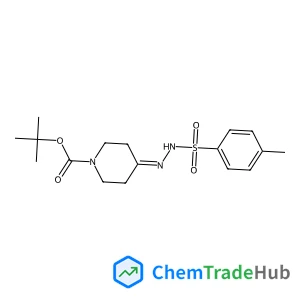
tert-Butyl 4-(2-(p-Tolylsulfonyl)hydrazono)piperidine-1-carboxylate
CAS番号:
1046478-89-0
分子式:
C17H25N3O4S
おすすめサプライヤー







免責事項
このページに表示される学術雑誌情報は、参考および研究目的のみを目的としています。当社は雑誌出版社とは提携しておらず、投稿の取り扱いも行っておりません。出版に関するお問い合わせは、各雑誌出版社に直接ご連絡ください。
表示されている情報に誤りがある場合は、support@chemtradehub.com までご連絡ください。迅速に確認し、対応いたします。