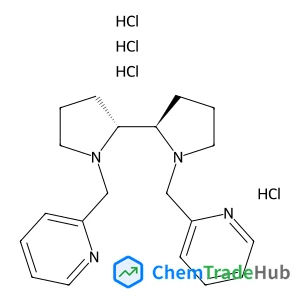
(2R,2'R)-1,1'-Bis(2-pyridinylmethyl)-2,2'-bipyrrolidine tetrahydrochloride
CAS番号:
1228077-88-0
分子式:
C20H30Cl4N4
Aušra Valiūnienė, Jurate Petroniene, Georgi Popkirov, Almira Ramanaviciene, Arunas Ramanavicius
Scanning electrochemical microscopy (SECM) hybridized with fast Fourier transform-based electrochemical impedance spectroscopy (FFT-EIS) seems to be a powerful variation of scanning electrochemical impedance microscopy (SEIM), wherein both state-of-the-art techniques are combined (FFT-SEIM) and can be used for the investigation and treatment of tissues at single cell level. However, in most EIS-based experiments, harmful redox mediators are applied, which affect the functioning of living cells and tissues. Therefore, the development of a redox-probe-free FFT-SEIM is still a very important challenge in electrochemistry. For this reason, in this research, we have demonstrated a redox-probe-free evaluation of conducting and non-conducting surfaces by combining scanning electrochemical microscopy with FFT-EIS. It was demonstrated that using the fast Fourier transform-based FFT-EIS technique, EIS spectra could be registered much faster compared to experiments performed using the conventional EIS equipment. An ultramicroelectrode (UME) was used as a scanning electrode to ensure high spatial resolution. We have performed FFT-SEIM measurements in a redox-probe-free mode (without any additional redox probes) and have investigated several surfaces with different conductivities. The FFT-EIS equipment and the built-in software help to avoid the influence of possible formation of hydrogen bubbles on the UME. This research opens up a new avenue for the application of FFT-SEIM in the investigation of samples that are unstable and very sensitive towards redox mediators (e.g., tissues and/or living cells).
Courtney P. Ennis, Ralf I. Kaiser
DOI: 10.1039/C0CP00493F
Alexandra Nemkevich, Mark A. Spackman, Ben Corry
DOI: 10.1039/C0CP01409E
Jenel Vatamanu, Peter G. Kusalik
DOI: 10.1039/C0CP00551G
Larissa S. Fenn, John A. McLean
DOI: 10.1039/C0CP01414A
Daniel M. Packwood, Leon F. Phillips
DOI: 10.1039/C0CP00787K
Christoph B. Messner, Thomas S. Hofer, Bernhard R. Randolf, Bernd M. Rode
DOI: 10.1039/C0CP01330G
Lenaïc Lartigue, Rachel Pflieger, Sergey I. Nikitenko, Yannick Guari, Lorenzo Stievano, Moulay T. Sougrati, Joulia Larionova
DOI: 10.1039/C0CP01670E
Szymon Smolarek, Anouk M. Rijs, Wybren Jan Buma, Marcel Drabbels
DOI: 10.1039/C0CP00746C
Galina Krylova, Arnaud Brioude, Soraya Ababou-Girard, Jan Mrazek, Lubomir Spanhel
DOI: 10.1039/C004517A
オステニ二甲磺酸塩は、GHS分類に基づき corrosive 物質として分類されます。REACH規則では、該当物質の登録が要求される可能性があります。また、FD...
環丁基肼盐酸盐は毒性があり、吸入や皮膚接触は有害です。使用時の安全対策として、密閉システムを使用し、適切な排気設備を備えた場所で作業することが推奨されます。
N-(4-パリドン基ソニルフェニル)硫代イソシアネートは高毒性で、皮膚や吸入による毒性があります。取り扱う際は防毒マスク、保護用手袋、保護眼鏡などのPPEを着用...
CAS番号3416-18-0の5-ヒドロキシ-1,3-ジヒドロ-2H-インドン-2-酮は、結晶性の白色粉末です。分子量は228.25であり、 aqueous m...
O-苄基-D-丝氨醇は、D-アミノ酸とベンゼン環の経由で合成されます。触媒としてジメチルアミノピリジンが使用され、選択性は高いです。一般的な収率は約90%です。
ナトリウム3-ヒドロキシbutano酸は、CAS番号13613-65-5で登録されている化合物です。この化合物は、(3R)-3-ヒドロキシbutano酸とナトリ...
CAS番号603-37-2の1-(二苯甲基)-4-甲基ベンゼンは、結晶性の固体で、分子量は244.28であり、水中的には微溶です。この化合物は有機反応において中...
ネアミン塩酸塩の分子量は321.19であり、結晶性の白色粉末です。この化合物は水に溶けやすく、pHが低くなると不溶性になります。反応活性は高く、水溶液中の酸化還...
偶氮二甲酰二哌啶は、医薬品、染料、高 Então 剤、触媒、溶媒、量論試薬など、様々な分野で使用されています。特に、高 Enough 反応において、グリコール酸...

Physical Chemistry Chemical Physics (PCCP) is an international journal co-owned by 19 physical chemistry and physics societies from around the world. This journal publishes original, cutting-edge research in physical chemistry, chemical physics and biophysical chemistry. To be suitable for publication in PCCP, articles must include significant innovation and/or insight into physical chemistry; this is the most important criterion that reviewers and Editors will judge against when evaluating submissions. The journal has a broad scope and welcomes contributions spanning experiment, theory, computation and data science. Topical coverage includes spectroscopy, dynamics, kinetics, statistical mechanics, thermodynamics, electrochemistry, catalysis, surface science, quantum mechanics, quantum computing and machine learning. Interdisciplinary research areas such as polymers and soft matter, materials, nanoscience, energy, surfaces/interfaces, and biophysical chemistry are welcomed if they demonstrate significant innovation and/or insight into physical chemistry. Joined experimental/theoretical studies are particularly appreciated when complementary and based on up-to-date approaches.