












![Ethanone, 1-[4-chloro-2-(methylthio)-5-pyrimidinyl]- structure](https://static.chemtradehub.com/structs/661/66116-82-3-863e.webp "Ethanone, 1-[4-chloro-2-(methylthio)-5-pyrimidinyl]- structure")
Molecular dynamics simulations of structure and dynamics of organic molecular crystals
文献情報
出版日
2010-10-14
DOI
10.1039/C0CP01409E
インパクトファクター
3.676
著者
Alexandra Nemkevich, Mark A. Spackman, Ben Corry
原文を見る
要旨
A set of model compounds covering a range of polarity and flexibility have been simulated using GAFF, CHARMM22, OPLS and MM3 force fields to examine how well classical molecular dynamics simulations can reproduce structural and dynamic aspects of organic molecular crystals. Molecular structure, crystal structure and thermal motion, including molecular reorientations and internal rotations, found from the simulations have been compared between force fields and with experimental data. The MM3 force field does not perform well in condensed phase simulations, while GAFF, CHARMM and OPLS perform very similarly. Generally molecular and crystal structure are reproduced well, with a few exceptions. The atomic displacement parameters (ADPs) are mostly underestimated in the simulations with a relative error of up to 70%. Examples of molecular reorientation and internal rotation, observed in the simulations, include in-plane reorientations of benzene, methyl rotations in alanine, decane, isopropylcyclohexane, pyramidal inversion of nitrogen in amino group and rotation of the whole group around the C–N bond. Frequencies of such dynamic processes were calculated, as well as thermodynamic properties for reorientations in benzene and alanine. We conclude that MD simulations can be used for qualitative analysis, while quantitative results should be taken with caution. It is important to compare the outcomes from simulations with as many experimental quantities as available before using them to study or quantify crystal properties not available from experiment.
関連文献
Fluorine-free ionic liquid electrolytes for sustainable neodymium recovery using an electrochemical approach
Kalani Periyapperuma, Jennifer M. Pringle, Laura Sanchez-Cupido, Maria Forsyth, Cristina Pozo-Gonzalo
2021-04-21
Paper
DOI: 10.1039/D1GC00361E
A new small molecule gelator and 3D framework ligator of lead(ii)
Jane V. Knichal, William J. Gee, Andrew D. Burrows, Paul R. Raithby, Chick C. Wilson
2015-08-24
Paper
DOI: 10.1039/C5CE01689D
High fluorescence selectivity and visual detection ofG-quadruplex structures by a novel dinuclear ruthenium complex
Liang Xu, Dan Zhang, Jing Huang, Minggang Deng, Ming Zhang
2009-11-26
Communication
DOI: 10.1039/B918045A
Controllable fabrication of nanostructured materials for photoelectrochemical water splitting via atomic layer deposition
Tuo Wang, Zhibin Luo, Chengcheng Li, Jinlong Gong
2014-02-06
Tutorial Review
DOI: 10.1039/C3CS60370A
Advances and challenges in electrochemical CO2 reduction processes: an engineering and design perspective looking beyond new catalyst materials
Sahil Garg, Mengran Li, Adam Z. Weber, Liye Li, Victor Rudolph, Guoxiong Wang, Thomas E. Rufford
2019-12-12
Review Article
DOI: 10.1039/C9TA13298H
Transition-metal-free C–C bond forming reactions of aryl, alkenyl and alkynylboronic acids and their derivatives
S. Roscales, A. G. Csákÿ
2014-09-03
Tutorial Review
DOI: 10.1039/C4CS00195H
Construction of mesoporous Cu-doped Co9S8 rectangular nanotube arrays for high energy density all-solid-state asymmetric supercapacitors
Wen Lu, Ze Yuan, Chunyang Xu, Jiqiang Ning, Yijun Zhong, Ziyang Zhang, Yong Hu
2019-02-04
Paper
DOI: 10.1039/C8TA10998B
The preparation of graft copolymers of cellulose and cellulose derivatives using ATRP under homogeneous reaction conditions
Osama M. Musa
2014-07-14
Review Article
DOI: 10.1039/C4CS00053F
Boosting supercapacitor and capacitive deionization performance of hierarchically porous carbon by polar surface and structural engineering
2019-12-14
Paper
DOI: 10.1039/C9TA12170F
こちらもおすすめ
化合物よくある質問
オステニ二甲磺酸塩に適用される法規ガイドラインは何ですか?
オステニ二甲磺酸塩は、GHS分類に基づき corrosive 物質として分類されます。REACH規則では、該当物質の登録が要求される可能性があります。また、FD...
2070014-82-1N-(2-{[2-(Dimethylam...
化合物よくある質問
環丁基肼盐酸盐は安全ですか?
環丁基肼盐酸盐は毒性があり、吸入や皮膚接触は有害です。使用時の安全対策として、密閉システムを使用し、適切な排気設備を備えた場所で作業することが推奨されます。
1156980-49-2Cyclobutylhydrazine ...
化合物よくある質問
N-(4-パリドン基ソニルフェニル)硫代イソシアネートを取り扱う際の実験室安全事項は何ですか?
N-(4-パリドン基ソニルフェニル)硫代イソシアネートは高毒性で、皮膚や吸入による毒性があります。取り扱う際は防毒マスク、保護用手袋、保護眼鏡などのPPEを着用...
7356-55-01-[(4-Isothiocyanato...
化合物よくある質問
5-ヒドロキシ-1,3-ジヒドロ-2H-インドン-2-酮の物理化学的性質は何ですか?
CAS番号3416-18-0の5-ヒドロキシ-1,3-ジヒドロ-2H-インドン-2-酮は、結晶性の白色粉末です。分子量は228.25であり、 aqueous m...
3416-18-05-Hydroxy-1,3-dihydr...
化合物よくある質問
O-苄基-D-丝氨醇はどのように合成されますか?
O-苄基-D-丝氨醇は、D-アミノ酸とベンゼン環の経由で合成されます。触媒としてジメチルアミノピリジンが使用され、選択性は高いです。一般的な収率は約90%です。
58577-88-1(s)-2-Amino-3-benzyl...
化合物よくある質問
ナトリウム3-ヒドロキシbutano酸とは何ですか?
ナトリウム3-ヒドロキシbutano酸は、CAS番号13613-65-5で登録されている化合物です。この化合物は、(3R)-3-ヒドロキシbutano酸とナトリ...
13613-65-5sodium;(3R)-3-hydrox...
化合物よくある質問
1-(二苯甲基)-4-甲基ベンゼンの物理化学的性質は何ですか?
CAS番号603-37-2の1-(二苯甲基)-4-甲基ベンゼンは、結晶性の固体で、分子量は244.28であり、水中的には微溶です。この化合物は有機反応において中...
603-37-21-(Diphenylmethyl)-4...
化合物よくある質問
ネアミン塩酸塩の物理化学的性質は何ですか?
ネアミン塩酸塩の分子量は321.19であり、結晶性の白色粉末です。この化合物は水に溶けやすく、pHが低くなると不溶性になります。反応活性は高く、水溶液中の酸化還...
15446-43-2NEAMINE HYDROCHLORID...
化合物よくある質問
偶氮二甲酰二哌啶の主な用途は何ですか?
偶氮二甲酰二哌啶は、医薬品、染料、高 Então 剤、触媒、溶媒、量論試薬など、様々な分野で使用されています。特に、高 Enough 反応において、グリコール酸...
10465-81-3(E)-1,2-Diazenediylb...
664969-54-44-[(2E)-3-Phenyl-2-p...
掲載誌
Physical Chemistry Chemical Physics

CiteScore:
5.5
自己引用率:
10.3%
年間論文数:
3036
Physical Chemistry Chemical Physics (PCCP) is an international journal co-owned by 19 physical chemistry and physics societies from around the world. This journal publishes original, cutting-edge research in physical chemistry, chemical physics and biophysical chemistry. To be suitable for publication in PCCP, articles must include significant innovation and/or insight into physical chemistry; this is the most important criterion that reviewers and Editors will judge against when evaluating submissions. The journal has a broad scope and welcomes contributions spanning experiment, theory, computation and data science. Topical coverage includes spectroscopy, dynamics, kinetics, statistical mechanics, thermodynamics, electrochemistry, catalysis, surface science, quantum mechanics, quantum computing and machine learning. Interdisciplinary research areas such as polymers and soft matter, materials, nanoscience, energy, surfaces/interfaces, and biophysical chemistry are welcomed if they demonstrate significant innovation and/or insight into physical chemistry. Joined experimental/theoretical studies are particularly appreciated when complementary and based on up-to-date approaches.
おすすめ化合物
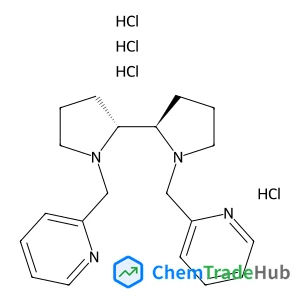
(2R,2'R)-1,1'-Bis(2-pyridinylmethyl)-2,2'-bipyrrolidine tetrahydrochloride
CAS番号:
1228077-88-0
分子式:
C20H30Cl4N4
![5,7-Dihydroxy-3-(4-hydroxyphenyl)-6-[(1R,6R)-3-methyl-6-prop-1-en-2-ylcyclohex-2-en-1-yl]chromen-4-one structure](https://static.chemtradehub.com/structs/191/1914963-20-4-2b05.webp "5,7-Dihydroxy-3-(4-hydroxyphenyl)-6-[(1R,6R)-3-methyl-6-prop-1-en-2-ylcyclohex-2-en-1-yl]chromen-4-one structure")
おすすめサプライヤー






免責事項
このページに表示される学術雑誌情報は、参考および研究目的のみを目的としています。当社は雑誌出版社とは提携しておらず、投稿の取り扱いも行っておりません。出版に関するお問い合わせは、各雑誌出版社に直接ご連絡ください。
表示されている情報に誤りがある場合は、support@chemtradehub.com までご連絡ください。迅速に確認し、対応いたします。