












Ion hydration and association in aqueous potassium tetrahydroxyborate solutions
文献情報
出版日
2020-01-29
DOI
10.1039/C9AN01662G
インパクトファクター
4.616
著者
Toshio Yamaguchi, Koji Yoshida
原文を見る
要旨
Potassium tetrahydroxyborate solution is a significant material in the borate solution family, but there is limited knowledge about hydration structures and interactions of K+, [B(OH)4−], and water. In this study, the X-ray diffraction measurements of potassium tetrahydroxyborate solutions have been made. The experimental structure factors are subjected to Empirical Potential Structure Refinement (EPSR) modeling to reveal the details of ion hydration and association in the aqueous solutions. This study shows that the O(W)–O(W) distance of water in the studied solutions ranges from 2.82 to 2.76 Å with a coordination number that ranges from 4.7 ± 1.4 to 3.1 ± 1.3 when the value of the water–salt molar ratio (WSR) is decreased from 30 to 6. The addition of ions slightly affects the tetrahedral structure of water even when the concentration of ions is high. The first hydration distance of K+ remained at ∼2.67 Å, whereas the value of the coordination number (CN) decreased from 5.4 ± 1.3 to 3.9 ± 1.5 when the concentration of the borate solution was increased. The hydration ability of K+ was weak and almost did not have a fixed local hydration structure. The pair distribution function (PDF) of gB–O(W)(r) shows that [B(OH)4−] has a broad hydration distance from 2.9 to 5.4 Å because of the complex interactive relationship between K+, [B(OH)4−] and water. There is a competitive hydration between K+ and [B(OH)4−]. Both the X-ray diffraction and DFT-based calculations confirm that the main species is monodentate contact ion pairs when WSR = 30, bidentate contact ion pairs when WSR = 14, and triple contact ion pairs when WSR = 6. These results will provide a new understanding about potassium tetrahydroxyborate solution.
関連文献
Understanding the concept of randomness in inelastic electron tunneling excitations
Jinlong Yang, Jianguo Hou
2010-08-16
Perspective
DOI: 10.1039/B926310A
Theoretical study of the infrared and Raman line shapes of liquid methanol
Renhui Zheng, Yuanyuan Sun, Qiang Shi
2010-11-09
Paper
DOI: 10.1039/C0CP01145B
Electrochemical and spectrophotometrical investigation of the electron-accepting strength of organic superelectrophiles: X-ray structure of their charge transfer complexes with tetrathiafulvalene
Guillaume Berionni, Anne-Marie Gonçalves, Charles Mathieu, Thomas Devic, Arnaud Etchéberry, Régis Goumont
2010-12-16
Paper
DOI: 10.1039/C0CP01282C
Impurity spectroscopy at its ultimate limit: relation between bulk spectrum, inhomogeneous broadening, and local disorder by spectroscopy of (nearly) all individual dopant molecules in solids
Andrei V. Naumov, Aleksey A. Gorshelev, Yury G. Vainer, Lothar Kador, Jürgen Köhler
2010-12-14
Paper
DOI: 10.1039/C0CP01689F
Si–C-bound alkyl chains on oxide-free Si: towards versatile solution preparation of electronic transport quality monolayers
Avi Lavi, Hagai Cohen, Tatyana Bendikov, Ayelet Vilan, David Cahen
2010-12-03
Communication
DOI: 10.1039/C0CP01445A
Step-wise proton-coupled electron transfer extended to aminobenzoquinone modified monolayers
Wenbin Zhang, Ian J. Burgess
2010-11-24
Paper
DOI: 10.1039/C0CP01251C
Effect of the surface on the secondary structure of soft landed peptide ions
Qichi Hu, Peng Wang, Julia Laskin
2010-08-27
Paper
DOI: 10.1039/C0CP00825G
Facile fabrication of narrowly-distributed polymeric micelles viahost–guest inclusion complexation of hyperbranched polymers and cyclodextrin and its two-dimensional self-assembly
Xiaoyi Sun, Wei Huang, Yongfeng Zhou, Deyue Yan
2010-08-16
Paper
DOI: 10.1039/C002463E
Amorphization and recrystallization study of lithium insertion into manganese dioxide
Rapela R. Maphanga, Dean C. Sayle, Thi X. T. Sayle, Phuti E. Ngoepe
2010-11-29
Paper
DOI: 10.1039/C0CP00274G
Single molecule charge transport: from a quantum mechanical to a classical description
Aleksey A. Kocherzhenko, Ferdinand C. Grozema, Laurens D. A. Siebbeles
2010-12-13
Perspective
DOI: 10.1039/C0CP01432J
こちらもおすすめ
化合物よくある質問
2,3-スチオエポキシマドルを取り扱う際の実験室安全事項は何ですか?
取り扱いにはPPE(プロテクティブ・パーソナル・エイド)が必要で、防ぐ手袋と保護眼鏡を着用してください。ドラフトチャンバーの使用を推奨します。漏洩した場合は、適...
4267-80-52,3-Thioepoxy Madol
53981-25-22-Amino-6-fluorophen...
化合物よくある質問
BOC-S-3-アミニ-4-(4-メチオキシベンチル)-ブタン酸の代替品はありますか?
この化合物の代替品としては、BOC保護基を有さないアミノ酸やその他の保護基化合物が考えられます。また、メチオキシ基を有しない他の芳香族アミノ酸も代替品として挙げ...
126800-59-7(3S)-4-(4-Methoxyphe...
化合物よくある質問
Methyl 2-(chloromethyl)-3-nitrobenzoate(1218910-61-2)の代替品はありますか?
Methyl 2-(chloromethyl)-3-nitrobenzoate(1218910-61-2)の代替品としては、化学組成を変えることで効果を達成する...
1218910-61-2Methyl 2-(chlorometh...
化合物よくある質問
(2R)-2-アミノ-N-ベンジル-3-ヒドロキシプロパナミドを含む廃棄物はどのように処理すべきですか?
(2R)-2-アミノ-N-ベンジル-3-ヒドロキシプロパナミドを含む廃棄物は、適切な廃棄物管理ガイドラインに基づき処理する必要があります。まず、廃棄物を適切に収...
175481-39-7(2R)-2-amino-N-benzy...
化合物よくある質問
6,7-二氢-咪唑並[1,2-a]ピリドイン-8(5h)-酮はどのように合成されますか?
6,7-二氢-咪唑並[1,2-a]ピリドイン-8(5h)-酮は、2-ブロモフェニルアセトインとリン酸ハロゲン化物を反応させることで合成できます。この反応は高温で...
457949-09-66,7-Dihydroimidazo[1...
化合物よくある質問
エチル(3R)-3-ピロリジニル酢酸水和塩とは何ですか?
エチル(3R)-3-ピロリジニル酢酸水和塩は、CAS番号1332459-32-1の化合物で、(R)-乙基2-(ピロリジン-3-基)酢酸塩水和塩と呼ばれます。この...
1332459-32-1Ethyl (3R)-3-pyrroli...
化合物よくある質問
(2S)-{[(2-メチルエチルオキシ]カルボニル}アミノ)[2-(トリアフルオロメチルフェニル]エチカシック酸の物理化学的性質は何ですか?
(2S)-{[(2-メチルエチルオキシ]カルボニル}アミノ)[2-(トリアフルオロメチルフェニル]エチカシック酸のCAS番号は1203454-45-8です。この...
1203454-45-8(2S)-({[(2-Methyl-2-...
化合物よくある質問
2-ブロモ-1-(2-メチル-2-プロパニル)-4-ニトロベンゼンはどのように保存すればよいですか?
2-ブロモ-1-(2-メチル-2-プロパニル)-4-ニトロベンゼンは、直射日光を避けて暗所で、室温(約15℃〜25℃)、乾燥した場所に保存する必要があります。ま...
6310-17-42-Bromo-1-(2-methyl-...
化合物よくある質問
1-[(4-硝基フェニル)スルホニル]-1H-1,2,4-三唑の市場動向や研究トレンドはどうですか?
市場動向としては、1-[(4-硝基フェニル)スルホニル]-1H-1,2,4-三唑は主に農業用除草剤や合成化学製品の原料として利用されています。研究トレンドとして...
57777-84-11-[(4-Nitrophenyl)su...
掲載誌
Analyst

CiteScore:
7.8
自己引用率:
5.6%
年間論文数:
653
Analyst publishes analytical and bioanalytical research that reports premier fundamental discoveries and inventions, and the applications of those discoveries, unconfined by traditional discipline barriers.
おすすめ化合物
![5,10-Dihydroindeno[2,1-a]indene structure](https://static.chemtradehub.com/structs/654/6543-29-9-71ca.webp "5,10-Dihydroindeno[2,1-a]indene structure")
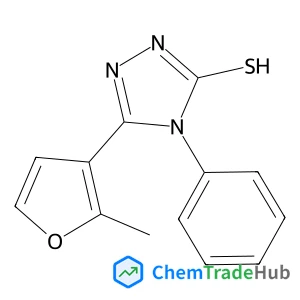
5-(2-Methyl-3-furyl)-4-phenyl-2,4-dihydro-3H-1,2,4-triazole-3-thione
CAS番号:
346464-59-3
分子式:
C13H11N3OS
おすすめサプライヤー



免責事項
このページに表示される学術雑誌情報は、参考および研究目的のみを目的としています。当社は雑誌出版社とは提携しておらず、投稿の取り扱いも行っておりません。出版に関するお問い合わせは、各雑誌出版社に直接ご連絡ください。
表示されている情報に誤りがある場合は、support@chemtradehub.com までご連絡ください。迅速に確認し、対応いたします。