












Single molecule charge transport: from a quantum mechanical to a classical description
文献情報
出版日
2010-12-13
DOI
10.1039/C0CP01432J
インパクトファクター
3.676
著者
Aleksey A. Kocherzhenko, Ferdinand C. Grozema, Laurens D. A. Siebbeles
原文を見る
要旨
This paper explores charge transport at the single molecule level. The conductive properties of both small organic molecules and conjugated polymers (molecular wires) are considered. In particular, the reasons for the transition from fully coherent to incoherent charge transport and the approaches that can be taken to describe this transition are addressed in some detail. The effects of molecular orbital symmetry, quantum interference, static disorder and molecular vibrations on charge transport are discussed. All of these effects must be taken into account (and may be used in a functional way) in the design of molecular electronic devices. An overview of the theoretical models employed when studying charge transport in small organic molecules and molecular wires is presented.
関連文献
Charge-reversible and pH-responsive biodegradable micelles and vesicles from linear-dendritic supramolecular amphiphiles for anticancer drug delivery
Hong Shen, Zuquan Weng
2017-10-27
Paper
DOI: 10.1039/C7PY01556A
Nano-porous structures via self-assembly of amphiphilic triblock copolymers: influence of solvent and molecular weight
S. Nehache, M. Semsarilar, A. Deratani, M. In, P. Dieudonné-George, J. Lai Kee Him, P. Bron, D. Quémener
2017-12-01
Paper
DOI: 10.1039/C7PY01853C
Nickel and palladium complexes with fluorinated alkyl substituted α-diimine ligands for living/controlled olefin polymerization
Robert Mundil, Anatolij Sokolohorskyj, Jan Hošek, Josef Cvačka, Ivana Císařová, Jaroslav Kvíčala, Jan Merna
2018-02-16
Paper
DOI: 10.1039/C8PY00201K
Luminescent solar concentrators based on PMMA films obtained from a red-emitting ATRP initiator
Riccardo Mori, Giuseppe Iasilli, Marco Lessi, Ana Belén Muñoz-García, Michele Pavone, Fabio Bellina, Andrea Pucci
2018-01-15
Paper
DOI: 10.1039/C7PY01933E
Self-stabilized, hydrophobic or PEGylated paclitaxel polymer prodrug nanoparticles for cancer therapy
Yinyin Bao, Elise Guégain, Julie Mougin, Julien Nicolas
2018-01-10
Paper
DOI: 10.1039/C7PY01918A
Synthesis of linear and star poly(ε-caprolactone) with controlled and high molecular weights via cyclic trimeric phosphazene base catalyzed ring-opening polymerization
Huaike Li, Na Zhao, Chuanli Ren, Shaofeng Liu, Zhibo Li
2017-11-13
Paper
DOI: 10.1039/C7PY01673E
Entry of nanoparticles into cells: the importance of nanoparticle properties
2017-12-18
Review Article
DOI: 10.1039/C7PY01603D
Correction: Increased hydrophobic block length of PTDMs promotes protein internalization
Coralie M. Backlund, Federica Sgolastra, Ronja Otter, Toshihide Takeuchi, Shiroh Futaki
2017-10-27
Correction
DOI: 10.1039/C7PY90169K
Synthesis of indocyanine green functionalized comblike poly(aspartic acid) derivatives for enhanced cancer cell ablation by targeting the endoplasmic reticulum
Jiaxun Wan, Luyan Sun, Pan Wu, Fang Wang, Jia Guo, Jianjun Cheng, Changchun Wang
2018-02-06
Paper
DOI: 10.1039/C7PY01994G
Covalently assembled polymer nanocapsules: a novel scaffold for light-harvesting
Xiaotong Fan, Ruizhen Tian, Shengda Liu, Shanpeng Qiao, Quan Luo, Tengfei Yan, Shuang Fu, Xin Zhang, Jiayun Xu, Junqiu Liu
2018-02-22
Communication
DOI: 10.1039/C7PY02068F
こちらもおすすめ
化合物よくある質問
2,3-スチオエポキシマドルを取り扱う際の実験室安全事項は何ですか?
取り扱いにはPPE(プロテクティブ・パーソナル・エイド)が必要で、防ぐ手袋と保護眼鏡を着用してください。ドラフトチャンバーの使用を推奨します。漏洩した場合は、適...
4267-80-52,3-Thioepoxy Madol
53981-25-22-Amino-6-fluorophen...
化合物よくある質問
BOC-S-3-アミニ-4-(4-メチオキシベンチル)-ブタン酸の代替品はありますか?
この化合物の代替品としては、BOC保護基を有さないアミノ酸やその他の保護基化合物が考えられます。また、メチオキシ基を有しない他の芳香族アミノ酸も代替品として挙げ...
126800-59-7(3S)-4-(4-Methoxyphe...
化合物よくある質問
Methyl 2-(chloromethyl)-3-nitrobenzoate(1218910-61-2)の代替品はありますか?
Methyl 2-(chloromethyl)-3-nitrobenzoate(1218910-61-2)の代替品としては、化学組成を変えることで効果を達成する...
1218910-61-2Methyl 2-(chlorometh...
化合物よくある質問
(2R)-2-アミノ-N-ベンジル-3-ヒドロキシプロパナミドを含む廃棄物はどのように処理すべきですか?
(2R)-2-アミノ-N-ベンジル-3-ヒドロキシプロパナミドを含む廃棄物は、適切な廃棄物管理ガイドラインに基づき処理する必要があります。まず、廃棄物を適切に収...
175481-39-7(2R)-2-amino-N-benzy...
化合物よくある質問
6,7-二氢-咪唑並[1,2-a]ピリドイン-8(5h)-酮はどのように合成されますか?
6,7-二氢-咪唑並[1,2-a]ピリドイン-8(5h)-酮は、2-ブロモフェニルアセトインとリン酸ハロゲン化物を反応させることで合成できます。この反応は高温で...
457949-09-66,7-Dihydroimidazo[1...
化合物よくある質問
エチル(3R)-3-ピロリジニル酢酸水和塩とは何ですか?
エチル(3R)-3-ピロリジニル酢酸水和塩は、CAS番号1332459-32-1の化合物で、(R)-乙基2-(ピロリジン-3-基)酢酸塩水和塩と呼ばれます。この...
1332459-32-1Ethyl (3R)-3-pyrroli...
化合物よくある質問
(2S)-{[(2-メチルエチルオキシ]カルボニル}アミノ)[2-(トリアフルオロメチルフェニル]エチカシック酸の物理化学的性質は何ですか?
(2S)-{[(2-メチルエチルオキシ]カルボニル}アミノ)[2-(トリアフルオロメチルフェニル]エチカシック酸のCAS番号は1203454-45-8です。この...
1203454-45-8(2S)-({[(2-Methyl-2-...
化合物よくある質問
2-ブロモ-1-(2-メチル-2-プロパニル)-4-ニトロベンゼンはどのように保存すればよいですか?
2-ブロモ-1-(2-メチル-2-プロパニル)-4-ニトロベンゼンは、直射日光を避けて暗所で、室温(約15℃〜25℃)、乾燥した場所に保存する必要があります。ま...
6310-17-42-Bromo-1-(2-methyl-...
化合物よくある質問
1-[(4-硝基フェニル)スルホニル]-1H-1,2,4-三唑の市場動向や研究トレンドはどうですか?
市場動向としては、1-[(4-硝基フェニル)スルホニル]-1H-1,2,4-三唑は主に農業用除草剤や合成化学製品の原料として利用されています。研究トレンドとして...
57777-84-11-[(4-Nitrophenyl)su...
掲載誌
Physical Chemistry Chemical Physics

CiteScore:
5.5
自己引用率:
10.3%
年間論文数:
3036
Physical Chemistry Chemical Physics (PCCP) is an international journal co-owned by 19 physical chemistry and physics societies from around the world. This journal publishes original, cutting-edge research in physical chemistry, chemical physics and biophysical chemistry. To be suitable for publication in PCCP, articles must include significant innovation and/or insight into physical chemistry; this is the most important criterion that reviewers and Editors will judge against when evaluating submissions. The journal has a broad scope and welcomes contributions spanning experiment, theory, computation and data science. Topical coverage includes spectroscopy, dynamics, kinetics, statistical mechanics, thermodynamics, electrochemistry, catalysis, surface science, quantum mechanics, quantum computing and machine learning. Interdisciplinary research areas such as polymers and soft matter, materials, nanoscience, energy, surfaces/interfaces, and biophysical chemistry are welcomed if they demonstrate significant innovation and/or insight into physical chemistry. Joined experimental/theoretical studies are particularly appreciated when complementary and based on up-to-date approaches.
おすすめ化合物
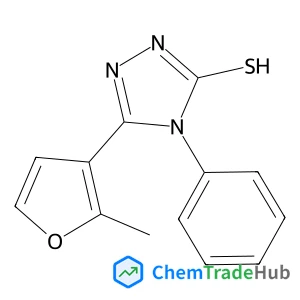
5-(2-Methyl-3-furyl)-4-phenyl-2,4-dihydro-3H-1,2,4-triazole-3-thione
CAS番号:
346464-59-3
分子式:
C13H11N3OS
おすすめサプライヤー




免責事項
このページに表示される学術雑誌情報は、参考および研究目的のみを目的としています。当社は雑誌出版社とは提携しておらず、投稿の取り扱いも行っておりません。出版に関するお問い合わせは、各雑誌出版社に直接ご連絡ください。
表示されている情報に誤りがある場合は、support@chemtradehub.com までご連絡ください。迅速に確認し、対応いたします。