












Potentiometric analysis of sialic acid with a flexible carbon cloth based on boronate affinity and molecularly imprinted polymers
文献情報
出版日
2019-09-27
DOI
10.1039/C9AN01600G
インパクトファクター
4.616
著者
Yanli Zhou, Huijie Huangfu, Jie Yang, Hui Dong, Lantao liu, Maotian Xu
原文を見る
要旨
An electrochemical platform was proposed for highly sensitive and selective analysis of sialic acid based on molecularly imprinted polymers (MIPs), which were electropolymerized with the monomer molecules of 3-aminophenylboronic acid (ABA) on a carbon cloth (CC) electrode in the presence of template molecules. The fabricated sensor, named the PABA/CC-based MIP electrode, could be used for the detection of sialic acid because the reversible and covalent boronic acid–diol binding was sensitive to the electrochemical potential of the prepared sensor. The utilization of a CC film as the substrate could improve the sensitivity due to its good electrical conductivity and large surface area. Under the optimized conditions, a good relationship between the change in potential and the concentration of sialic acid was obtained in the range from 40 μM to 440 μM with a detection limit of 0.5 μM. The resulting MIP sensor also displayed good selectivity, reproducibility and stability. Moreover, this sensor was successfully applied for the evaluation of the sialic acid level in infant formulas.
関連文献
Interface Schottky barrier in Hf2NT2/MSSe (T = F, O, OH; M = Mo, W) heterostructures
Tao Jing, Dongmei Liang, Jinxin Hao, Mingsen Deng, Shaohong Cai
2019-02-19
Paper
DOI: 10.1039/C9CP00028C
Coarse-grained molecular dynamics simulation of the interface behaviour and self-assembly of CTAB cationic surfactants
Sílvia Illa-Tuset, David C. Malaspina, Jordi Faraudo
2018-09-25
Paper
DOI: 10.1039/C8CP04505D
The role of solvation models on the computed absorption and emission spectra: the case of fireflies oxyluciferin
Cristina García-Iriepa, Madjid Zemmouche, Isabelle Navizet
2019-02-04
Paper
DOI: 10.1039/C8CP07352J
Bismuth oxysulfide film electrodes with giant incident photon-to-current conversion efficiency: the dynamics of properties with deposition time
Evgeny A. Bondarenko, Eugene A. Streltsov, Alexander V. Mazanik, Anatoly I. Kulak, Vytautas Grivickas, Patrik Ščajev, Ekaterina V. Skorb
2018-06-22
Paper
DOI: 10.1039/C8CP03225D
Role of suppressed oxygen vacancies in the BiFeO3 nanofiller to improve the polar phase and multifunctional performance of poly(vinylidene fluoride)
Abhishek Sasmal, Shrabanee Sen, P. Sujatha Devi
2019-02-21
Paper
DOI: 10.1039/C8CP07281G
Evidence of the O–Pd–O and Pd–O4 structure units as oxide seeds and their origin on Pd(211): revealing the mechanism of surface oxide formation
Xiran Cheng, Ziyun Wang, Yu Mao, P. Hu
2019-02-19
Paper
DOI: 10.1039/C8CP06224B
Unveiling the multifunctional roles of hitherto known capping ligand oleic acid as blue emitter and sensitizer in tuning the emission colour to white in red-emitting phosphors
S. Sekar, J. George Muller
2018-07-05
Paper
DOI: 10.1039/C8CP02954G
Tuning polaronic redox behavior in olivine phosphate
Yue Gu, Mouyi Weng, Gaofeng Teng, Hua Zeng, Jianshu Jie, Weiji Xiao, Jiaxin Zheng, Feng Pan
2019-01-31
Paper
DOI: 10.1039/C8CP06083E
こちらもおすすめ
化合物よくある質問
2-ブロモ-9,9-ジフェニル-9H-フルオレンの主な用途は何ですか?
2-溴-9,9-二苯基芴は、医薬品、工業材料、有機合成の研究分野で応用されます。特に、レーザー材料や機能性ポリマーの合成に使用されることがあります。また、蛍光色...
474918-32-62-Bromo-9,9-diphenyl...
化合物よくある質問
四氯化铱の市場動向や研究トレンドはどうですか?
四氯化铱の市場は研究開発分野で注目されており、特にナノ技術や金属有機框架(MOFs)の分野での需要が増加傾向にあります。価格は安定しており、中国や韓国での生産が...
207399-11-9Tetrachloroiridium h...
882-06-44-Nitrocinnamic acid
化合物よくある質問
1-(4-溴-3-氟苯基)-2-氯乙酮を含む廃棄物はどのように処理すべきですか?
1-(4-溴-3-氟苯基)-2-氯乙酮 (CAS番号: 1260857-14-4) の廃棄物は専門的な廃棄処理が必要です。まず、廃棄物は密閉された容器に収集し、...
1260857-14-41-(4-Bromo-3-fluorop...
化合物よくある質問
苦参酚Kとは何ですか?
苦参酚Kは、CAS番号101236-49-1を持つ化合物で、主に天然由来の生薬から抽出されます。この化合物は、抗炎症作用や抗癌作用を持つことが報告されています。
101236-49-1Kushenol K
化合物よくある質問
POTASSIUM (1-(TERTBUTOXYCARBONYL)AZETIDIN-3-YL)TRIFLUOROBORATE を含む廃棄物はどのように処理すべきですか?
POTASSIUM (1-(TERTBUTOXYCARBONYL)AZETIDIN-3-YL)TRIFLUOROBORATE を含む廃棄物は、まず安全なエント...
1430219-73-0Potassium (1-(tert-b...
化合物よくある質問
4-庚基-4’-联苯羧酸の市場動向や研究トレンドはどうですか?
4-庚基-4’-聯苯羧酸は、特殊化学品や合成化学の分野で用いられる化学物質ですが、市場動向としては、研究開発の進展とともに需要が増加しています。また、環境配慮型...
58573-94-74'-Heptyl-4-biphenyl...
化合物よくある質問
6-ブロモ-3-メトキシ-1-フェニル-1H-インドゾールを含む廃棄物はどのように処理すべきですか?
6-ブロモ-3-メトキシ-1-フェニル-1H-インドゾールを含む廃棄物は、適切な化学廃棄処理が必要です。通常、廃棄物は密閉容器に収集され、専門の廃棄処理業者に引...
1332527-03-36-Bromo-3-methoxy-1-...
化合物よくある質問
4,4-二甲基-2-吡咯烷酮はどの業界で使用されていますか?
4,4-二甲基-2-吡咯烷酮は医薬、ポリマー、センサー、半導体などの業界で広く使用されています。特に溶媒としての性能が高く評価されています。
66899-02-34,4-dimethylpyrrolid...
51312-42-6Sodium Phosphotungst...
掲載誌
Analyst

CiteScore:
7.8
自己引用率:
5.6%
年間論文数:
653
Analyst publishes analytical and bioanalytical research that reports premier fundamental discoveries and inventions, and the applications of those discoveries, unconfined by traditional discipline barriers.
おすすめ化合物
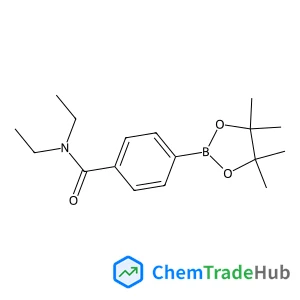
N,N-Diethyl-4-(4,4,5,5-tetramethyl-1,3,2-dioxaborolan-2-yl)benzamide
CAS番号:
325142-99-2
分子式:
C17H26BNO3
![6-Benzyl-4,5,6,7-tetrahydro-1H-pyrazolo[3,4-c]pyridin-3(2H)-one structure](https://static.chemtradehub.com/structs/909/909187-64-0-f54f.webp "6-Benzyl-4,5,6,7-tetrahydro-1H-pyrazolo[3,4-c]pyridin-3(2H)-one structure")
おすすめサプライヤー



免責事項
このページに表示される学術雑誌情報は、参考および研究目的のみを目的としています。当社は雑誌出版社とは提携しておらず、投稿の取り扱いも行っておりません。出版に関するお問い合わせは、各雑誌出版社に直接ご連絡ください。
表示されている情報に誤りがある場合は、support@chemtradehub.com までご連絡ください。迅速に確認し、対応いたします。