












A dual-mode fluorometric/colorimetric sensor for Cu2+ detection based on hybridized carbon dots and gold–silver core–shell nanoparticles
文献情報
出版日
2019-06-03
DOI
10.1039/C9AN00850K
インパクトファクター
4.616
著者
Yuqing Chen, Yawen Lian, Mengna Huang, Lin Wei, Lehui Xiao
原文を見る
要旨
A fluorometric and colorimetric dual mode sensing platform based on hybridized carbon dots (Cdots) and gold–silver core–shell nanoparticles (Au@Ag NPs) has been established for the sensitive detection of trace Cu2+ ions in aqueous solution. In this system, the fluorescence of Cdots was quenched by Au@Ag NPs due to the surface plasmon-enhanced energy transfer. Due to the fact that Cu2+ could accelerate the etching process of Au@Ag NPs in the presence of thiosulfate, the fluorescence of Cdots was recovered. The limit of detection (LOD) is 4.81 nM for fluorometric measurements and 3.85 nM for colorimetric measurements. The dynamic range from these two modes is 0.005–1 μM. Importantly, Cu2+ in solution can also be directly visualized by this sensor via evident color change from the solution. Therefore, this dual mode nanosensor has potential applications for the efficient detection of Cu2+ ions in aqueous samples with great selectivity and high sensitivity.
関連文献
Proton conduction in alkali metal ion-exchanged porous ionic crystals
Sayaka Uchida, Reina Hosono, Ryo Eguchi, Ryosuke Kawahara, Ryota Osuga, Junko N. Kondo, Mitsuhiro Hibino, Noritaka Mizuno
2017-09-06
Paper
DOI: 10.1039/C7CP04619G
Stochastic chiral symmetry breaking process besides the deterministic one
L. Silva-Dias, A. López-Castillo
2017-10-12
Paper
DOI: 10.1039/C7CP04674J
Quantum-state-selected integral cross sections for the charge transfer collision of O2+(a4Πu5/2,3/2,1/2,−1/2: v+ = 1–2; J+) [O2+(X2Πg3/2,1/2: v+ = 22–23; J+)] + Ar at center-of-mass collision energies of 0.05–10.00 eV
Bo Xiong, Yih-Chung Chang, Cheuk-Yiu Ng
2017-09-07
Paper
DOI: 10.1039/C7CP04886F
Understanding the role of co-catalysts on silicon photocathodes using intensity modulated photocurrent spectroscopy
James E. Thorne, Yanyan Zhao, Da He, Shizhao Fan, Srinivas Vanka, Zetian Mi, Dunwei Wang
2017-10-24
Paper
DOI: 10.1039/C7CP06533G
Interplay between the folding mechanism and binding modes in folding coupled to binding processes
2017-10-18
Communication
DOI: 10.1039/C7CP04748G
LK peptide side chain dynamics at interfaces are independent of secondary structure
Michael A. Donovan, Helmut Lutz, Yeneneh Y. Yimer, Jim Pfaendtner, Mischa Bonn
2017-10-09
Communication
DOI: 10.1039/C7CP05897G
Ni supported CdIn2S4 spongy-like spheres: a noble metal free high-performance sunlight driven photocatalyst for hydrogen production
Manh-Hiep Vu, Chinh-Chien Nguyen, M. Sakar, Trong-On Do
2017-10-17
Paper
DOI: 10.1039/C7CP06085H
Hydrogen evolution based on the electrons/protons stored on amorphous TiO2
Ling Zhang, Wenzhong Wang
2017-10-18
Communication
DOI: 10.1039/C7CP06067J
こちらもおすすめ
化合物よくある質問
環戊烷-1,3-二甲酸甲酯はどのように合成されますか?
環戊烷-1,3-二甲酸甲酯は、環戊烷と塩酸によるヒンデンブルク反応を経由して合成されます。この反応では、環戊烷が塩酸と作用し、1,3-ジカルボキシ基が導入されま...
2435-36-1Dimethyl 1,3-cyclope...
化合物よくある質問
4-メトキシ-1,2,3-スチアゼ-3,5-ジオンとは何ですか?
4-メトキシ-1,2,3-スチアゼ-3,5-ジオンは、CAS番号107843-77-6の化合物で、(E)-ベンジル3-(3,4-ジヒドロキシフェニル) acry...
107843-77-6(E)-Benzyl 3-(3,4-di...
化合物よくある質問
プロスタグランジンA2について「に適用される法規ガイドラインは何ですか?'
プロスタグランジンA2 (CAS番号: 41691-92-3) は、化学物質の安全管理に関する規制として、GHS (危険物質の国際的ハザード分類・ラベル付けシス...
41691-92-316,16-DIMETHYL PROST...
化合物よくある質問
4-アミノ-1-ナフタレン sulfonic 酸についての物理化学的性質は何ですか?
4-アミノ-1-ナフタレン sulfonic 酸のCAS番号は84-86-6です。この化合物は結晶性で、分子量は212.15 g/molです。アルコールや水など...
84-86-64-Amino-1-naphthalen...
化合物よくある質問
N-GlcNAc-生物素を取り扱う際の実験室安全事項は何ですか?
N-GlcNAc-生物素は吸収性があり、皮膚や目への接触を避けることが重要です。PPE(個体保護具)は使用し、ドラフトチャンバーは必要に応じて使用します。漏洩時...
1272755-69-72-Acetamido-2-deoxy-...
化合物よくある質問
3-アミノメチルフローラノピペリジン-1-カルボニル酸テルブチルエステルとは何ですか?
CAS番号1209781-11-2の3-アミノメチルフローラノピペリジン-1-カルボニル酸テルブチルエステルは、有機化合物の一種で、化学式はC10H17FNO3...
1209781-11-22-Methyl-2-propanyl ...
化合物よくある質問
6-溴-1-甲基-1H-ベンゾ[d][1,2,3]三氮唑はどのように合成されますか?
6- bromo-1-methyl-1H-benzotriazoleは、ブロモフリオリンと1-メチル-1H-ベンゾ[d][1,2,3]三氮唑の反応により合成され...
944718-32-56-Bromo-1-methyl-1H-...
化合物よくある質問
4-硫代尿苷はどのように合成されますか?
4-硫代尿苷は、尿素とD-リボシルヒドロキシアルデヒドを用いてスルホン化反応を経て合成されます。通常は塩酸ヒドロキシチオニルスルホン酸などの触媒を使用し、選択性...
6741-73-71-(4-thio-beta-D-rib...
化合物よくある質問
ブレインナトリユリックペプチド32ラットとは何ですか?
ブレインナトリユリックペプチド32ラット(CAS番号: 133448-20-1)は、心臓で作られるホルモンの一つで、心不全の診断や予後評価に使用されます。
133448-20-1Brain Natriuretic Pe...
化合物よくある質問
1-(3-氮杂啶)-4-羟基哌啶双盐酸盐の物理化学的性質は何ですか?
CAS番号810680-60-5の1-(3-氮杂啶)-4-羟基哌啶双盐酸盐は、白色の結晶性粉末である。分子量は360.84 g/molで、水に溶けやすい。反応活...
810680-60-51-(3-Azetidinyl)-4-p...
掲載誌
Analyst

CiteScore:
7.8
自己引用率:
5.6%
年間論文数:
653
Analyst publishes analytical and bioanalytical research that reports premier fundamental discoveries and inventions, and the applications of those discoveries, unconfined by traditional discipline barriers.
おすすめ化合物
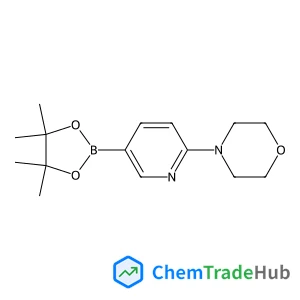
4-(5-(4,4,5,5-tetramethyl-1,3,2-dioxaborolan-2-yl)pyridin-2-yl)morpholine
CAS番号:
485799-04-0
分子式:
C15H23BN2O3
![N-[(9H-Fluoren-9-ylmethoxy)carbonyl]-beta-phenyl-L-phenylalanine structure](https://static.chemtradehub.com/structs/201/201484-50-6-c2fc.webp "N-[(9H-Fluoren-9-ylmethoxy)carbonyl]-beta-phenyl-L-phenylalanine structure")
おすすめサプライヤー







免責事項
このページに表示される学術雑誌情報は、参考および研究目的のみを目的としています。当社は雑誌出版社とは提携しておらず、投稿の取り扱いも行っておりません。出版に関するお問い合わせは、各雑誌出版社に直接ご連絡ください。
表示されている情報に誤りがある場合は、support@chemtradehub.com までご連絡ください。迅速に確認し、対応いたします。