












![2,4-Dichloro-6-isopropyl-5H-pyrrolo[3,4-d]pyrimidin-7(6H)-one structure](https://static.chemtradehub.com/structs/107/1079649-94-7-ad4a.webp "2,4-Dichloro-6-isopropyl-5H-pyrrolo[3,4-d]pyrimidin-7(6H)-one structure")
A novel turn-on fluorescent probe for selective sensing and imaging of glutathione in live cells and organisms
文献情報
出版日
2019-03-28
DOI
10.1039/C9AN00115H
インパクトファクター
4.616
著者
Xiaodong Zhang, Ziqian Wang, Zongwei Guo, Nianzhe He, Peng Liu, Dasha Xia, Xiufen Yan, Zhichao Zhang
原文を見る
要旨
We synthesized six 1-oxo-1H-phenalene-2,3-dicarbonitrile (OPD)-based probes with various leaving groups using an arylthioether linker and for the first time identified the probe O-NH2 capable of highly selective detection of glutathione over cysteine/homocysteine in vitro and in vivo based on an aromatic nuclear substitution reaction (SNAr) mechanism. The fluorescence of the probe O-NH2 was quenched because of the photoinduced electron transfer (PET) process, but switched on by a glutathione-triggered specific recognition reaction between the probe O-NH2 and glutathione. The recognition mechanism for glutathione was explored and verified by theoretical calculations and ESI-MS analysis. Using O-NH2 as the probe, the GSH fluorescence images were demonstrated in HeLa cells and the intracellular GSH levels in different imatinib-resistant K562 tumor cells were firstly determined. Further, O-NH2 was utilized to detect glutathione in D. magna and zebrafish embryos. The combined results indicate that O-NH2 can be applied as an effective tool for detecting glutathione in biological investigations.
関連文献
Chromium-catalyzed allylic defluorinative acylation of trifluoromethyl-substituted alkenes with acyl oxime esters
Hongzhang Shi, Haiyan Dong, Chuan Wang
2023-10-09
Research Article
DOI: 10.1039/D3QO01331F
Transition-metal catalyzed reactions of diazo compounds and N,N-dialkylnitrosoamines
Yuan Chen, Rui-jun Peng, Xue-jing Zhang, Ming Yan
2023-11-21
Research Article
DOI: 10.1039/D3QO01607B
Regio- and stereoselective divergent cross-coupling of alkynes and disubstituted alkenes via photoredox cobalt dual catalysis
Yan-Lin Li, Kun Cui, Zheng-Yang Gu, Hu He
2023-10-28
Research Article
DOI: 10.1039/D3QO01281F
Visualizing and characterizing excited states from time-dependent density functional theory
2023-12-12
Perspective
DOI: 10.1039/D3CP04226J
Straight-chain ω-amino-α,β-unsaturated carbonyl compounds: versatile synthons for the synthesis of nitrogen-containing heterocycles via organocatalytic reactions
Shuhui Li, Xiaoxuan Li, Hui Yao, Mengting Tan, Dan Xu, Nianyu Huang, Nengzhong Wang
2023-11-30
Review Article
DOI: 10.1039/D3QO01734F
A novel electrochemical flow-cell for operando XAS investigations in X-ray opaque supports
Guillaume Alizon, Andrea Zitolo, Andrea Di Cicco, Hélène Magnan, Emiliano Fonda
2024-01-08
Paper
DOI: 10.1039/D3CP04701F
Iron-catalyzed asymmetric Csp3–H/Csp3–H coupling: improving the chirality induction by mechanochemical liquid-assisted grinding
Tao Ying, Hong Chen, Keyu Xiang, Weike Su, Haijiao Xie, Jingbo Yu
2023-11-10
Research Article
DOI: 10.1039/D3QO01467C
Ideal two-dimensional quantum spin Hall insulators MgA2Te4 (A = Ga, In) with Rashba spin splitting and tunable properties
Xinlu Cheng
2024-01-03
Paper
DOI: 10.1039/D3CP04898E
Stereoselective synthesis of Δ(1)-pyrroline sulfonamides via a chiral aldehyde mediated cascade reaction
Wei Wen, Zhao-Pin Ai, Zhu-Lian Wu, Tian Cai, Qi-Xiang Guo
2023-11-15
Research Article
DOI: 10.1039/D3QO01675G
BX3-mediated borylation for the synthesis of organoboron compounds
2023-10-19
Review Article
DOI: 10.1039/D3QO01487H
こちらもおすすめ
化合物よくある質問
3-イチチルビフェニルはどのように合成されますか?
3-イチチルビフェニルは、ビフェニルとイチプロピオニトリルを回収率約90%で反応させて合成されます。触媒は通常、亜リチウムホウ素を用います。
5668-93-93-Ethylbiphenyl
化合物よくある質問
8-溴-5-三氟甲基喹啉はどのように合成されますか?
8-溴-5-三氟甲基喹啉は、5-トリフルオロメチル-2-メチル-1,3-ベンゼンジオールをブロモエタノールと反応させて生成します。この反応は塩基性条件下で行われ...
917251-92-48-Bromo-5-(trifluoro...
化合物よくある質問
ジメチル4-(4,4,5,5-テトラメチル-1,3,2-ドioxaborolan-2-基)-2,6-ピリジンジカルボイル酸フェニルアミニドの代替品はありますか?
ジメチル4-(4,4,5,5-テトラメチル-1,3,2-ドioxaborolan-2-基)-2,6-ピリジンジカルボイル酸フェニルアミニドの代替品としては、4-...
741709-66-0Dimethyl 4-(4,4,5,5-...
化合物よくある質問
N-(3,5-ヘキサクロロ-4-ピリドインイル)-8-メチオキシ-5-キノリンカーボン酸の市場動向や研究トレンドはどのようなものでしょうか?
N-(3,5-ヘキサクロロ-4-ピリドインイル)-8-メチオキシ-5-キノリンカーボン酸の市場動向は、主に産業用途での需要により影響を受けます。研究トレンドとし...
199871-63-1N-(3,5-Dichloro-4-py...
化合物よくある質問
イソステアロイルグリセリルは安全ですか?
イソステアロイルグリセリルは一般的に安全性が高いとされていますが、過度な使用や個人差により皮�owsん炎などの反応が起こる可能性があります。使用前に医師に相談す...
222723-55-92-[(5Z,8Z,11Z,14Z)-5...
化合物よくある質問
1-(二苯甲基)-3,3-二氟-氮杂环丁烷の市場動向や研究トレンドはどうですか?
1-(二苯甲基)-3,3-二氟-氮杂环丁烷の市場動向は、医薬品や合成化学の研究分野で注目を集めています。新興研究は、該当化合物の合成改良と生体内での作用メカニズ...
288315-02-61-Benzhydryl-3,3-dif...
化合物よくある質問
3-チオフェンスチオールの物理化学的性質は何ですか?
3-チオフェンスチオールのCAS番号は7774-73-4です。結晶性の白色粉末で、分子量は122.17です。この化合物は水に微溶解し、エタノールやジクロロメタン...
7774-73-43-Thiophenethiol
化合物よくある質問
2-Methyl-2-propanyl (2S)-2-(aminomethyl)-1-piperidinecarboxylateは安全ですか?
2-Methyl-2-propanyl (2S)-2-(aminomethyl)-1-piperidinecarboxylateは一定の安全性基準を満たしていま...
475105-35-22-Methyl-2-propanyl ...
化合物よくある質問
CAS番号1316822-90-8の化合物は安全ですか?
CAS番号1316822-90-8の化合物は安全性に関しては評価が不足していますが、一般的には生物学的に活性な物質であり、取り扱いには適切な安全防護措置が必要で...
1316822-90-8Gal beta(1-3)[Neu5Ac...
化合物よくある質問
Tert-butyl 2-(2-羟基乙基)哌嗪-1-羧酸はどのように保存すればよいですか?
Tert-butyl 2-(2-羟基乙基)哌嗪-1-羧酸は、冷暗所で保存し、直射日光から遠ざけてください。容器は密閉し、高湿度や高温を避けて保管してください。
517866-79-4Tert-butyl 2-(2-hydr...
掲載誌
Analyst

CiteScore:
7.8
自己引用率:
5.6%
年間論文数:
653
Analyst publishes analytical and bioanalytical research that reports premier fundamental discoveries and inventions, and the applications of those discoveries, unconfined by traditional discipline barriers.
おすすめ化合物
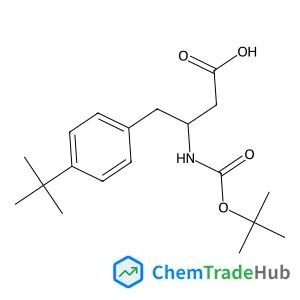
(S)-3-((tert-Butoxycarbonyl)amino)-4-(4-(tert-butyl)phenyl)butanoic acid
CAS番号:
403661-85-8
分子式:
C19H29NO4
![N-{3-[Benzyl(methyl)amino]propyl}-9-chloro-5,6,7,8-tetrahydro-2-acridinecarboxamide structure](https://static.chemtradehub.com/structs/142/1426944-49-1-1e4c.webp "N-{3-[Benzyl(methyl)amino]propyl}-9-chloro-5,6,7,8-tetrahydro-2-acridinecarboxamide structure")
おすすめサプライヤー


免責事項
このページに表示される学術雑誌情報は、参考および研究目的のみを目的としています。当社は雑誌出版社とは提携しておらず、投稿の取り扱いも行っておりません。出版に関するお問い合わせは、各雑誌出版社に直接ご連絡ください。
表示されている情報に誤りがある場合は、support@chemtradehub.com までご連絡ください。迅速に確認し、対応いたします。