


Understanding the effects of ionic liquids on a unimolecular substitution process: correlating solvent parameters with reaction outcome
文献情報
出版日
2018-12-15
DOI
10.1039/C8OB02460J
インパクトファクター
3.876
著者
Alyssa Gilbert, Ronald S. Haines, Jason B. Harper
原文を見る
要旨
A unimolecular substitution process was studied in five different ionic liquids, with systematic variation of either the cation or anion, in order to determine the factors leading to the increase in the rate constant for the process relative to acetonitrile. It was found that both components of the ionic liquid, and the proportion of the salt in the reaction mixture, affect the rate constant. Activation parameters determined for the process suggest that there is a balance between interactions of the components of the ionic liquid with both starting material and transition state. A correlation was found between the rate constant and a combination of Kamlet–Taft solvent parameters; with the polarisability of the solvent being the most significant factor. As this reaction proceeds through both unimolecular and bimolecular pathways, competition experiments determined that the unimolecular pathway for the reaction can be favoured using small amounts of ionic liquid in the reaction mixture, demonstrating the potential to control reaction mechanisms using ionic liquids.
おすすめジャーナル

Acta Metallurgica Sinica-English Letters

Journal of Asian Natural Products Research

Cellulose

Critical Reviews in Solid State and Materials Sciences

Herald of the Russian Academy of Sciences

Main Group Chemistry

Medicinal Chemistry Research

Topics in Catalysis

Chinese Journal of Chemistry

Bioorganic & Medicinal Chemistry Letters
関連文献
Adjustment of the bioresistivity by electron irradiation: self-assembled monolayers of oligo(ethyleneglycol)-terminated alkanethiols with embedded cleavable group
Simone Krakert, Nirmalya Ballav, Michael Zharnikov, Andreas Terfort
2009-11-16
Paper
DOI: 10.1039/B915036F
Density functional calculations of the electronic structure of 3-phenylamino-4-phenyl-1,2,4-triazole-5-thione
Ali Hussain Reshak, Dalibor Stys, S. Auluck, I. V. Kityk
2010-02-03
Paper
DOI: 10.1039/B920743K
Editorial Highlight: Molecules in confined spaces
Bert M. Weckhuysen
2009-03-24
Paper
DOI: 10.1039/B905015A
Computational identification of a metal organic framework for high selectivity membrane-based CO2/CH4 separations: Cu(hfipbb)(H2hfipbb)0.5
Taku Watanabe, Seda Keskin, Sankar Nair, David S. Sholl
2009-10-29
Communication
DOI: 10.1039/B918254N
A new route for local probing of inner interactions within a layered double hydroxide/benzene derivative hybrid material
S. Fleutot, J. C. Dupin, I. Baraille, C. Forano, G. Renaudin, F. Leroux, D. Gonbeau, H. Martinez
2009-03-02
Paper
DOI: 10.1039/B818730D
Supported vanadium oxide in heterogeneous catalysis: elucidating the structure–activity relationship with spectroscopy
Ilke Muylaert, Pascal Van Der Voort
2009-03-05
Perspective
DOI: 10.1039/B819808J
Para-hydrogen induced polarization in multi-spin systems studied at variable magnetic field
S. E. Korchak, H.-M. Vieth
2009-09-02
Paper
DOI: 10.1039/B914188J
Investigation of the nucleation and growth dynamics of FePt nanoparticles prepared via a high-temperature synthesis route employing PtCl2 as platinum precursor
Hauke Heller, Kirsten Ahrenstorf, Jose A. C. Broekaert, Horst Weller
2009-03-19
Paper
DOI: 10.1039/B822306H
Impact of vibrational excitation on the kinetics of a nascent ketene
Thomas Schmierer, Wolfgang J. Schreier, Florian O. Koller, Tobias E. Schrader
2009-11-05
Paper
DOI: 10.1039/B915451E
こちらもおすすめ
化合物よくある質問
2-氟-4-イオドベンzo酸エチルエステルを取り扱う際の実験室安全事項は何ですか?
2-氟-4-イオドベンzo酸エチルエステルは有機溶媒を用いた反応であり、ドラフトチャンバーでの操作が必要です。漏洩時にはSDS参照の安全措置を講じ、PPE(防護...
205750-82-9Benzoic acid, 2-fluo...
化合物よくある質問
血根碱の主な用途は何ですか?
血根碱は主に医薬分野で利用され、抗炎症や抗がん剤としての潜在的な効果が研究されています。また、化学研究や薬物開発において、新しい薬剤設計の参考となる化合物として...
2447-54-313-Methyl[1,3]benzod...
化合物よくある質問
Methyl 3-methoxythiophene-2-carboxylateの主な用途は何ですか?
Methyl 3-メトキシスチフェン-2-カルボン酸メチルエステルは、薬品合成、染料製造、以及合成中間体としての用途が広がっています。
62353-75-7Methyl 3-methoxythio...
化合物よくある質問
丹磺酰-L-亮氨酸はどのように保存すればよいですか?
丹磺酰-L-亮氨酸は乾燥した場所で、直射日光から保護し、低温(室温以下)で保存してください。密閉容器に入れて保管することをおすすめします。
1100-22-7N-{[5-(Dimethylamino...
化合物よくある質問
5-(苄氧基)ピラミジン-4-アミンの代替品はありますか?
5-(苄氧基)ピラミジン-4-アミンの代替品として、6-メトキシピラミジンや5-フェニルピラミジンなどが挙げられます。これらの化合物は、5-(苄氧基)ピラミジン...
92289-50-45-benzyloxypyrimidin...
化合物よくある質問
8-ヒドロキシノルデコペントアセートの物理化学的性質は何ですか?
8-ヒドロキシノルデコペントアセートはCAS番号84807-87-4の化合物で、分子量は750.02 uです。これは油溶性で、水に溶けにくい特徴があります。反応...
84807-87-4(5Z,8Z,11Z,13E,15S)-...
化合物よくある質問
tert-ブチル(エス)-1-ヒドロキシペンタ-4-エン-2-イルカルバamateの主な用途は何ですか?
tert-ブチル(エス)-1-ヒドロキシペンタ-4-エン-2-イルカルバamateは主に医薬品の合成材料や分析化学の試薬として使用されます。
116613-81-12-Methyl-2-propanyl ...
化合物よくある質問
ブコール-L-2-フローヨルブリンについて適切な法規ガイドラインは何ですか?
ブコール-L-2-フローヨルブリン(CAS番号: 1196107-73-9)は、GHS(グローバルハザードアサessmentシステム)に基づく危害分類と表示が求...
1196107-73-92-Bromo-13,13-dimeth...
化合物よくある質問
6-ブロモ-N-環丙基-2-ピリジニニメタンの市場動向や研究トレンドはどうですか
6-ブロモ-N-環丙基-2-ピリジニニメタンは、薬理学研究や合成化学に使用される化合物であり、特に抗ウイルス薬や抗がん薬の開発に注目されています。市場では、薬物...
959237-20-86-Bromo-N-cyclopropy...
化合物よくある質問
RS-AMPÀはどのように保存すればよいですか?
RS-AMPÀは、遮光容器に保存し、室温(15〜25℃)で保管することが推奨されます。高湿や熱は物質を劣化させるため、湿度は50%以下に保つことが重要です。また...
74341-63-2(RS)-AMPA
掲載誌
Organic & Biomolecular Chemistry

CiteScore:
3.4
自己引用率:
10.3%
年間論文数:
1041
Organic & Biomolecular Chemistry (OBC) publishes original and high impact research and reviews in organic chemistry. We welcome research that shows new or significantly improved protocols or methodologies in total synthesis, synthetic methodology or physical and theoretical organic chemistry as well as research that shows a significant advance in the organic chemistry or molecular design aspects of chemical biology, catalysis, supramolecular and macromolecular chemistry, theoretical chemistry, mechanism-oriented physical organic chemistry, medicinal chemistry or natural products. Articles published in the journal should report new work which makes a highly-significant impact in the field. Routine and incremental work is generally not suitable for publication in the journal. More details about key areas of our scope are below. In all cases authors should include in their article clear rationale for why their research has been carried out.
おすすめ化合物
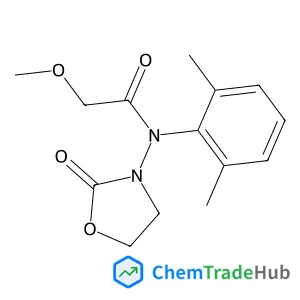
N-(2,6-Dimethylphenyl)-2-methoxy-N-(2-oxo-1,3-oxazolidin-3-yl)acetamide
CAS番号:
77732-09-3
分子式:
C14H18N2O4
おすすめサプライヤー






免責事項
このページに表示される学術雑誌情報は、参考および研究目的のみを目的としています。当社は雑誌出版社とは提携しておらず、投稿の取り扱いも行っておりません。出版に関するお問い合わせは、各雑誌出版社に直接ご連絡ください。
表示されている情報に誤りがある場合は、support@chemtradehub.com までご連絡ください。迅速に確認し、対応いたします。