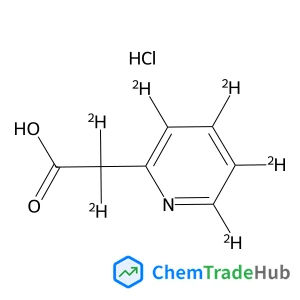
2,2-dideuterio-2-(3,4,5,6-tetradeuterio-2-pyridyl)acetic acid;hydrochloride
CAS番号:
1329799-67-8
分子式:
C7H2ClD6NO2
Lan Hu, Yan Zhao
A difficult challenge in synthetic enzymes is the creation of substrate-selective active sites with accurately positioned catalytic groups. Covalent molecular imprinting in cross-linked micelles afforded such active sites in protein-sized, water-soluble nanoparticle catalysts. Our method allowed a systematic tuning of the distance of the catalytic group to the bound substrate. The catalysts displayed enzyme-like kinetics and easily distinguished substrates with subtle structural differences.

Journal of Catalysis

Organic Preparations and Procedures International

Journal of Physics and Chemistry of Solids

Fibre Chemistry

Helvetica Chimica Acta

Pharmacological Reviews

Molecular Pharmacology

Proceedings of the National Academy of Sciences of the United States of America

Science

European Journal of Wood and Wood Products
Sergi Ruiz-Barragan, Saskia Körning, Dominik Marx
DOI: 10.1039/D0CP00916D
Zhefu Li, Gregory A. Voth
DOI: 10.1039/D0CP00378F
Katherine McCullough, Travis Williams, Kathleen Mingle, Pooyan Jamshidi, Jochen Lauterbach
DOI: 10.1039/D0CP00972E
Fabrizio Creazzo, Sana Bougueroua, Alessandra Serva, Jiri Sponer, Franz Saija, Marie-Pierre Gaigeot
DOI: 10.1039/C9CP06970D
Patrick R. Nawrocki, Nicolaj Kofod, Mikkel Juelsholt, Kirsten M. Ø. Jensen, Thomas Just Sørensen
DOI: 10.1039/D0CP00989J
Nur Amirah Jamaluddin, Suriani Abu Bakar, Tretya Ardyani, Masanobu Sagisaka, Shota Suhara, Mohamad Hafiz Mamat, Mohd Khairul Ahmad, Stephen M. King, Sarah E. Rogers, Julian Eastoe
DOI: 10.1039/D0CP01243B
Jyoti Rani, Vratta Grover, Swati Dhamija, Hatem M. Titi
DOI: 10.1039/D0CP00351D
Naciye Esma Tirtom, Yang Hsu, Hung-Wen Li
DOI: 10.1039/D0CP01061H
Quynh L. D. Nguyen, William K. Peters, Ryan C. Fortenberry
DOI: 10.1039/D0CP01835J
CAS番号163217-74-1の「邻羟基阿托伐他汀内酯标准品」は、GHS分類では危険物に分類されず、主にREACH規則とFDA/EPAの管理対象となります。R...
メチル(3R)-3-アミノ-2,3-ジヒドロ-1-ベンゾファンラニン-5-カルボイル酸塩塩酸塩は、医薬品や合成化学の研究に広く用いられます。また、特定の薬物の前...
トランス-4-メチルピロリジン-3-オール塩酸塩は、4-メチルピロリジンの塩酸塩化によって合成されます。一般的な合成方法では、4-メチルピロリジンを塩酸に加えて...
硫雜環丁烷-1,1-二氧化物は安全ではありません。毒性は報告されていませんが、高温下で分解し、可燃性があるため、高圧ガスは注意が必要です。密閉した容器で保管し、...
9-ヒドロキシエリプチシネ塩酸塩は、エリプチシネから塩酸を添加することで合成されます。選択性は高いですが、収率は約70%です。
5-塩素-2-(メチルアミノ)フェニル-(2-塩素フェニル)メタン酮のCAS番号は5621-86-3です。この化合物は白色の結晶性粉末で、分子量は415.03で...
1-[2-(4-甲氧基-苯氧基)-乙基]-哌嗪は、直射日光を避けて暗所に、室温(15-25℃)で保管し、密閉容器に入れることで安定性を保つことができます。
2-[3-(4-甲氧基フェニル)プロピル]-4,4,5,5-四メチル-1,3,2-ドイボロロールアンは、医薬品の合成、有機合成化学、および新材料の研究で使用され...

Organic & Biomolecular Chemistry (OBC) publishes original and high impact research and reviews in organic chemistry. We welcome research that shows new or significantly improved protocols or methodologies in total synthesis, synthetic methodology or physical and theoretical organic chemistry as well as research that shows a significant advance in the organic chemistry or molecular design aspects of chemical biology, catalysis, supramolecular and macromolecular chemistry, theoretical chemistry, mechanism-oriented physical organic chemistry, medicinal chemistry or natural products. Articles published in the journal should report new work which makes a highly-significant impact in the field. Routine and incremental work is generally not suitable for publication in the journal. More details about key areas of our scope are below. In all cases authors should include in their article clear rationale for why their research has been carried out.