












Palladium catalyzed stereocontrolled synthesis of C-aryl glycosides using glycals and arenediazonium salts at room temperature‡
文献情報
出版日
2018-06-28
DOI
10.1039/C8OB01393D
インパクトファクター
3.876
著者
Adesh Kumar Singh, Jeyakumar Kandasamy
原文を見る
要旨
A stereocontrolled synthesis of aryl-C-glycosides was achieved using glycals and aryldiazonium salts in the presence of palladium acetate. A wide range of glycals including D-glucal, D-galactal, L-rhamnal, D-xylal and D-ribal underwent C-arylation at the anomeric carbon in the presence of different aryldiazonium tetrafluoroborates and gave synthetically useful 2,3-deoxy-3-keto-α-aryl-C-glycosides in good to excellent yields. Broad substrate scope, simple operation and room temperature reactions make this protocol very attractive in organic synthesis.
関連文献
Stereoselective self-assembly of atropoisomeric Pd(ii) metallocycles induced by an aromatic guest
Dolores Abella, Víctor Blanco, Elena Pía, Marcos Chas, Carlos Platas-Iglesias, Carlos Peinador, José M. Quintela
2008-04-18
Communication
DOI: 10.1039/B802213E
In situ investigation of the oxidative addition in homogeneous Pd catalysts by synchronised time resolved UV-Vis/EXAFS
Gemma Guilera, Mark A. Newton, Charlene Polli, Sakura Pascarelli, Meritxell Guinó, King Kuog (Mimi) Hii
2006-09-04
Communication
DOI: 10.1039/B606772G
Photophysical and photosensitizing properties of brominated porphycenes
Hisashi Shimakoshi, Tatsushi Baba, Yusuke Iseki, Isao Aritome, Ayataka Endo, Chihaya Adachi, Yoshio Hisaeda
2008-04-18
Communication
DOI: 10.1039/B802730G
A versatile protocol for Stille–Migita cross coupling reactions‡
Alois Fürstner, Jacques-Alexis Funel, Martin Tremblay, Laure C. Bouchez, Cristina Nevado, Mario Waser, Jens Ackerstaff, Christopher C. Stimson
2008-06-02
Communication
DOI: 10.1039/B805299A
Structurally-defined potassium-mediated regioselective zincation of amino- and alkoxy-substituted pyridines
Ben Conway, David V. Graham, Eva Hevia, Alan R. Kennedy, Jan Klett, Robert E. Mulvey
2008-05-16
Communication
DOI: 10.1039/B805606D
Synthesis of propargylic fluorides from allenylsilanes
Laurence Carroll, Mª Carmen Pacheco, Ludivine Garcia, Véronique Gouverneur
2006-08-23
Communication
DOI: 10.1039/B610013A
Large mixed metal nitride clusters encapsulated in a small cage: the confinement of the C68-based clusterfullerenes
Lothar Dunsch
2008-04-18
Communication
DOI: 10.1039/B803200A
Azacalix[4]arene cation radicals: spin-delocalised doublet- and triplet-ground states observed in the macrocyclic m-phenylene system connected with nitrogen atoms
Koichi Ishibashi, Hirohito Tsue, Naoko Sakai, Satoshi Tokita, Kazuhiro Matsui, Jun Yamauchi, Rui Tamura
2008-04-11
Communication
DOI: 10.1039/B801127C
Microwave-assisted catalytic allylation of aldehydes promoted by a mesoporous silica-supported BINOL ligand in solid media
Guohua Liu, Yan Gao, Xiaoquan Lu, Mouming Liu, Fang Zhang, Hexing Li
2008-04-29
Communication
DOI: 10.1039/B803111H
こちらもおすすめ
28770-01-62-(2-Isopropyl-1,3-o...
化合物よくある質問
「邻羟基阿托伐他汀内酯标准品」に適用される法規ガイドelinesは何ですか?
CAS番号163217-74-1の「邻羟基阿托伐他汀内酯标准品」は、GHS分類では危険物に分類されず、主にREACH規則とFDA/EPAの管理対象となります。R...
163217-74-1ortho-Hydroxy Atorva...
化合物よくある質問
メチル(3R)-3-アミノ-2,3-ジヒドロ-1-ベンゾファンラニン-5-カルボイル酸塩塩酸塩の主な用途は何ですか?
メチル(3R)-3-アミノ-2,3-ジヒドロ-1-ベンゾファンラニン-5-カルボイル酸塩塩酸塩は、医薬品や合成化学の研究に広く用いられます。また、特定の薬物の前...
2241594-15-8Methyl (3R)-3-amino-...
化合物よくある質問
トランス-4-メチルピロリジン-3-オール塩酸塩はどのように合成されますか?
トランス-4-メチルピロリジン-3-オール塩酸塩は、4-メチルピロリジンの塩酸塩化によって合成されます。一般的な合成方法では、4-メチルピロリジンを塩酸に加えて...
265108-42-7trans-4-Methylpyrrol...
化合物よくある質問
硫雜環丁烷-1,1-二氧化物は安全ですか?
硫雜環丁烷-1,1-二氧化物は安全ではありません。毒性は報告されていませんが、高温下で分解し、可燃性があるため、高圧ガスは注意が必要です。密閉した容器で保管し、...
5687-92-3Thietane 1,1-dioxide
6054-10-02H, 8H-Benzo[1,2-b
化合物よくある質問
9-ヒドロキシエリプチシネ塩酸塩はどのように合成されますか?
9-ヒドロキシエリプチシネ塩酸塩は、エリプチシネから塩酸を添加することで合成されます。選択性は高いですが、収率は約70%です。
52238-35-49-Hydroxyellipticine...
化合物よくある質問
5-塩素-2-(メチルアミノ)フェニル-(2-塩素フェニル)メタン酮の物理化学的性質は何ですか?
5-塩素-2-(メチルアミノ)フェニル-(2-塩素フェニル)メタン酮のCAS番号は5621-86-3です。この化合物は白色の結晶性粉末で、分子量は415.03で...
5621-86-3[5-Chloro-2-(methyla...
化合物よくある質問
1-[2-(4-甲氧基-苯氧基)-乙基]-哌嗪はどのように保存すればよいですか?
1-[2-(4-甲氧基-苯氧基)-乙基]-哌嗪は、直射日光を避けて暗所に、室温(15-25℃)で保管し、密閉容器に入れることで安定性を保つことができます。
117132-44-21-[2-(4-Methoxy-phen...
化合物よくある質問
2-[3-(4-甲氧基フェニル)プロピル]-4,4,5,5-四メチル-1,3,2-ドイボロロールアンの主な用途は何ですか?
2-[3-(4-甲氧基フェニル)プロピル]-4,4,5,5-四メチル-1,3,2-ドイボロロールアンは、医薬品の合成、有機合成化学、および新材料の研究で使用され...
1073371-72-82-[3-(4-Methoxypheny...
掲載誌
Organic & Biomolecular Chemistry

CiteScore:
3.4
自己引用率:
10.3%
年間論文数:
1041
Organic & Biomolecular Chemistry (OBC) publishes original and high impact research and reviews in organic chemistry. We welcome research that shows new or significantly improved protocols or methodologies in total synthesis, synthetic methodology or physical and theoretical organic chemistry as well as research that shows a significant advance in the organic chemistry or molecular design aspects of chemical biology, catalysis, supramolecular and macromolecular chemistry, theoretical chemistry, mechanism-oriented physical organic chemistry, medicinal chemistry or natural products. Articles published in the journal should report new work which makes a highly-significant impact in the field. Routine and incremental work is generally not suitable for publication in the journal. More details about key areas of our scope are below. In all cases authors should include in their article clear rationale for why their research has been carried out.
おすすめ化合物
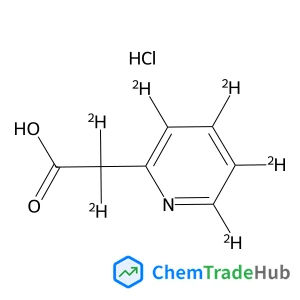
2,2-dideuterio-2-(3,4,5,6-tetradeuterio-2-pyridyl)acetic acid;hydrochloride
CAS番号:
1329799-67-8
分子式:
C7H2ClD6NO2
おすすめサプライヤー






免責事項
このページに表示される学術雑誌情報は、参考および研究目的のみを目的としています。当社は雑誌出版社とは提携しておらず、投稿の取り扱いも行っておりません。出版に関するお問い合わせは、各雑誌出版社に直接ご連絡ください。
表示されている情報に誤りがある場合は、support@chemtradehub.com までご連絡ください。迅速に確認し、対応いたします。