












Palladium mediated deallylation in fully aqueous conditions for native chemical ligation at aspartic and glutamic acid sites
文献情報
出版日
2018-05-07
DOI
10.1039/C8OB00890F
インパクトファクター
3.876
著者
Muhammad Jbara, Emad Eid, Ashraf Brik
原文を見る
要旨
An efficient native chemical ligation approach at Asp and Glu sites is reported applying a hydrazide precursor, as a peptide thioester, and allyl protection at the side chain of Asp and Glu. The allyl protection was efficiently removed, after the ligation step, using the water-soluble palladium complex [Pd(allyl)Cl]2 and glutathione within a few minutes under fully aqueous conditions.
おすすめジャーナル
関連文献
Cocatalyst-controlled divergent cascade cycloaddition reaction of arylalkynols and dioxopyrrolidienes: access to spiroketals and oxa-bridged eight-membered cyclic ethers
Hongkai Wang, Tianlong Zeng, Xinhong Li, Songmeng Wang, Weiguo Xiao, Lingyan Liu, Weixing Chang
2020-05-21
Research Article
DOI: 10.1039/D0QO00464B
Palladium-catalyzed cross-coupling of (hetero)aryl or alkenyl sulfonates with aryl titanium as the multi-functional reagent
2020-03-03
Research Article
DOI: 10.1039/C9QO01537J
Palladium-catalyzed enantioselective [5 + 4] annulation of ortho-quinone methides and vinylethylene carbonates
Chao Xia, Dong-Chao Wang, Gui-Rong Qu
2020-05-08
Research Article
DOI: 10.1039/D0QO00128G
A semipinacol rearrangement of vinylogous α-ketol cocatalyzed by a cinchona-based primary amine and N-Boc-phenylglycines: mechanisms, roles of catalysts and the origin of enantioselectivity
Chao-Xian Yan, Fang-Ling Yang, Ka Lu, Xing Yang, Pan-Pan Zhou, Xiangfeng Shao
2020-06-05
Research Article
DOI: 10.1039/D0QO00506A
Radical SAM-dependent adenosylation catalyzed by l-tyrosine lyases
Yujie Wu, Runze Wu, Dhanaraju Mandalapu, Xinjian Ji, Tuo Chen, Wei Ding, Qi Zhang
2018-12-06
Communication
DOI: 10.1039/C8OB02906G
Aromatization-driven deconstruction/refunctionalization of unstrained rings
Fangzhi Hu, Lubin Xu
2020-06-01
Highlight
DOI: 10.1039/D0QO00344A
Ag2O-catalysed nucleophilic isocyanation: selective formation of less-stable benzylic isonitriles
Taiga Yurino, Yuji Tange, Ryutaro Tani, Takeshi Ohkuma
2020-04-27
Research Article
DOI: 10.1039/D0QO00336K
Bicyclic acetals: biological relevance, scaffold analysis, and applications in diversity-oriented synthesis
Elena Lenci, Fernanda I. Saldívar-Gonzalez, José L. Medina-Franco
2018-12-19
Review Article
DOI: 10.1039/C8OB02808G
こちらもおすすめ
化合物よくある質問
環戊烷-1,3-二甲酸甲酯はどのように合成されますか?
環戊烷-1,3-二甲酸甲酯は、環戊烷と塩酸によるヒンデンブルク反応を経由して合成されます。この反応では、環戊烷が塩酸と作用し、1,3-ジカルボキシ基が導入されま...
2435-36-1Dimethyl 1,3-cyclope...
化合物よくある質問
4-メトキシ-1,2,3-スチアゼ-3,5-ジオンとは何ですか?
4-メトキシ-1,2,3-スチアゼ-3,5-ジオンは、CAS番号107843-77-6の化合物で、(E)-ベンジル3-(3,4-ジヒドロキシフェニル) acry...
107843-77-6(E)-Benzyl 3-(3,4-di...
化合物よくある質問
プロスタグランジンA2について「に適用される法規ガイドラインは何ですか?'
プロスタグランジンA2 (CAS番号: 41691-92-3) は、化学物質の安全管理に関する規制として、GHS (危険物質の国際的ハザード分類・ラベル付けシス...
41691-92-316,16-DIMETHYL PROST...
化合物よくある質問
4-アミノ-1-ナフタレン sulfonic 酸についての物理化学的性質は何ですか?
4-アミノ-1-ナフタレン sulfonic 酸のCAS番号は84-86-6です。この化合物は結晶性で、分子量は212.15 g/molです。アルコールや水など...
84-86-64-Amino-1-naphthalen...
化合物よくある質問
N-GlcNAc-生物素を取り扱う際の実験室安全事項は何ですか?
N-GlcNAc-生物素は吸収性があり、皮膚や目への接触を避けることが重要です。PPE(個体保護具)は使用し、ドラフトチャンバーは必要に応じて使用します。漏洩時...
1272755-69-72-Acetamido-2-deoxy-...
化合物よくある質問
3-アミノメチルフローラノピペリジン-1-カルボニル酸テルブチルエステルとは何ですか?
CAS番号1209781-11-2の3-アミノメチルフローラノピペリジン-1-カルボニル酸テルブチルエステルは、有機化合物の一種で、化学式はC10H17FNO3...
1209781-11-22-Methyl-2-propanyl ...
化合物よくある質問
6-溴-1-甲基-1H-ベンゾ[d][1,2,3]三氮唑はどのように合成されますか?
6- bromo-1-methyl-1H-benzotriazoleは、ブロモフリオリンと1-メチル-1H-ベンゾ[d][1,2,3]三氮唑の反応により合成され...
944718-32-56-Bromo-1-methyl-1H-...
化合物よくある質問
4-硫代尿苷はどのように合成されますか?
4-硫代尿苷は、尿素とD-リボシルヒドロキシアルデヒドを用いてスルホン化反応を経て合成されます。通常は塩酸ヒドロキシチオニルスルホン酸などの触媒を使用し、選択性...
6741-73-71-(4-thio-beta-D-rib...
化合物よくある質問
ブレインナトリユリックペプチド32ラットとは何ですか?
ブレインナトリユリックペプチド32ラット(CAS番号: 133448-20-1)は、心臓で作られるホルモンの一つで、心不全の診断や予後評価に使用されます。
133448-20-1Brain Natriuretic Pe...
化合物よくある質問
1-(3-氮杂啶)-4-羟基哌啶双盐酸盐の物理化学的性質は何ですか?
CAS番号810680-60-5の1-(3-氮杂啶)-4-羟基哌啶双盐酸盐は、白色の結晶性粉末である。分子量は360.84 g/molで、水に溶けやすい。反応活...
810680-60-51-(3-Azetidinyl)-4-p...
掲載誌
Organic & Biomolecular Chemistry

CiteScore:
3.4
自己引用率:
10.3%
年間論文数:
1041
Organic & Biomolecular Chemistry (OBC) publishes original and high impact research and reviews in organic chemistry. We welcome research that shows new or significantly improved protocols or methodologies in total synthesis, synthetic methodology or physical and theoretical organic chemistry as well as research that shows a significant advance in the organic chemistry or molecular design aspects of chemical biology, catalysis, supramolecular and macromolecular chemistry, theoretical chemistry, mechanism-oriented physical organic chemistry, medicinal chemistry or natural products. Articles published in the journal should report new work which makes a highly-significant impact in the field. Routine and incremental work is generally not suitable for publication in the journal. More details about key areas of our scope are below. In all cases authors should include in their article clear rationale for why their research has been carried out.
おすすめ化合物
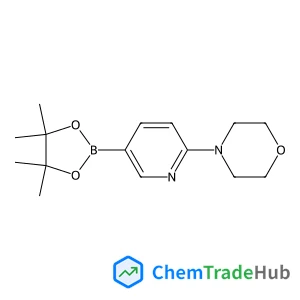
4-(5-(4,4,5,5-tetramethyl-1,3,2-dioxaborolan-2-yl)pyridin-2-yl)morpholine
CAS番号:
485799-04-0
分子式:
C15H23BN2O3
おすすめサプライヤー




免責事項
このページに表示される学術雑誌情報は、参考および研究目的のみを目的としています。当社は雑誌出版社とは提携しておらず、投稿の取り扱いも行っておりません。出版に関するお問い合わせは、各雑誌出版社に直接ご連絡ください。
表示されている情報に誤りがある場合は、support@chemtradehub.com までご連絡ください。迅速に確認し、対応いたします。