











Design and characterization of novel polymorphs of single-layered tin-sulfide for direction-dependent thermoelectric applications using first-principles approaches
文献情報
出版日
2019-01-28
DOI
10.1039/C8CP07645F
インパクトファクター
3.676
著者
Bakhtiar Ul Haq, S. AlFaify, A. Laref
原文を見る
要旨
Advanced computational approaches have made the design and characterization of novel two-dimensional (2D) materials possible for applications in cutting-edge technologies. In this work, we designed five polymorphs of 2D tin sulfide (namely, α-SnS, β-SnS, γ-SnS, δ-SnS, and ε-SnS) and explored their potential for thermoelectric applications using density functional theory-based computational approaches. Investigations of the energetic stability showed that the generated monolayers were as stable as parent α-SnS and exhibited cohesive and formation energies comparable to those of other stable 2D materials. These monolayers demonstrated high structural anisotropy (except β-SnS), which resulted in interesting features in the effective mass of the charge carriers and the subsequent thermoelectric properties. The in-plane anisotropy yielded different effective masses of charge carriers along the 100- and 010-directions. The x- and y-components of the electrical conductivity tensors were accordingly enhanced by the p-type doping and n-type doping, respectively. We estimated the maximum thermoelectric power factors along the x- and y-axes and the corresponding optimal doping levels were recognized; this suggested that the thermoelectric performance of these monolayers along the x-direction can be improved by p-type doping and that along the y-direction can be improved by n-type doping. Moreover, the thermoelectric figures of merit of the SnS monolayers approached a benchmark value of unity at room temperature. Our results suggested that these novel polymorphs of 2D SnS are promising materials for applications in direction-dependent thermoelectric devices. The present study can provide valuable guidance for generating low-cost and non-toxic polymorphs of other layered-structure materials.
関連文献
Cu-based catalyst designs in CO2 electroreduction: precise modulation of reaction intermediates for high-value chemical generation
Liangyiqun Xie, Yujing Jiang, Wenlei Zhu, Shichao Ding, Yang Zhou, Jun-Jie Zhu
2023-10-16
Review Article
DOI: 10.1039/D3SC04353C
Plasmon-mediated dehydrogenation of the aromatic methyl group and benzyl radical formation
Govinda Ghimire, Alexander M. Mebel, Shuai Chang
2023-11-28
Edge Article
DOI: 10.1039/D3SC05847F
(C5H6.16N2Cl0.84)(IO2Cl2): a birefringent crystal featuring unprecedented (IO2Cl2)− anions and π-conjugated organic cations
Chun-Li Hu
2023-11-27
Edge Article
DOI: 10.1039/D3SC05770D
Using waste to treat waste: facile synthesis of hollow carbon nanospheres from lignin for water decontamination
Xiang Liu, Zixuan Hao, Chen Fang, Kun Pang, Jiaying Yan, Yingping Huang, Di Huang
2023-11-27
Edge Article
DOI: 10.1039/D3SC05275C
O–H bond activation of β,γ-unsaturated oximes via hydrogen atom transfer (HAT) and photoredox dual catalysis
Chen Zhu, Xiangyu Chen, Huifeng Yue, Tengfei Ji, Yiqiao Ma, Yuanyuan Cao, Rajesh Kancherla, Magnus Rueping
2023-11-30
Edge Article
DOI: 10.1039/D3SC04410F
Supramolecular “baking powder”: a hexameric halogen-bonded phosphonium salt cage encapsulates and functionalises small-molecule carbonyl compounds
Hatem M. Titi, Yong Teoh
2023-11-28
Edge Article
DOI: 10.1039/D2SC04615F
18F-Labeled brain-penetrant EGFR tyrosine kinase inhibitors for PET imaging of glioblastoma
Jonathan E. Tsang, David A. Nathanson
2023-11-09
Edge Article
DOI: 10.1039/D3SC04424F
Crystallographic evidence for global aromaticity in the di-anion and tetra-anion of a cyclophane hydrocarbon
Yikun Zhu, Zheng Wei, Marina A. Petrukhina, Harry L. Anderson
2023-09-20
Edge Article
DOI: 10.1039/D3SC04251K
Triplet dynamic nuclear polarization of pyruvate via supramolecular chemistry
Tomoyuki Hamachi, Koki Nishimura, Keita Sakamoto, Yusuke Kawashima, Hironori Kouno, Shunsuke Sato
2023-11-21
Edge Article
DOI: 10.1039/D3SC04123A
こちらもおすすめ
化合物よくある質問
2-ブロモ-9,9-ジフェニル-9H-フルオレンの主な用途は何ですか?
2-溴-9,9-二苯基芴は、医薬品、工業材料、有機合成の研究分野で応用されます。特に、レーザー材料や機能性ポリマーの合成に使用されることがあります。また、蛍光色...
474918-32-62-Bromo-9,9-diphenyl...
化合物よくある質問
四氯化铱の市場動向や研究トレンドはどうですか?
四氯化铱の市場は研究開発分野で注目されており、特にナノ技術や金属有機框架(MOFs)の分野での需要が増加傾向にあります。価格は安定しており、中国や韓国での生産が...
207399-11-9Tetrachloroiridium h...
882-06-44-Nitrocinnamic acid
化合物よくある質問
1-(4-溴-3-氟苯基)-2-氯乙酮を含む廃棄物はどのように処理すべきですか?
1-(4-溴-3-氟苯基)-2-氯乙酮 (CAS番号: 1260857-14-4) の廃棄物は専門的な廃棄処理が必要です。まず、廃棄物は密閉された容器に収集し、...
1260857-14-41-(4-Bromo-3-fluorop...
化合物よくある質問
苦参酚Kとは何ですか?
苦参酚Kは、CAS番号101236-49-1を持つ化合物で、主に天然由来の生薬から抽出されます。この化合物は、抗炎症作用や抗癌作用を持つことが報告されています。
101236-49-1Kushenol K
化合物よくある質問
POTASSIUM (1-(TERTBUTOXYCARBONYL)AZETIDIN-3-YL)TRIFLUOROBORATE を含む廃棄物はどのように処理すべきですか?
POTASSIUM (1-(TERTBUTOXYCARBONYL)AZETIDIN-3-YL)TRIFLUOROBORATE を含む廃棄物は、まず安全なエント...
1430219-73-0Potassium (1-(tert-b...
化合物よくある質問
4-庚基-4’-联苯羧酸の市場動向や研究トレンドはどうですか?
4-庚基-4’-聯苯羧酸は、特殊化学品や合成化学の分野で用いられる化学物質ですが、市場動向としては、研究開発の進展とともに需要が増加しています。また、環境配慮型...
58573-94-74'-Heptyl-4-biphenyl...
化合物よくある質問
6-ブロモ-3-メトキシ-1-フェニル-1H-インドゾールを含む廃棄物はどのように処理すべきですか?
6-ブロモ-3-メトキシ-1-フェニル-1H-インドゾールを含む廃棄物は、適切な化学廃棄処理が必要です。通常、廃棄物は密閉容器に収集され、専門の廃棄処理業者に引...
1332527-03-36-Bromo-3-methoxy-1-...
化合物よくある質問
4,4-二甲基-2-吡咯烷酮はどの業界で使用されていますか?
4,4-二甲基-2-吡咯烷酮は医薬、ポリマー、センサー、半導体などの業界で広く使用されています。特に溶媒としての性能が高く評価されています。
66899-02-34,4-dimethylpyrrolid...
51312-42-6Sodium Phosphotungst...
掲載誌
Physical Chemistry Chemical Physics

CiteScore:
5.5
自己引用率:
10.3%
年間論文数:
3036
Physical Chemistry Chemical Physics (PCCP) is an international journal co-owned by 19 physical chemistry and physics societies from around the world. This journal publishes original, cutting-edge research in physical chemistry, chemical physics and biophysical chemistry. To be suitable for publication in PCCP, articles must include significant innovation and/or insight into physical chemistry; this is the most important criterion that reviewers and Editors will judge against when evaluating submissions. The journal has a broad scope and welcomes contributions spanning experiment, theory, computation and data science. Topical coverage includes spectroscopy, dynamics, kinetics, statistical mechanics, thermodynamics, electrochemistry, catalysis, surface science, quantum mechanics, quantum computing and machine learning. Interdisciplinary research areas such as polymers and soft matter, materials, nanoscience, energy, surfaces/interfaces, and biophysical chemistry are welcomed if they demonstrate significant innovation and/or insight into physical chemistry. Joined experimental/theoretical studies are particularly appreciated when complementary and based on up-to-date approaches.
おすすめ化合物
![2,6-Bis({(2R)-2-[hydroxy(diphenyl)methyl]-1-pyrrolidinyl}methyl)-4-methylphenol structure](https://static.chemtradehub.com/structs/877/877395-58-9-70bf.webp "2,6-Bis({(2R)-2-[hydroxy(diphenyl)methyl]-1-pyrrolidinyl}methyl)-4-methylphenol structure")
![6-Benzyl-4,5,6,7-tetrahydro-1H-pyrazolo[3,4-c]pyridin-3(2H)-one structure](https://static.chemtradehub.com/structs/909/909187-64-0-f54f.webp "6-Benzyl-4,5,6,7-tetrahydro-1H-pyrazolo[3,4-c]pyridin-3(2H)-one structure")
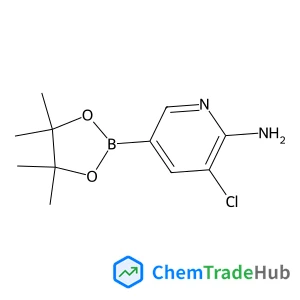
3-Chloro-5-(4,4,5,5-tetramethyl-1,3,2-dioxaborolan-2-yl)-2-pyridinamine
CAS番号:
1032758-99-8
分子式:
C11H16BClN2O2
おすすめサプライヤー





免責事項
このページに表示される学術雑誌情報は、参考および研究目的のみを目的としています。当社は雑誌出版社とは提携しておらず、投稿の取り扱いも行っておりません。出版に関するお問い合わせは、各雑誌出版社に直接ご連絡ください。
表示されている情報に誤りがある場合は、support@chemtradehub.com までご連絡ください。迅速に確認し、対応いたします。