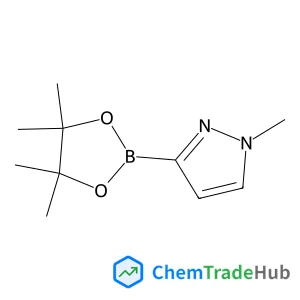
1-Methyl-3-(4,4,5,5-tetramethyl-1,3,2-dioxaborolan-2-yl)-1H-pyrazole
CAS番号:
1020174-04-2
分子式:
C10H17BN2O2
Feng Wang, Charles E. Diesendruck
A comprehensive examination of the synthesis of single chain polymer nanoparticles (SCPNs) from a copolymer of methyl acrylate (MA) and 2-hydroxyethyl acrylate (HEA) via the intra-chain urethane formation by using hexamethylene diisocyanate (HDI) as a cross-linker is described. By introducing model urethane, urea, and amine compounds, the resulting SCPNs were carefully characterized by NMR, DSC, IR and GPC. In addition to the advantages of using cheap and accessible commercially available materials, the effects of the long reaction time under high dilution or harsher heating conditions on the cross-linking chemistry are studied, providing clear limitations on the use of this chemistry for intra-chain collapse.

Proceedings of the National Academy of Sciences of the United States of America

Helvetica Chimica Acta

Israel Journal of Chemistry

Journal of Medicinal Chemistry

Nature

Organic Preparations and Procedures International

Kinetics and Catalysis

Science Progress

Journal of Organometallic Chemistry

Russian Chemical Reviews
Guanzhong Lu
DOI: 10.1039/C4CP04766D
Li Zheng, Xinhong Cheng, Yuehui Yu, Yahong Xie, Xiaolong Li, Zhongjian Wang
DOI: 10.1039/C4CP04957H
Manas Ranjan Dash, B. Rajakumar
DOI: 10.1039/C4CP04677C
F. M. Hoffmann, J. Hrbek, I. Waluyo, J. A. Boscoboinik, D. J. Stacchiola
DOI: 10.1039/C4CP05088F
DOI: 10.1039/C4CP04427D
Wen-kai Zhao, Bin Cui, Chang-feng Fang, Guo-min Ji, Jing-fen Zhao, Xiang-ru Kong, Dong-qing Zou, Dong-mei Li
DOI: 10.1039/C4CP04859H
Jiri Bursik, Jelena Horky, Ramakrishnan Anbalagan, Ramesh Chandra Mallik, Michael Zehetbauer
DOI: 10.1039/C4CP05230G
Erlendur Jónsson, Patrik Johansson
DOI: 10.1039/C4CP04592K
DOI: 10.1039/C4CP04571H
Daniela Trogolo, J. Samuel Arey
DOI: 10.1039/C4CP03987D
2-溴-9,9-二苯基芴は、医薬品、工業材料、有機合成の研究分野で応用されます。特に、レーザー材料や機能性ポリマーの合成に使用されることがあります。また、蛍光色...
四氯化铱の市場は研究開発分野で注目されており、特にナノ技術や金属有機框架(MOFs)の分野での需要が増加傾向にあります。価格は安定しており、中国や韓国での生産が...
1-(4-溴-3-氟苯基)-2-氯乙酮 (CAS番号: 1260857-14-4) の廃棄物は専門的な廃棄処理が必要です。まず、廃棄物は密閉された容器に収集し、...
苦参酚Kは、CAS番号101236-49-1を持つ化合物で、主に天然由来の生薬から抽出されます。この化合物は、抗炎症作用や抗癌作用を持つことが報告されています。
POTASSIUM (1-(TERTBUTOXYCARBONYL)AZETIDIN-3-YL)TRIFLUOROBORATE を含む廃棄物は、まず安全なエント...
4-庚基-4’-聯苯羧酸は、特殊化学品や合成化学の分野で用いられる化学物質ですが、市場動向としては、研究開発の進展とともに需要が増加しています。また、環境配慮型...
6-ブロモ-3-メトキシ-1-フェニル-1H-インドゾールを含む廃棄物は、適切な化学廃棄処理が必要です。通常、廃棄物は密閉容器に収集され、専門の廃棄処理業者に引...
4,4-二甲基-2-吡咯烷酮は医薬、ポリマー、センサー、半導体などの業界で広く使用されています。特に溶媒としての性能が高く評価されています。

Polymer Chemistry welcomes submissions in all areas of polymer science that have a strong focus on macromolecular chemistry. Manuscripts may cover a broad range of fields, yet no direct application focus is required.
![1-Naphthalenesulfonic acid, 2-[(2-hydroxy-1-naphthalenyl)azo]-, bariumsalt (2:1) structure](https://static.chemtradehub.com/structs/110/1103-38-4-0b33.webp "1-Naphthalenesulfonic acid, 2-[(2-hydroxy-1-naphthalenyl)azo]-, bariumsalt (2:1) structure")