












![4-Chloro-3-(trifluoromethyl)-1H-pyrrolo[2,3-b]pyridine structure](https://static.chemtradehub.com/structs/869/869335-75-1-a9d0.webp "4-Chloro-3-(trifluoromethyl)-1H-pyrrolo[2,3-b]pyridine structure")
Effects of biaxial tensile strain on the first-principles-driven thermal conductivity of buckled arsenene and phosphorene
文献情報
出版日
2018-10-23
DOI
10.1039/C8CP05342A
インパクトファクター
3.676
著者
Armin Taheri, Carlos Da Silva, Cristina H. Amon
原文を見る
要旨
Strain engineering is an effective way to tune the thermal and electrical properties of novel two-dimensional (2D) materials. In this work, first-principles density functional theory (DFT) is used to systematically investigate the strain-dependent lattice thermal conductivity and phonon properties of buckled arsenene and phosphorene, which are the 2D materials with the highest thermal conductivities among monolayers in group-VA. We implemented an iterative self-consistent solution to the Peierls–Boltzmann transport equation (PBTE). Our results showed that the thermal conductivity in both monolayers exhibits an up-and-down behavior when biaxial tensile strain is applied in the range from 0% to 9%. The peak values in the thermal conductivities occur at 5% of strain in arsenene and 3% in phosphorene, with the maximum conductivities of strained arsenene and phosphorene being 1.4 and 1.2 times higher than those of unstrained samples, respectively. We provide a rigorous description of the underlying phonon physics responsible for these thermal responses to strain, addressing the interplay between phonon group velocities, heat capacities, and relaxation times. The acoustic-optical phonon band gaps in arsenene and phosphorene were found to reduce with strain, being the reduction more significant in phosphorene. Our results also showed that the use of the single mode relaxation time approximation (SMRTA) predict substantially lower thermal conductivities for arsenene and phosphorene than those predicted by the iterative solution of the PBTE.
関連文献
Life of superoxide in aprotic Li–O2 battery electrolytes: simulated solvent and counter-ion effects
J. Scheers, D. Lidberg, Z. Futera
2016-02-24
Paper
DOI: 10.1039/C5CP08056H
Slowing and cooling of heavy or light (even with a tiny electric dipole moment) polar molecules using a novel, versatile electrostatic Stark decelerator
Qin Wang, Shunyong Hou, Liang Xu, Jianping Yin
2016-01-06
Paper
DOI: 10.1039/C5CP06392B
Kinetics of the ClO + HO2 reaction over the temperature range T = 210–298 K
Michael K. M. Ward, David M. Rowley
2016-02-02
Paper
DOI: 10.1039/C5CP07329D
Proton coupled electron transfer from the excited state of a ruthenium(ii) pyridylimidazole complex
Andrea Pannwitz, Oliver S. Wenger
2016-04-08
Paper
DOI: 10.1039/C6CP00437G
Current transient and in situ AFM studies of initial growth stages of electrochemically deposited nickel cobalt hydroxide nanosheet films
Tuyen Nguyen, M. Fátima Montemor
2016-03-29
Paper
DOI: 10.1039/C6CP00709K
A wavelength dependent investigation of the indole photophysics via ionization and fragmentation pump–probe spectroscopies
T. J. Godfrey, Hui Yu, Michael S. Biddle, Susanne Ullrich
2015-09-01
Paper
DOI: 10.1039/C5CP02975A
Structural determination of niobium-doped silicon clusters by far-infrared spectroscopy and theory
Xiaojun Li, Pieterjan Claes, Marko Haertelt, Peter Lievens, Ewald Janssens
2016-01-27
Paper
DOI: 10.1039/C5CP07298K
Electrophoresis of pH-regulated nanoparticles: impact of the Stern layer
Lanju Mei, Tzung-Han Chou, Yu-Shen Cheng, Ming-Jiang Huang, Li-Hsien Yeh, Shizhi Qian
2015-10-14
Paper
DOI: 10.1039/C5CP05728K
こちらもおすすめ
化合物よくある質問
2-ヒドロキシ-5-ニトロベンジンブロモイドの代替品はありますか?
2-ヒドロキシ-5-ニトロベンジンブロモイドは特定の化学反応に適しているため、代替品は限られています。しかし、同様の構造を持つ2-ヒドロキシ-4-ニトロベンジン...
772-33-82-(Bromomethyl)-4-ni...
化合物よくある質問
N-(2-ブロモフェニル)-1-チロール-3-オキソ-3-(ピペリジニル)プロペン-2-イル)ベンゼンアミドを取り扱う際の実験室安全事項は何ですか?
N-(2-ブロモフェニル)-1-チロール-3-オキソ-3-(ピペリジニル)プロペン-2-イル)ベンゼンアミドは有毒で、皮膚や粘膜に刺激を与える可能性があります。...
1800044-77-2N-[(1Z)-1-(2-Bromoph...
化合物よくある質問
1,3プロパンジオール,2-[2-(2アミノ-6クロロ-9Hピリミジン-9-イル)エチル-1,1,2,2-D4]-2,3-ジアセタートの市場動向や研究トレンドはどうですか?
この化合物は、新規治療薬の開発に注目されています。市場では、その有効性と安全性が評価され、研究分野では、分子生物学と医薬化学の新たな発見が期待されています。
1020718-81-31,3-Propanediol, 2-[...
579-44-2Ethanone, 2-hydroxy-...
化合物よくある質問
Succinimidyl-alanyl-phenylalanyl-prolyl-phenylalanine 4-nitroanilide はどの業界で使用されていますか?
Succinimidyl-alanyl-phenylalanyl-prolyl-phenylalanine 4-nitroanilide は主に医薬品開発やポ...
128802-73-3succinimidyl-alanyl-...
化合物よくある質問
メチル6-アミノ-5-クロロピリジン-2-カーボイル酸について、適用される法規ガイドラインは何ですか?
メチル6-アミノ-5-クロロピリジン-2-カーボイル酸(CAS番号: 1256794-05-4)の使用には、GHS( Globally Harmonized S...
1256794-05-4Methyl 6-amino-5-chl...
化合物よくある質問
エチル4-(シクロ Pentagonyl)アミノ-2-メチル硫化基ピリミジン-5-カルボキシレートを取り扱う際の実験室安全事項は何ですか?
取り扱いには、耐薬品性の容器を使用し、通気性の良い場所で操作することを推奨します。漏れ時は、SDS(安全データシート)を参照して適切な措置を取ること。手洗いと洗...
211245-62-4ethyl 4-(cyclopentyl...
化合物よくある質問
(S)-3-ベンZYルピペリジン塩酸塩とは何ですか?
(S)-3-ベンZYルピペリジン塩酸塩は、CAS番号1258940-00-9で表される化合物です。これは、(S)-3-苯基哌啶的盐酸盐であり、主に医薬品の原料と...
1258940-00-9(S)-3-Phenylpiperidi...
化合物よくある質問
3,5-二甲基金剛胺の主な用途は何ですか?
3,5-二甲基金剛胺は、主に医薬品の原料として使用され、また抗うつ薬や抗アルツハイマー薬の開発に利用されます。さらに、化粧品や食品添加物の製造でも重要な役割を果...
19988-45-52-(2,3-Dihydroxyphen...
化合物よくある質問
ビス(4-メチル-2-ペンチル)フェニルカルボン酸エステルの代替品はありますか?
ビス(4-メチル-2-ペンチル)フェニルカルボン酸エステル (CAS番号: 1398066-13-1) の代替品には、ビス(2-エチルヘキシル)フェノールカルボ...
1398066-13-1Bis(4-methyl-2-penty...
掲載誌
Physical Chemistry Chemical Physics

CiteScore:
5.5
自己引用率:
10.3%
年間論文数:
3036
Physical Chemistry Chemical Physics (PCCP) is an international journal co-owned by 19 physical chemistry and physics societies from around the world. This journal publishes original, cutting-edge research in physical chemistry, chemical physics and biophysical chemistry. To be suitable for publication in PCCP, articles must include significant innovation and/or insight into physical chemistry; this is the most important criterion that reviewers and Editors will judge against when evaluating submissions. The journal has a broad scope and welcomes contributions spanning experiment, theory, computation and data science. Topical coverage includes spectroscopy, dynamics, kinetics, statistical mechanics, thermodynamics, electrochemistry, catalysis, surface science, quantum mechanics, quantum computing and machine learning. Interdisciplinary research areas such as polymers and soft matter, materials, nanoscience, energy, surfaces/interfaces, and biophysical chemistry are welcomed if they demonstrate significant innovation and/or insight into physical chemistry. Joined experimental/theoretical studies are particularly appreciated when complementary and based on up-to-date approaches.
おすすめ化合物
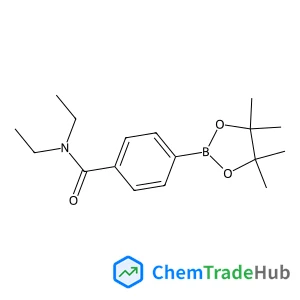
N,N-Diethyl-4-(4,4,5,5-tetramethyl-1,3,2-dioxaborolan-2-yl)benzamide
CAS番号:
325142-99-2
分子式:
C17H26BNO3
おすすめサプライヤー



免責事項
このページに表示される学術雑誌情報は、参考および研究目的のみを目的としています。当社は雑誌出版社とは提携しておらず、投稿の取り扱いも行っておりません。出版に関するお問い合わせは、各雑誌出版社に直接ご連絡ください。
表示されている情報に誤りがある場合は、support@chemtradehub.com までご連絡ください。迅速に確認し、対応いたします。