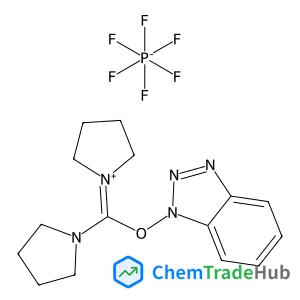
(1H-Benzotriazol-1-yloxy)(di-1-pyrrolidinyl)methylium hexafluorophosphate
CAS番号:
105379-24-6
分子式:
C15H21F6N5OP
Deliang Chen, Yibao Li, Mingming Zhao, Wen Tan, Xun Li, Wei Guo, Xiaolin Fan
Enhancing the binding affinities of ligands by means of lead modifications that displace bridging water molecules at protein–ligand interfaces is an important and widely studied lead optimization strategy. However, it is still challenging to ensure the success of this lead optimization strategy. Here we use theoretical derivations, which are then validated using reported experimental data, to identify the major determining factors in lead optimization designed to displace bridging water molecules. Our findings demonstrate that the nature of hydrogen-bond pairing between the ligand and protein polar atom(s) is the principal factor displacing interface water molecules, and not the binding strength of the water molecule. Our results also indicate that all interfacing bridging water molecules can potentially be targeted for displacement using this new approach. In summary, we show that strong–strong/weak–weak hydrogen-bond pairings of ligand atoms with protein atoms may provide useful guidance in lead modifications by designing modified ligands with higher binding affinities than their lead molecules. This study can help to increase the efficiency of rational drug design.
Jin Liu, Kelly Jo Boarman
DOI: 10.1039/B413898H
David Ellis, Maria Elena Lopez, Ruaraidh McIntosh, Georgina M. Rosair, Alan J. Welch, Romain Quenardelle
DOI: 10.1039/B416646A
Makoto Tadokoro, Shin Mizugaki, Masatoshi Kozaki, Keiji Okada
DOI: 10.1039/B415374J
Bogdan Marciniec, Magdalena Jankowska, Cezary Pietraszuk
DOI: 10.1039/B414644A
Cuihua Xue, Ganesh Arumugam, Kumaranand Palaniappan, Stephen A. Hackney, Haiying Liu, Jian Liu
DOI: 10.1039/B415652H
Eunice L. P. Tan, Resmi C. Panicker
DOI: 10.1039/B415506H
M. Schwidder, M. Santhosh Kumar, A. Brückner, W. Grünert
DOI: 10.1039/B414179B
Chih-Hsiu Lin, Krishnan Radhakrishnan
DOI: 10.1039/B412090F
Irene C. Reynhout, Dennis W. P. M. Löwik, Jan C. M. van Hest, Jeroen J. L. M. Cornelissen, Roeland J. M. Nolte
DOI: 10.1039/B413973A
Yu Chen, Zhong Shen, Holger Frey, Julia Pérez-Prieto, Salah-Eddine Stiriba
DOI: 10.1039/B414046J
2-溴-9,9-二苯基芴は、医薬品、工業材料、有機合成の研究分野で応用されます。特に、レーザー材料や機能性ポリマーの合成に使用されることがあります。また、蛍光色...
四氯化铱の市場は研究開発分野で注目されており、特にナノ技術や金属有機框架(MOFs)の分野での需要が増加傾向にあります。価格は安定しており、中国や韓国での生産が...
1-(4-溴-3-氟苯基)-2-氯乙酮 (CAS番号: 1260857-14-4) の廃棄物は専門的な廃棄処理が必要です。まず、廃棄物は密閉された容器に収集し、...
苦参酚Kは、CAS番号101236-49-1を持つ化合物で、主に天然由来の生薬から抽出されます。この化合物は、抗炎症作用や抗癌作用を持つことが報告されています。
POTASSIUM (1-(TERTBUTOXYCARBONYL)AZETIDIN-3-YL)TRIFLUOROBORATE を含む廃棄物は、まず安全なエント...
4-庚基-4’-聯苯羧酸は、特殊化学品や合成化学の分野で用いられる化学物質ですが、市場動向としては、研究開発の進展とともに需要が増加しています。また、環境配慮型...
6-ブロモ-3-メトキシ-1-フェニル-1H-インドゾールを含む廃棄物は、適切な化学廃棄処理が必要です。通常、廃棄物は密閉容器に収集され、専門の廃棄処理業者に引...
4,4-二甲基-2-吡咯烷酮は医薬、ポリマー、センサー、半導体などの業界で広く使用されています。特に溶媒としての性能が高く評価されています。

Physical Chemistry Chemical Physics (PCCP) is an international journal co-owned by 19 physical chemistry and physics societies from around the world. This journal publishes original, cutting-edge research in physical chemistry, chemical physics and biophysical chemistry. To be suitable for publication in PCCP, articles must include significant innovation and/or insight into physical chemistry; this is the most important criterion that reviewers and Editors will judge against when evaluating submissions. The journal has a broad scope and welcomes contributions spanning experiment, theory, computation and data science. Topical coverage includes spectroscopy, dynamics, kinetics, statistical mechanics, thermodynamics, electrochemistry, catalysis, surface science, quantum mechanics, quantum computing and machine learning. Interdisciplinary research areas such as polymers and soft matter, materials, nanoscience, energy, surfaces/interfaces, and biophysical chemistry are welcomed if they demonstrate significant innovation and/or insight into physical chemistry. Joined experimental/theoretical studies are particularly appreciated when complementary and based on up-to-date approaches.
![4-{2-[4-(2-Methyl-2-propanyl)phenyl]ethoxy}quinazoline structure](https://static.chemtradehub.com/structs/120/120928-09-8-d3db.webp "4-{2-[4-(2-Methyl-2-propanyl)phenyl]ethoxy}quinazoline structure")