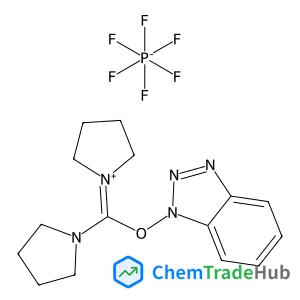
(1H-Benzotriazol-1-yloxy)(di-1-pyrrolidinyl)methylium hexafluorophosphate
CAS番号:
105379-24-6
分子式:
C15H21F6N5OP
Ferrogels are smart soft materials, consisting of a polymeric network and embedded magnetic particles. Novel phenomena, such as the variation of the overall mechanical properties by external magnetic fields, emerge consequently. However, the dynamic behavior of ferrogels remains largely unveiled. In this paper, we consider a one-dimensional chain consisting of magnetic dipoles and elastic springs between them as a simple model for ferrogels. The model is evaluated by corresponding simulations. To probe the dynamics theoretically, we investigate a continuum limit of the energy governing the system and the corresponding equation of motion. We provide general classification scenarios for the dynamics, elucidating the touching/detachment dynamics of the magnetic particles along the chain. In particular, it is verified in certain cases that the long-time relaxation corresponds to solutions of shock-wave propagation, while formations of particle pairs underlie the initial stage of the dynamics. We expect that these results will provide insight into the understanding of the dynamics of more realistic models with randomness in parameters and time-dependent magnetic fields.
Karen Freytag, Stefanie Säfken, Kai Wolter, Jan C. Namyslo, Eike G. Hübner
DOI: 10.1039/C7PY01487B
Bingkun Yan, Yan Zhang, Chao Wei, Yue Xu
DOI: 10.1039/C7PY01908D
Chiao-Wen Lin, Chao-Tsen Chen, Jan Golder
DOI: 10.1039/C7PY00338B
Reece W. Lewis, Richard A. Evans, Nino Malic, Kei Saito
DOI: 10.1039/C7PY01752A
Xiaomin Zhu, Rongfeng Zou, Peng Sun, Qi Wang, Junchen Wu
DOI: 10.1039/C7PY01901G
Xinwen Yan, Shaowen Zhang, Deqian Peng, Pengfei Zhang, Junge Zhi, Xiaolu Wu, Lin Wang, Yuping Dong, Xiaofang Li
DOI: 10.1039/C8PY00007G
P.-Y. Dugas, B. Charleux, M. Lansalot, E. Bourgeat-Lami
DOI: 10.1039/C7PY00595D
Min Zeng, Decheng Wu, Yen Wei, Jinying Yuan
DOI: 10.1039/C8PY00029H
2-溴-9,9-二苯基芴は、医薬品、工業材料、有機合成の研究分野で応用されます。特に、レーザー材料や機能性ポリマーの合成に使用されることがあります。また、蛍光色...
四氯化铱の市場は研究開発分野で注目されており、特にナノ技術や金属有機框架(MOFs)の分野での需要が増加傾向にあります。価格は安定しており、中国や韓国での生産が...
1-(4-溴-3-氟苯基)-2-氯乙酮 (CAS番号: 1260857-14-4) の廃棄物は専門的な廃棄処理が必要です。まず、廃棄物は密閉された容器に収集し、...
苦参酚Kは、CAS番号101236-49-1を持つ化合物で、主に天然由来の生薬から抽出されます。この化合物は、抗炎症作用や抗癌作用を持つことが報告されています。
POTASSIUM (1-(TERTBUTOXYCARBONYL)AZETIDIN-3-YL)TRIFLUOROBORATE を含む廃棄物は、まず安全なエント...
4-庚基-4’-聯苯羧酸は、特殊化学品や合成化学の分野で用いられる化学物質ですが、市場動向としては、研究開発の進展とともに需要が増加しています。また、環境配慮型...
6-ブロモ-3-メトキシ-1-フェニル-1H-インドゾールを含む廃棄物は、適切な化学廃棄処理が必要です。通常、廃棄物は密閉容器に収集され、専門の廃棄処理業者に引...
4,4-二甲基-2-吡咯烷酮は医薬、ポリマー、センサー、半導体などの業界で広く使用されています。特に溶媒としての性能が高く評価されています。

Physical Chemistry Chemical Physics (PCCP) is an international journal co-owned by 19 physical chemistry and physics societies from around the world. This journal publishes original, cutting-edge research in physical chemistry, chemical physics and biophysical chemistry. To be suitable for publication in PCCP, articles must include significant innovation and/or insight into physical chemistry; this is the most important criterion that reviewers and Editors will judge against when evaluating submissions. The journal has a broad scope and welcomes contributions spanning experiment, theory, computation and data science. Topical coverage includes spectroscopy, dynamics, kinetics, statistical mechanics, thermodynamics, electrochemistry, catalysis, surface science, quantum mechanics, quantum computing and machine learning. Interdisciplinary research areas such as polymers and soft matter, materials, nanoscience, energy, surfaces/interfaces, and biophysical chemistry are welcomed if they demonstrate significant innovation and/or insight into physical chemistry. Joined experimental/theoretical studies are particularly appreciated when complementary and based on up-to-date approaches.

![1-Naphthalenesulfonic acid, 2-[(2-hydroxy-1-naphthalenyl)azo]-, bariumsalt (2:1) structure](https://static.chemtradehub.com/structs/110/1103-38-4-0b33.webp "1-Naphthalenesulfonic acid, 2-[(2-hydroxy-1-naphthalenyl)azo]-, bariumsalt (2:1) structure")