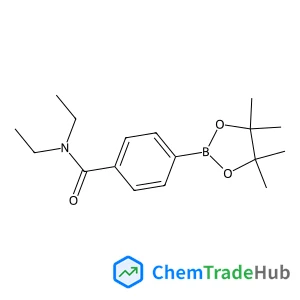
N,N-Diethyl-4-(4,4,5,5-tetramethyl-1,3,2-dioxaborolan-2-yl)benzamide
CAS番号:
325142-99-2
分子式:
C17H26BNO3
Niloufar Shafizadeh, Séverine Boyé-Péronne, Satchin Soorkia, Barbara K. Cunha de Miranda, Gustavo A. Garcia, Laurent Nahon, Shufeng Chen, Aurélien de la Lande, Lionel Poisson, Benoît Soep
A combined theoretical and experimental approach has been used to investigate the binding energy of a ruthenium metalloporphyrin ligated with CO, ruthenium tetraphenylporphyrin [RuII TPP], in the RuII oxidation degree. Measurements performed with VUV ionization using the DESIRS beamline at Synchrotron SOLEIL led to adiabatic ionization energies of [RuII TPP] and its complex with CO, [RuII TPP–CO], of 6.48 ± 0.03 eV and 6.60 ± 0.03 eV, respectively, while the ion dissociation threshold of [RuII TPP–CO]+ is measured to be 8.36 ± 0.03 eV using the ground-state neutral complex. These experimental data are used to derive the binding energies of the CO ligand in neutral and cationic complexes (1.88 ± 0.06 eV and 1.76 ± 0.06 eV, respectively) using a Born–Haber cycle. Density functional theory calculations, in very satisfactory agreement with the experimental results, help to get insights into the metal–ligand bond. Notably, the high ligation energies can be rationalized in terms of the ruthenium orbital structure, which is singular compared to that of the iron atom. Thus, beyond indications of a strengthening of the Ru–CO bond due to the decrease in the CO vibrational frequency in the complex as compared to the Fe–CO bond, high-level calculations are essential to accurately describe the metal ligand (CO) bond and show that the Ru–CO bond energy is strongly affected by the splitting of triplet and singlet spin states in uncomplexed [Ru TPP].
Thomas Degabriel, Elodie Colaço, Rute F. Domingos, Karim El Kirat, Dalil Brouri, Sandra Casale, Jessem Landoulsi, Jolanda Spadavecchia
DOI: 10.1039/C7CP08054A
Anton Rudenko, Jean-Philippe Colombier, Tatiana E. Itina
DOI: 10.1039/C7CP07603G
Yasuyuki Yokota, Hiroo Miyamoto, Akihito Imanishi, Kouji Inagaki, Ken-ichi Fukui
DOI: 10.1039/C8CP01043A
Haiming Lv, Yi Wang, Lei Pan, Leipeng Zhang, Hangchuan Zhang, Lei Shang, Huiying Qu, Na Li, Jiupeng Zhao, Yao Li
DOI: 10.1039/C7CP07617G
Weilong Zhao, Ziqiu Wang, Zhijun Xu
DOI: 10.1039/C8CP01105B
Yujie Dong, Feifei Luo, Lan Chen, Feiya Yuan, Yuejiao Hou, Weijun Li, Shuanma Yan, Yuyu Dai, Mi Ouyang, Cheng Zhang
DOI: 10.1039/C8CP00338F
Xuegeng Yang, Dominik Baczyzmalski, Christian Cierpka, Gerd Mutschke
DOI: 10.1039/C8CP01050A
Evelin Rauscher, Gábor Schuszter, Bíborka Bohner, Ágota Tóth, Dezső Horváth
DOI: 10.1039/C7CP08282G
DOI: 10.1039/C8CP00071A
T. V. Raziman, J. A. Duenas, W. I. Milne, O. J. F. Martin, P. Dawson
DOI: 10.1039/C7CP06416K
2-ヒドロキシ-5-ニトロベンジンブロモイドは特定の化学反応に適しているため、代替品は限られています。しかし、同様の構造を持つ2-ヒドロキシ-4-ニトロベンジン...
N-(2-ブロモフェニル)-1-チロール-3-オキソ-3-(ピペリジニル)プロペン-2-イル)ベンゼンアミドは有毒で、皮膚や粘膜に刺激を与える可能性があります。...
この化合物は、新規治療薬の開発に注目されています。市場では、その有効性と安全性が評価され、研究分野では、分子生物学と医薬化学の新たな発見が期待されています。
Succinimidyl-alanyl-phenylalanyl-prolyl-phenylalanine 4-nitroanilide は主に医薬品開発やポ...
メチル6-アミノ-5-クロロピリジン-2-カーボイル酸(CAS番号: 1256794-05-4)の使用には、GHS( Globally Harmonized S...
取り扱いには、耐薬品性の容器を使用し、通気性の良い場所で操作することを推奨します。漏れ時は、SDS(安全データシート)を参照して適切な措置を取ること。手洗いと洗...
(S)-3-ベンZYルピペリジン塩酸塩は、CAS番号1258940-00-9で表される化合物です。これは、(S)-3-苯基哌啶的盐酸盐であり、主に医薬品の原料と...
3,5-二甲基金剛胺は、主に医薬品の原料として使用され、また抗うつ薬や抗アルツハイマー薬の開発に利用されます。さらに、化粧品や食品添加物の製造でも重要な役割を果...
ビス(4-メチル-2-ペンチル)フェニルカルボン酸エステル (CAS番号: 1398066-13-1) の代替品には、ビス(2-エチルヘキシル)フェノールカルボ...

Physical Chemistry Chemical Physics (PCCP) is an international journal co-owned by 19 physical chemistry and physics societies from around the world. This journal publishes original, cutting-edge research in physical chemistry, chemical physics and biophysical chemistry. To be suitable for publication in PCCP, articles must include significant innovation and/or insight into physical chemistry; this is the most important criterion that reviewers and Editors will judge against when evaluating submissions. The journal has a broad scope and welcomes contributions spanning experiment, theory, computation and data science. Topical coverage includes spectroscopy, dynamics, kinetics, statistical mechanics, thermodynamics, electrochemistry, catalysis, surface science, quantum mechanics, quantum computing and machine learning. Interdisciplinary research areas such as polymers and soft matter, materials, nanoscience, energy, surfaces/interfaces, and biophysical chemistry are welcomed if they demonstrate significant innovation and/or insight into physical chemistry. Joined experimental/theoretical studies are particularly appreciated when complementary and based on up-to-date approaches.
![Methyl 4-({[(2-methyl-2-propanyl)oxy]carbonyl}amino)bicyclo[2.2.2]octane-1-carboxylate structure](https://static.chemtradehub.com/structs/943/943845-74-7-b7e5.webp "Methyl 4-({[(2-methyl-2-propanyl)oxy]carbonyl}amino)bicyclo[2.2.2]octane-1-carboxylate structure")