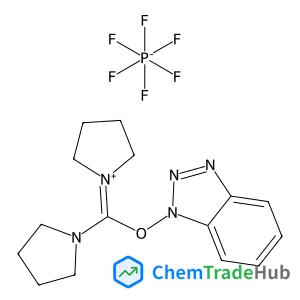
(1H-Benzotriazol-1-yloxy)(di-1-pyrrolidinyl)methylium hexafluorophosphate
CAS番号:
105379-24-6
分子式:
C15H21F6N5OP
Alicja Domaracka, Rudy Delaunay, Arkadiusz Mika, Michael Gatchell, Henning Zettergren, Henrik Cederquist, Patrick Rousseau, Bernd A. Huber
Ionization, fragmentation and molecular growth have been studied in collisions of 22.5 keV He2+- or 3 keV Ar+-projectiles with pure loosely bound clusters of coronene (C24H12) molecules or with loosely bound mixed C60–C24H12 clusters by using mass spectrometry. The heavier and slower Ar+ projectiles induce prompt knockout–fragmentation – C- and/or H-losses – from individual molecules and highly efficient secondary molecular growth reactions before the clusters disintegrate on picosecond timescales. The lighter and faster He2+ projectiles have a higher charge and the main reactions are then ionization by ions that are not penetrating the clusters. This leads mostly to cluster fragmentation without molecular growth. However, here penetrating collisions may also lead to molecular growth but to a much smaller extent than with 3 keV Ar+. Here we present fragmentation and molecular growth mass distributions with 1 mass unit resolution, which reveals that the same numbers of C- and H-atoms often participate in the formation and breaking of covalent bonds inside the clusters. We find that masses close to those with integer numbers of intact coronene molecules, or with integer numbers of both intact coronene and C60 molecules, are formed where often one or several H-atoms are missing or have been added on. We also find that super-hydrogenated coronene is formed inside the clusters.
Xiaomin Zhu, Rongfeng Zou, Peng Sun, Qi Wang, Junchen Wu
DOI: 10.1039/C7PY01901G
Mahdi Rahimi, Kazem D. Safa, Roya Salehi
DOI: 10.1039/C7PY01701D
Xiaodong Liu, Yuanyuan Ni, Jian Wu, Hongjuan Jiang, Zhengbiao Zhang, Lifen Zhang, Zhenping Cheng
DOI: 10.1039/C7PY02008B
T. Hardeman, G. Koeckelberghs
DOI: 10.1039/C7PY00624A
D. Pintori
DOI: 10.1039/C7PY00788D
Daniel Schiefer, Ralf Hanselmann
DOI: 10.1039/C7PY00612H
Gabriela Pricope, Elena Laura Ursu, Monica Sardaru, Corneliu Cojocaru, Lilia Clima, Narcisa Marangoci, Ramona Danac, Ionel I. Mangalagiu, Mariana Pinteala, Alexandru Rotaru
DOI: 10.1039/C7PY01668A
2-溴-9,9-二苯基芴は、医薬品、工業材料、有機合成の研究分野で応用されます。特に、レーザー材料や機能性ポリマーの合成に使用されることがあります。また、蛍光色...
四氯化铱の市場は研究開発分野で注目されており、特にナノ技術や金属有機框架(MOFs)の分野での需要が増加傾向にあります。価格は安定しており、中国や韓国での生産が...
1-(4-溴-3-氟苯基)-2-氯乙酮 (CAS番号: 1260857-14-4) の廃棄物は専門的な廃棄処理が必要です。まず、廃棄物は密閉された容器に収集し、...
苦参酚Kは、CAS番号101236-49-1を持つ化合物で、主に天然由来の生薬から抽出されます。この化合物は、抗炎症作用や抗癌作用を持つことが報告されています。
POTASSIUM (1-(TERTBUTOXYCARBONYL)AZETIDIN-3-YL)TRIFLUOROBORATE を含む廃棄物は、まず安全なエント...
4-庚基-4’-聯苯羧酸は、特殊化学品や合成化学の分野で用いられる化学物質ですが、市場動向としては、研究開発の進展とともに需要が増加しています。また、環境配慮型...
6-ブロモ-3-メトキシ-1-フェニル-1H-インドゾールを含む廃棄物は、適切な化学廃棄処理が必要です。通常、廃棄物は密閉容器に収集され、専門の廃棄処理業者に引...
4,4-二甲基-2-吡咯烷酮は医薬、ポリマー、センサー、半導体などの業界で広く使用されています。特に溶媒としての性能が高く評価されています。

Physical Chemistry Chemical Physics (PCCP) is an international journal co-owned by 19 physical chemistry and physics societies from around the world. This journal publishes original, cutting-edge research in physical chemistry, chemical physics and biophysical chemistry. To be suitable for publication in PCCP, articles must include significant innovation and/or insight into physical chemistry; this is the most important criterion that reviewers and Editors will judge against when evaluating submissions. The journal has a broad scope and welcomes contributions spanning experiment, theory, computation and data science. Topical coverage includes spectroscopy, dynamics, kinetics, statistical mechanics, thermodynamics, electrochemistry, catalysis, surface science, quantum mechanics, quantum computing and machine learning. Interdisciplinary research areas such as polymers and soft matter, materials, nanoscience, energy, surfaces/interfaces, and biophysical chemistry are welcomed if they demonstrate significant innovation and/or insight into physical chemistry. Joined experimental/theoretical studies are particularly appreciated when complementary and based on up-to-date approaches.