












Synthesis of conjugated copolymers by combining different coupling reactions
文献情報
出版日
2017-06-19
DOI
10.1039/C7PY00624A
インパクトファクター
5.582
著者
T. Hardeman, G. Koeckelberghs
原文を見る
要旨
Despite the significant progress in the controlled synthesis of conjugated polymers using a Catalyst Transfer Condensative Polymerization, the possibilities regarding random and gradient copolymers remain very limited. Therefore, a novel concept is introduced, in which different organometallic functions are placed on the monomers in a copolymerization, meaning that different types of coupling reactions are combined. By using combinations of Grignard, organozinc, organoboron, organotin and organogold functional groups, the goal is to tune the reactivity ratio of the monomers. As such, it enables to tune the polymer structure without having to intervene during the polymerization, something which was impossible up to now. In this study, two randomly copolymerizing thiophene monomers are considered, whose reactivity is varied by altering the organometallic function. Despite the significant difference in reactivity between the chosen functional groups, it is found that most combinations nevertheless result in the formation of a random copolymer. However, the combination of the organotin and organogold monomer shows a gradient in the monomer consumption, with a preferential incorporation of the organogold monomer at low conversion. Although the copolymerization is not controlled, it is an indication that the use of different organometallic functions is a viable strategy to tune the gradient in a copolymerization.
関連文献
Reductive cleavage of the C–O bond of acetals and orthoesters: reduction by silane in the presence of a Rh–PPh3 complex
Tetsuo Ohta, Tsugumi Michibata, Kazuyuki Yamada, Ryohei Omori, Isao Furukawa
2003-04-17
Communication
DOI: 10.1039/B302124F
A new dark quencher for use in genetic analysis
Jonathan P. May, Lynda J. Brown, Ivo Rudloff, Tom Brown
2003-03-18
Communication
DOI: 10.1039/B300934C
A miniature biofuel cell operating at 0.78 V
Nicolas Mano, Fei Mao, Ting Chen, Adam Heller
2003-01-21
Communication
DOI: 10.1039/B211796G
Enhancement of facilitated olefin transport by amino acid in silver–polymer complex membranes
Sang Wook Kang, Jong Hak Kim, Jongok Won, Kookheon Char, Yong Soo Kang
2003-02-25
Communication
DOI: 10.1039/B211933A
A new organic superconductor, (DODHT)2BF4·H2O
Hiroyuki Nishikawa, Asami Machida, Takanobu Morimoto, Koichi Kikuchi, Takeshi Kodama, Isao Ikemoto, Jun-ichi Yamada, Harukazu Yoshino, Keizo Murata
2003-01-27
Communication
DOI: 10.1039/B211275B
The first example of direct oxidation of sulfides to sulfones by an osmate molecular oxygen system
Boyapati M. Choudary, Chinta Reddy V. Reddy, Billakanti V. Prakash, Mannepalli L. Kantam, B. Sreedhar
2003-02-20
Communication
DOI: 10.1039/B212749K
A highly active K-Co-Mo/C catalyst for mixed alcohol synthesis from CO + H2
Jun Bao, YiLu Fu, ZhongHai Sun, Chen Gao
2003-02-25
Communication
DOI: 10.1039/B212504H
Non-covalent switch for intramolecular energy transfer
Joe Otsuki, Akane Yasuda, Toshio Takido
2003-02-05
Communication
DOI: 10.1039/B212912D
Preparation of ZnO nanocrystalsvia ultrasonic irradiation
Dong Qian, J.Z. Jiang, Poul Lenvig Hansen
2003-03-28
Communication
DOI: 10.1039/B301504A
こちらもおすすめ
化合物よくある質問
2-ブロモ-9,9-ジフェニル-9H-フルオレンの主な用途は何ですか?
2-溴-9,9-二苯基芴は、医薬品、工業材料、有機合成の研究分野で応用されます。特に、レーザー材料や機能性ポリマーの合成に使用されることがあります。また、蛍光色...
474918-32-62-Bromo-9,9-diphenyl...
化合物よくある質問
四氯化铱の市場動向や研究トレンドはどうですか?
四氯化铱の市場は研究開発分野で注目されており、特にナノ技術や金属有機框架(MOFs)の分野での需要が増加傾向にあります。価格は安定しており、中国や韓国での生産が...
207399-11-9Tetrachloroiridium h...
882-06-44-Nitrocinnamic acid
化合物よくある質問
1-(4-溴-3-氟苯基)-2-氯乙酮を含む廃棄物はどのように処理すべきですか?
1-(4-溴-3-氟苯基)-2-氯乙酮 (CAS番号: 1260857-14-4) の廃棄物は専門的な廃棄処理が必要です。まず、廃棄物は密閉された容器に収集し、...
1260857-14-41-(4-Bromo-3-fluorop...
化合物よくある質問
苦参酚Kとは何ですか?
苦参酚Kは、CAS番号101236-49-1を持つ化合物で、主に天然由来の生薬から抽出されます。この化合物は、抗炎症作用や抗癌作用を持つことが報告されています。
101236-49-1Kushenol K
化合物よくある質問
POTASSIUM (1-(TERTBUTOXYCARBONYL)AZETIDIN-3-YL)TRIFLUOROBORATE を含む廃棄物はどのように処理すべきですか?
POTASSIUM (1-(TERTBUTOXYCARBONYL)AZETIDIN-3-YL)TRIFLUOROBORATE を含む廃棄物は、まず安全なエント...
1430219-73-0Potassium (1-(tert-b...
化合物よくある質問
4-庚基-4’-联苯羧酸の市場動向や研究トレンドはどうですか?
4-庚基-4’-聯苯羧酸は、特殊化学品や合成化学の分野で用いられる化学物質ですが、市場動向としては、研究開発の進展とともに需要が増加しています。また、環境配慮型...
58573-94-74'-Heptyl-4-biphenyl...
化合物よくある質問
6-ブロモ-3-メトキシ-1-フェニル-1H-インドゾールを含む廃棄物はどのように処理すべきですか?
6-ブロモ-3-メトキシ-1-フェニル-1H-インドゾールを含む廃棄物は、適切な化学廃棄処理が必要です。通常、廃棄物は密閉容器に収集され、専門の廃棄処理業者に引...
1332527-03-36-Bromo-3-methoxy-1-...
化合物よくある質問
4,4-二甲基-2-吡咯烷酮はどの業界で使用されていますか?
4,4-二甲基-2-吡咯烷酮は医薬、ポリマー、センサー、半導体などの業界で広く使用されています。特に溶媒としての性能が高く評価されています。
66899-02-34,4-dimethylpyrrolid...
51312-42-6Sodium Phosphotungst...
掲載誌
Polymer Chemistry

CiteScore:
8.6
自己引用率:
7.3%
年間論文数:
457
Polymer Chemistry welcomes submissions in all areas of polymer science that have a strong focus on macromolecular chemistry. Manuscripts may cover a broad range of fields, yet no direct application focus is required.
おすすめ化合物
![5-Acetyl-2,3-dihydrobenzo[b]furan structure](https://static.chemtradehub.com/structs/908/90843-31-5-eea4.webp "5-Acetyl-2,3-dihydrobenzo[b]furan structure")
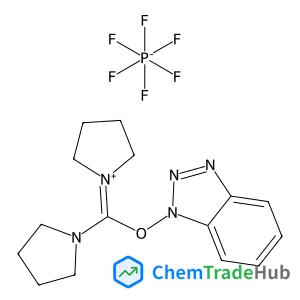
(1H-Benzotriazol-1-yloxy)(di-1-pyrrolidinyl)methylium hexafluorophosphate
CAS番号:
105379-24-6
分子式:
C15H21F6N5OP
おすすめサプライヤー





免責事項
このページに表示される学術雑誌情報は、参考および研究目的のみを目的としています。当社は雑誌出版社とは提携しておらず、投稿の取り扱いも行っておりません。出版に関するお問い合わせは、各雑誌出版社に直接ご連絡ください。
表示されている情報に誤りがある場合は、support@chemtradehub.com までご連絡ください。迅速に確認し、対応いたします。