











Rapid detection of metal impurities on the surfaces of intact objects with irregular shapes using electrochemical mass spectrometry
文献情報
出版日
2019-03-27
DOI
10.1039/C8AN02472C
インパクトファクター
4.616
著者
Lili Song, Jiaquan Xu, Dacai Zhong, Konstantin Chingin, Ying Qu, Huanwen Chen
原文を見る
要旨
New approaches are demanded in daily life and industry for the rapid inspection of chemical impurities on various objects, particularly those with irregular shapes. Herein, an analytical strategy combining electrochemistry (EC) and mass spectrometry (MS) has been developed for the direct inspection of metal impurities on various objects which are commonly used in daily life and industry. An intact object (e.g., necklace, bearing, ring) was immersed in an electrolytic cell containing EDTA/acetonitrile/water solution at appropriate potentials to form metal ions. The formed metal ions were instantly chelated with specific ligands (e.g. ethylenediaminetetraacetic acid) and sampled for online electrospray ionization (ESI) with high-resolution MS detection. The unique feature of the method is that metal speciation information can be obtained even when just a metal impurity (e.g., Pb, Ni) is localized on a hard-to-reach tiny spot on the inner surface of objects with extremely irregular shapes. A single sample analysis requires less than 10 minutes, regardless of the object shape. The limit of detection is 0.05 ppb with sample consumption on the nanogram level. The experimental results demonstrate that the method is promising for the non-destructive quality and safety inspection of metal impurities on virtually any kinds of objects with high chemical sensitivity.
関連文献
Straight-chain ω-amino-α,β-unsaturated carbonyl compounds: versatile synthons for the synthesis of nitrogen-containing heterocycles via organocatalytic reactions
Shuhui Li, Xiaoxuan Li, Hui Yao, Mengting Tan, Dan Xu, Nianyu Huang, Nengzhong Wang
2023-11-30
Review Article
DOI: 10.1039/D3QO01734F
Stereoselective synthesis of Δ(1)-pyrroline sulfonamides via a chiral aldehyde mediated cascade reaction
Wei Wen, Zhao-Pin Ai, Zhu-Lian Wu, Tian Cai, Qi-Xiang Guo
2023-11-15
Research Article
DOI: 10.1039/D3QO01675G
Global minimum and a heap of low-lying isomers with planar tetracoordinate carbon in the CAl3MgH2− system
Abdul Hamid Malhan, Krishnan Thirumoorthy
2024-01-09
Communication
DOI: 10.1039/D3CP05841G
Unveiling the potency of a phenalenyl-based photocatalyst for intramolecular dehydrogenative lactonization‡
Partha Pratim Sen, Vishali Pathania, Sudipta Raha Roy
2023-11-07
Research Article
DOI: 10.1039/D3QO01662E
Directed copper-catalyzed dehydrogenative C–H amination of unsaturated sialic acids
Samir Messaoudi
2023-11-27
Research Article
DOI: 10.1039/D3QO01448G
Photoredox dearomative β-hydroborylation of indoles for the synthesis of borylated indolines
Yongchan Jian, Fei Wen, Jianping Shang, Xiaolong Li, Zhenyu Liu, Yuanyuan An, Yubin Wang
2023-11-15
Research Article
DOI: 10.1039/D3QO01452E
Breaking the Hoff/Le Bel rule by an electron-compensation strategy: the global energy minimum of NGa4S4+
Xiu-dong Jia, Zhi-wei Du
2024-01-03
Paper
DOI: 10.1039/D3CP05290G
A structural study on a specific Li-ion ordered complex in dimethyl carbonate-based dual-cation electrolytes
Tomoya Tashiro, Saki Sawayama, Ayana Kobayashi, Ayuna Matsumoto, Kenta Fujii
2024-01-05
Paper
DOI: 10.1039/D3CP05526D
こちらもおすすめ
化合物よくある質問
3-イチチルビフェニルはどのように合成されますか?
3-イチチルビフェニルは、ビフェニルとイチプロピオニトリルを回収率約90%で反応させて合成されます。触媒は通常、亜リチウムホウ素を用います。
5668-93-93-Ethylbiphenyl
化合物よくある質問
8-溴-5-三氟甲基喹啉はどのように合成されますか?
8-溴-5-三氟甲基喹啉は、5-トリフルオロメチル-2-メチル-1,3-ベンゼンジオールをブロモエタノールと反応させて生成します。この反応は塩基性条件下で行われ...
917251-92-48-Bromo-5-(trifluoro...
化合物よくある質問
ジメチル4-(4,4,5,5-テトラメチル-1,3,2-ドioxaborolan-2-基)-2,6-ピリジンジカルボイル酸フェニルアミニドの代替品はありますか?
ジメチル4-(4,4,5,5-テトラメチル-1,3,2-ドioxaborolan-2-基)-2,6-ピリジンジカルボイル酸フェニルアミニドの代替品としては、4-...
741709-66-0Dimethyl 4-(4,4,5,5-...
化合物よくある質問
N-(3,5-ヘキサクロロ-4-ピリドインイル)-8-メチオキシ-5-キノリンカーボン酸の市場動向や研究トレンドはどのようなものでしょうか?
N-(3,5-ヘキサクロロ-4-ピリドインイル)-8-メチオキシ-5-キノリンカーボン酸の市場動向は、主に産業用途での需要により影響を受けます。研究トレンドとし...
199871-63-1N-(3,5-Dichloro-4-py...
化合物よくある質問
イソステアロイルグリセリルは安全ですか?
イソステアロイルグリセリルは一般的に安全性が高いとされていますが、過度な使用や個人差により皮�owsん炎などの反応が起こる可能性があります。使用前に医師に相談す...
222723-55-92-[(5Z,8Z,11Z,14Z)-5...
化合物よくある質問
1-(二苯甲基)-3,3-二氟-氮杂环丁烷の市場動向や研究トレンドはどうですか?
1-(二苯甲基)-3,3-二氟-氮杂环丁烷の市場動向は、医薬品や合成化学の研究分野で注目を集めています。新興研究は、該当化合物の合成改良と生体内での作用メカニズ...
288315-02-61-Benzhydryl-3,3-dif...
化合物よくある質問
3-チオフェンスチオールの物理化学的性質は何ですか?
3-チオフェンスチオールのCAS番号は7774-73-4です。結晶性の白色粉末で、分子量は122.17です。この化合物は水に微溶解し、エタノールやジクロロメタン...
7774-73-43-Thiophenethiol
化合物よくある質問
2-Methyl-2-propanyl (2S)-2-(aminomethyl)-1-piperidinecarboxylateは安全ですか?
2-Methyl-2-propanyl (2S)-2-(aminomethyl)-1-piperidinecarboxylateは一定の安全性基準を満たしていま...
475105-35-22-Methyl-2-propanyl ...
化合物よくある質問
CAS番号1316822-90-8の化合物は安全ですか?
CAS番号1316822-90-8の化合物は安全性に関しては評価が不足していますが、一般的には生物学的に活性な物質であり、取り扱いには適切な安全防護措置が必要で...
1316822-90-8Gal beta(1-3)[Neu5Ac...
化合物よくある質問
Tert-butyl 2-(2-羟基乙基)哌嗪-1-羧酸はどのように保存すればよいですか?
Tert-butyl 2-(2-羟基乙基)哌嗪-1-羧酸は、冷暗所で保存し、直射日光から遠ざけてください。容器は密閉し、高湿度や高温を避けて保管してください。
517866-79-4Tert-butyl 2-(2-hydr...
掲載誌
Analyst

CiteScore:
7.8
自己引用率:
5.6%
年間論文数:
653
Analyst publishes analytical and bioanalytical research that reports premier fundamental discoveries and inventions, and the applications of those discoveries, unconfined by traditional discipline barriers.
おすすめ化合物

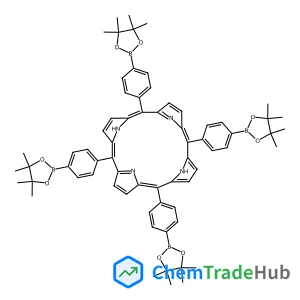
5,10,15,20-tetrakis(4-boronic acid pinacol ester phenyl) porphyrin
CAS番号:
1332748-00-1
分子式:
C68H74B4N4O8

おすすめサプライヤー





免責事項
このページに表示される学術雑誌情報は、参考および研究目的のみを目的としています。当社は雑誌出版社とは提携しておらず、投稿の取り扱いも行っておりません。出版に関するお問い合わせは、各雑誌出版社に直接ご連絡ください。
表示されている情報に誤りがある場合は、support@chemtradehub.com までご連絡ください。迅速に確認し、対応いたします。