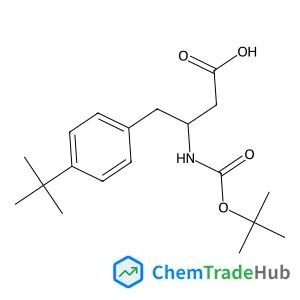
(S)-3-((tert-Butoxycarbonyl)amino)-4-(4-(tert-butyl)phenyl)butanoic acid
CAS番号:
403661-85-8
分子式:
C19H29NO4
Yanling Song, Xing Xu, Wei Wang, Tian Tian, Zhi Zhu
As the basic units of life, cells present dramatic heterogeneity which, although crucial to an organism's behavior, is undetected by bulk analysis. Recently, much attention has been paid to reveal cellular types and states at the single-cell level including genome, transcriptome, epigenome or proteome—based on sequencing and immunological methods, etc. Among these approaches, transcriptomic analysis provides knowledge of the molecular linkages between genetic information and the proteome, leading to a comprehensive understanding of biological processes and diseases. Compared to single-dimensional inspection, multi-dimensional analysis combines the transcriptome with other “omics” to enable a comprehensive understanding of single-cell processes and functions. Moreover, compared to separate observations or single snapshots, spatial dimension and lineage time tracing can provide a more multifaceted understanding of the micro-environment and dynamic processes. In this review, we will introduce current transcriptomic analysis methods, as well as their combination with other omics methods including genomic, proteomic, and epigenetic approaches. Multi-dimensional analysis using these approaches for spatial positioning and lineage tracing applications will be reviewed. The future perspectives of single-cell multi-omics analysis based on the transcriptome will also be discussed.
Zijie Zhou, Ling Ye, Lu Yang, Xinying Li, Zhigang Zhao, Xuefeng Li
DOI: 10.1039/D3QO01563G
Guopeng Du, Yu Zhao, Pingliang Zhu, Shaowen Ling, Baolong Xu, Hui Liu, Xinjin Li, Feng-Gang Sun
DOI: 10.1039/D3QO01484C
Xabier del Corte, Edorta Martínez de Marigorta, Francisco Palacios, Javier Vicario, Aitor Maestro
DOI: 10.1039/D3QO90085A
Yan-Hua Zhao, Xing-Wei Gu
DOI: 10.1039/D3QO01688A
Ting Wang, Zhi-Huan Peng, Liexin Wu, Qingwei Song, Qianying Li, Hui Gao, Zhongyi Zeng, Zhi Zhou, Wei Yi
DOI: 10.1039/D3QO01263H
Krister Holmberg
DOI: 10.1039/D3CP04730J
Dong Guk Nam, Jin Won Lee, Hyun Sil Jung, Do Hyun Ryu
DOI: 10.1039/D3QO01523H
Derek Hao, Liping Lu, Qi Wang
DOI: 10.1039/D3CP04499H
3-イチチルビフェニルは、ビフェニルとイチプロピオニトリルを回収率約90%で反応させて合成されます。触媒は通常、亜リチウムホウ素を用います。
8-溴-5-三氟甲基喹啉は、5-トリフルオロメチル-2-メチル-1,3-ベンゼンジオールをブロモエタノールと反応させて生成します。この反応は塩基性条件下で行われ...
ジメチル4-(4,4,5,5-テトラメチル-1,3,2-ドioxaborolan-2-基)-2,6-ピリジンジカルボイル酸フェニルアミニドの代替品としては、4-...
N-(3,5-ヘキサクロロ-4-ピリドインイル)-8-メチオキシ-5-キノリンカーボン酸の市場動向は、主に産業用途での需要により影響を受けます。研究トレンドとし...
イソステアロイルグリセリルは一般的に安全性が高いとされていますが、過度な使用や個人差により皮�owsん炎などの反応が起こる可能性があります。使用前に医師に相談す...
1-(二苯甲基)-3,3-二氟-氮杂环丁烷の市場動向は、医薬品や合成化学の研究分野で注目を集めています。新興研究は、該当化合物の合成改良と生体内での作用メカニズ...
3-チオフェンスチオールのCAS番号は7774-73-4です。結晶性の白色粉末で、分子量は122.17です。この化合物は水に微溶解し、エタノールやジクロロメタン...
2-Methyl-2-propanyl (2S)-2-(aminomethyl)-1-piperidinecarboxylateは一定の安全性基準を満たしていま...
CAS番号1316822-90-8の化合物は安全性に関しては評価が不足していますが、一般的には生物学的に活性な物質であり、取り扱いには適切な安全防護措置が必要で...
Tert-butyl 2-(2-羟基乙基)哌嗪-1-羧酸は、冷暗所で保存し、直射日光から遠ざけてください。容器は密閉し、高湿度や高温を避けて保管してください。

Analyst publishes analytical and bioanalytical research that reports premier fundamental discoveries and inventions, and the applications of those discoveries, unconfined by traditional discipline barriers.
![N-{3-[Benzyl(methyl)amino]propyl}-9-chloro-5,6,7,8-tetrahydro-2-acridinecarboxamide structure](https://static.chemtradehub.com/structs/142/1426944-49-1-1e4c.webp "N-{3-[Benzyl(methyl)amino]propyl}-9-chloro-5,6,7,8-tetrahydro-2-acridinecarboxamide structure")