












Glutathione-driven Cu(i)–O2 chemistry: a new light-up fluorescent assay for intracellular glutathione
文献情報
出版日
2018-04-25
DOI
10.1039/C8AN00704G
インパクトファクター
4.616
著者
Peng Fei Gao, Yu Ting Mao, Tong Yang, Hong Yan Zou, Yuan Fang Li
原文を見る
要旨
Besides its widely known role as an endogenous antioxidant in scavenging free radicals, glutathione (GSH) can also play the role of prooxidant and promote CuO-induced formation of hydroxyl radicals to light up a fluorescent signal through Cu(I)–O2 chemistry without requiring additional H2O2. This approach is independent of the mechanisms of enzyme mimics, such as the well-known oxidase and peroxidase mimetics, providing a new method to simply and effectively analyze intracellular GSH.
関連文献
Evaluation of nine condensed-phase force fields of the GROMOS, CHARMM, OPLS, AMBER, and OpenFF families against experimental cross-solvation free energies
Sadra Kashefolgheta, Shuzhe Wang, William E. Acree, Jr., Philippe H. Hünenberger
2021-04-30
Paper
DOI: 10.1039/D1CP00215E
The origin of the faster mechanism of partial enthalpy recovery deep in the glassy state of polymers
2021-05-24
Paper
DOI: 10.1039/D1CP01445E
Characterization of cisplatin/membrane interactions by QM/MM energy decomposition analysis
Gustavo Cárdenas, Álvaro Pérez-Barcia, Marcos Mandado
2021-09-03
Paper
DOI: 10.1039/D1CP03382D
A single isomer rotary switch demonstrating anti-Kasha behaviour: Does acidity function matter?
Ivan Angelov, Liudmil Antonov
2021-05-24
Paper
DOI: 10.1039/D1CP01378E
In silico mutational analyses reveal different ligand-binding abilities of double pockets of medaka fish taste receptor type 1 essential for efficient taste recognition
Hayato Aida, Rikuri Morita
2021-08-20
Paper
DOI: 10.1039/D1CP02876F
Molecular insights into the binding variance of the SARS-CoV-2 spike with human, cat and dog ACE2 proteins
Yongjian Zang, Xuhua Li, Yizhen Zhao, He Wang, Dongxiao Hao, Lei Zhang, Zhiwei Yang, Xiaohui Yuan, Shengli Zhang
2021-06-03
Paper
DOI: 10.1039/D1CP01611C
Effect of curing reaction types on the structures and properties of acetylene-containing thermosets: towards optimization of curing procedure
Junli Zhu, Liquan Wang, Jiaping Lin, Lei Du, Qixin Zhuang
2021-06-01
Paper
DOI: 10.1039/D0CP05580H
Theoretical study of the mechanism of the solvent dependency of ESIPT in HBT
Keiji Naka
2021-07-19
Paper
DOI: 10.1039/D0CP06604D
Fabrication and photocatalytic activity of graphitic-C3N4 quantum dots-decorated basic zinc carbonate prepared by a co-precipitation method
Ping Zhao, Bo Jin, Qingchun Zhang, Rufang Peng
2021-08-09
Paper
DOI: 10.1039/D1CP03466A
Bonding of C1 fragments on metal nanoclusters: a search for methane conversion catalysts with swarm intelligence
Mikiya Hori, Yuta Tsuji, Kazunari Yoshizawa
2021-06-01
Paper
DOI: 10.1039/D1CP00345C
こちらもおすすめ
化合物よくある質問
3-イチチルビフェニルはどのように合成されますか?
3-イチチルビフェニルは、ビフェニルとイチプロピオニトリルを回収率約90%で反応させて合成されます。触媒は通常、亜リチウムホウ素を用います。
5668-93-93-Ethylbiphenyl
化合物よくある質問
8-溴-5-三氟甲基喹啉はどのように合成されますか?
8-溴-5-三氟甲基喹啉は、5-トリフルオロメチル-2-メチル-1,3-ベンゼンジオールをブロモエタノールと反応させて生成します。この反応は塩基性条件下で行われ...
917251-92-48-Bromo-5-(trifluoro...
化合物よくある質問
ジメチル4-(4,4,5,5-テトラメチル-1,3,2-ドioxaborolan-2-基)-2,6-ピリジンジカルボイル酸フェニルアミニドの代替品はありますか?
ジメチル4-(4,4,5,5-テトラメチル-1,3,2-ドioxaborolan-2-基)-2,6-ピリジンジカルボイル酸フェニルアミニドの代替品としては、4-...
741709-66-0Dimethyl 4-(4,4,5,5-...
化合物よくある質問
N-(3,5-ヘキサクロロ-4-ピリドインイル)-8-メチオキシ-5-キノリンカーボン酸の市場動向や研究トレンドはどのようなものでしょうか?
N-(3,5-ヘキサクロロ-4-ピリドインイル)-8-メチオキシ-5-キノリンカーボン酸の市場動向は、主に産業用途での需要により影響を受けます。研究トレンドとし...
199871-63-1N-(3,5-Dichloro-4-py...
化合物よくある質問
イソステアロイルグリセリルは安全ですか?
イソステアロイルグリセリルは一般的に安全性が高いとされていますが、過度な使用や個人差により皮�owsん炎などの反応が起こる可能性があります。使用前に医師に相談す...
222723-55-92-[(5Z,8Z,11Z,14Z)-5...
化合物よくある質問
1-(二苯甲基)-3,3-二氟-氮杂环丁烷の市場動向や研究トレンドはどうですか?
1-(二苯甲基)-3,3-二氟-氮杂环丁烷の市場動向は、医薬品や合成化学の研究分野で注目を集めています。新興研究は、該当化合物の合成改良と生体内での作用メカニズ...
288315-02-61-Benzhydryl-3,3-dif...
化合物よくある質問
3-チオフェンスチオールの物理化学的性質は何ですか?
3-チオフェンスチオールのCAS番号は7774-73-4です。結晶性の白色粉末で、分子量は122.17です。この化合物は水に微溶解し、エタノールやジクロロメタン...
7774-73-43-Thiophenethiol
化合物よくある質問
2-Methyl-2-propanyl (2S)-2-(aminomethyl)-1-piperidinecarboxylateは安全ですか?
2-Methyl-2-propanyl (2S)-2-(aminomethyl)-1-piperidinecarboxylateは一定の安全性基準を満たしていま...
475105-35-22-Methyl-2-propanyl ...
化合物よくある質問
CAS番号1316822-90-8の化合物は安全ですか?
CAS番号1316822-90-8の化合物は安全性に関しては評価が不足していますが、一般的には生物学的に活性な物質であり、取り扱いには適切な安全防護措置が必要で...
1316822-90-8Gal beta(1-3)[Neu5Ac...
化合物よくある質問
Tert-butyl 2-(2-羟基乙基)哌嗪-1-羧酸はどのように保存すればよいですか?
Tert-butyl 2-(2-羟基乙基)哌嗪-1-羧酸は、冷暗所で保存し、直射日光から遠ざけてください。容器は密閉し、高湿度や高温を避けて保管してください。
517866-79-4Tert-butyl 2-(2-hydr...
掲載誌
Analyst

CiteScore:
7.8
自己引用率:
5.6%
年間論文数:
653
Analyst publishes analytical and bioanalytical research that reports premier fundamental discoveries and inventions, and the applications of those discoveries, unconfined by traditional discipline barriers.
おすすめ化合物
![5'-Fluoro-[2,3'-biindolinylidene]-2',3-dione structure](https://static.chemtradehub.com/structs/251/251903-00-1-9cb1.webp "5'-Fluoro-[2,3'-biindolinylidene]-2',3-dione structure")
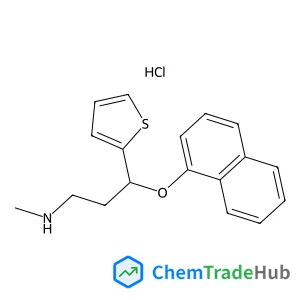
N-Methyl-3-(1-naphthyloxy)-3-(2-thienyl)-1-propanamine hydrochloride (1:1)
CAS番号:
1188266-11-6
分子式:
C18H20ClNOS
おすすめサプライヤー





免責事項
このページに表示される学術雑誌情報は、参考および研究目的のみを目的としています。当社は雑誌出版社とは提携しておらず、投稿の取り扱いも行っておりません。出版に関するお問い合わせは、各雑誌出版社に直接ご連絡ください。
表示されている情報に誤りがある場合は、support@chemtradehub.com までご連絡ください。迅速に確認し、対応いたします。