











Multi-functional derivatization of amine, hydroxyl, and carboxylate groups for metabolomic investigations of human tissue by electrospray ionization mass spectrometry
文献情報
出版日
2018-06-14
DOI
10.1039/C8AN00490K
インパクトファクター
4.616
著者
Tianjiao Huang, Richard Lee, Dawn S. Hui, James L. Edwards
原文を見る
要旨
Metabolomics, the study of small molecules involved in cellular processes, offers the potential to reveal insights into the pathophysiology of disease states. Analysis of metabolites by electrospray mass spectrometry is complicated by their structural diversity. Amine, hydroxyl, and carboxylate groups all affect signal responses differently based on their polarity and proton affinity. This heterogeneity of signal response, sensitivity, and resistance to competing ionization complicates metabolite quantitation. Such limitations can be mitigated by a dual derivatization scheme. In this work, primary amine and hydroxyl groups are tagged with a linear acyl chloride head containing a tertiary amine tail, followed by carboxylate groups coupled to a linear amine tag with a tertiary amine tail. This tagging scheme increases analyte proton affinity and hydrophobicity. In the case of carboxylate groups, the inherent anionic charge is inverted to a cationic charge. This dual tagging is completed within 2.5 hours, diminishes adduct formation, and improves sensitivity by >75-fold. The average limit of detection for 23 metabolites was 38 nM and the R2 was 0.97. This process was used to investigate metabolite changes from human tissue. Examination of diabetic and non-diabetic human tissue showed marked changes in both energy metabolites and amino acids. Further examination of the tissue showed that HbA1C value is inversely correlated with fumarate levels. This technique potentially allows for the analysis of virtually all metabolites in a single analytical run. Thus, it may lead to a more complete picture of metabolic dysfunction in human disease.
関連文献
Ruthenium(ii)-catalyzed C–H activation/lactonization of aromatic acids with diazonaphthoquinones: regioselective synthesis of polycyclic coumarin frameworks
Chandan Kumar Giri, Sudeshna Mondal, Mahiuddin Baidya
2023-10-09
Research Article
DOI: 10.1039/D3QO01450A
Palladium/norbornene/copper-catalysed intermolecular thio-esterification from ketones: modular access towards tetrasubstituted vinyl sulfides
Guopeng Du, Yu Zhao, Pingliang Zhu, Shaowen Ling, Baolong Xu, Hui Liu, Xinjin Li, Feng-Gang Sun
2023-11-07
Research Article
DOI: 10.1039/D3QO01484C
A non-diazo approach to functionalized (2-furyl)-2-pyrrolidines through a cascade reaction of enynal-derived zinc carbenoids with β-arylaminoketones
Chenxin Ou, Bidhan Ghosh, Indrajeet Sharma
2023-10-12
Research Article
DOI: 10.1039/D3QO01354E
Difluorocarbene as a C–F source for the construction of fluorinated benzothiazoles
Jiao Yu, Wei-Guo Cao, Ji-Chang Xiao
2023-11-13
Research Article
DOI: 10.1039/D3QO01422C
Pyridine-N-oxide catalyzed acylative desymmetrization of bisphenols: access to P-stereogenic phosphinates with low catalyst loadings
Yang-Guang Chen, Ying Hu, Jia-Yi Liu, Ming-Sheng Xie
2023-10-31
Research Article
DOI: 10.1039/D3QO01499A
Blue-light induced iron-catalyzed chemoselective α-alkylation and α-olefination of arylacetonitriles with alcohols
Dingguo Song, Shiliang Wang, Weiwei Huang, Rong Chen, Fangyuan Hu, Lingxin Cheng, Xianghua Zhao, Fei Ling, Weihui Zhong
2023-10-18
Research Article
DOI: 10.1039/D3QO01220D
Control of excitation selectivity in pulse EPR on spin-correlated radical pairs with shaped pulses
Daniele Panariti, Sarah M. Conron, Jinyuan Zhang, Michael R. Wasielewski, Marilena Di Valentin, Claudia E. Tait
2023-12-26
Paper
DOI: 10.1039/D3CP06009H
Classically forbidden nonadiabatic transitions in multidimensional chemical dynamics
I-Yun Hsiao, Yoshiaki Teranishi, Hiroki Nakamura
2024-01-10
Communication
DOI: 10.1039/D3CP04794F
NO-induced adaptive antiaromaticity in cyclobutadiene
Qianqian Deng, Sajid Imran, Jun Yan, Jun Zhu
2023-10-23
Research Article
DOI: 10.1039/D3QO01498C
こちらもおすすめ
化合物よくある質問
3-イチチルビフェニルはどのように合成されますか?
3-イチチルビフェニルは、ビフェニルとイチプロピオニトリルを回収率約90%で反応させて合成されます。触媒は通常、亜リチウムホウ素を用います。
5668-93-93-Ethylbiphenyl
化合物よくある質問
8-溴-5-三氟甲基喹啉はどのように合成されますか?
8-溴-5-三氟甲基喹啉は、5-トリフルオロメチル-2-メチル-1,3-ベンゼンジオールをブロモエタノールと反応させて生成します。この反応は塩基性条件下で行われ...
917251-92-48-Bromo-5-(trifluoro...
化合物よくある質問
ジメチル4-(4,4,5,5-テトラメチル-1,3,2-ドioxaborolan-2-基)-2,6-ピリジンジカルボイル酸フェニルアミニドの代替品はありますか?
ジメチル4-(4,4,5,5-テトラメチル-1,3,2-ドioxaborolan-2-基)-2,6-ピリジンジカルボイル酸フェニルアミニドの代替品としては、4-...
741709-66-0Dimethyl 4-(4,4,5,5-...
化合物よくある質問
N-(3,5-ヘキサクロロ-4-ピリドインイル)-8-メチオキシ-5-キノリンカーボン酸の市場動向や研究トレンドはどのようなものでしょうか?
N-(3,5-ヘキサクロロ-4-ピリドインイル)-8-メチオキシ-5-キノリンカーボン酸の市場動向は、主に産業用途での需要により影響を受けます。研究トレンドとし...
199871-63-1N-(3,5-Dichloro-4-py...
化合物よくある質問
イソステアロイルグリセリルは安全ですか?
イソステアロイルグリセリルは一般的に安全性が高いとされていますが、過度な使用や個人差により皮�owsん炎などの反応が起こる可能性があります。使用前に医師に相談す...
222723-55-92-[(5Z,8Z,11Z,14Z)-5...
化合物よくある質問
1-(二苯甲基)-3,3-二氟-氮杂环丁烷の市場動向や研究トレンドはどうですか?
1-(二苯甲基)-3,3-二氟-氮杂环丁烷の市場動向は、医薬品や合成化学の研究分野で注目を集めています。新興研究は、該当化合物の合成改良と生体内での作用メカニズ...
288315-02-61-Benzhydryl-3,3-dif...
化合物よくある質問
3-チオフェンスチオールの物理化学的性質は何ですか?
3-チオフェンスチオールのCAS番号は7774-73-4です。結晶性の白色粉末で、分子量は122.17です。この化合物は水に微溶解し、エタノールやジクロロメタン...
7774-73-43-Thiophenethiol
化合物よくある質問
2-Methyl-2-propanyl (2S)-2-(aminomethyl)-1-piperidinecarboxylateは安全ですか?
2-Methyl-2-propanyl (2S)-2-(aminomethyl)-1-piperidinecarboxylateは一定の安全性基準を満たしていま...
475105-35-22-Methyl-2-propanyl ...
化合物よくある質問
CAS番号1316822-90-8の化合物は安全ですか?
CAS番号1316822-90-8の化合物は安全性に関しては評価が不足していますが、一般的には生物学的に活性な物質であり、取り扱いには適切な安全防護措置が必要で...
1316822-90-8Gal beta(1-3)[Neu5Ac...
化合物よくある質問
Tert-butyl 2-(2-羟基乙基)哌嗪-1-羧酸はどのように保存すればよいですか?
Tert-butyl 2-(2-羟基乙基)哌嗪-1-羧酸は、冷暗所で保存し、直射日光から遠ざけてください。容器は密閉し、高湿度や高温を避けて保管してください。
517866-79-4Tert-butyl 2-(2-hydr...
掲載誌
Analyst

CiteScore:
7.8
自己引用率:
5.6%
年間論文数:
653
Analyst publishes analytical and bioanalytical research that reports premier fundamental discoveries and inventions, and the applications of those discoveries, unconfined by traditional discipline barriers.
おすすめ化合物
![6,7-Dihydro-5H-pyrrolo[1,2-a]imidazole-6-carboxylic acid structure](https://static.chemtradehub.com/structs/136/1369160-12-2-6524.webp "6,7-Dihydro-5H-pyrrolo[1,2-a]imidazole-6-carboxylic acid structure")
![6-Bromo-3-ethyl-3H-imidazo[4,5-b]pyridine structure](https://static.chemtradehub.com/structs/103/1033202-59-3-2a8f.webp "6-Bromo-3-ethyl-3H-imidazo[4,5-b]pyridine structure")
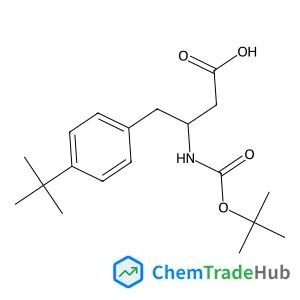
(S)-3-((tert-Butoxycarbonyl)amino)-4-(4-(tert-butyl)phenyl)butanoic acid
CAS番号:
403661-85-8
分子式:
C19H29NO4
おすすめサプライヤー




免責事項
このページに表示される学術雑誌情報は、参考および研究目的のみを目的としています。当社は雑誌出版社とは提携しておらず、投稿の取り扱いも行っておりません。出版に関するお問い合わせは、各雑誌出版社に直接ご連絡ください。
表示されている情報に誤りがある場合は、support@chemtradehub.com までご連絡ください。迅速に確認し、対応いたします。