













Analysis of 14C-bearing compounds released by the corrosion of irradiated steel using accelerator mass spectrometry
文献情報
出版日
2018-05-07
DOI
10.1039/C8AN00237A
インパクトファクター
4.616
著者
B. Z. Cvetković, G. Salazar, D. Kunz, S. Szidat, E. Wieland
原文を見る
要旨
The combination of ion chromatography (IC) with accelerator mass spectrometry (AMS) was developed to determine the speciation of 14C-(radiocarbon) bearing organic compounds in the femto to pico molar concentration range. The development of this compound-specific radiocarbon analysis (CSRA) of carboxylic acids is reported and the application of the method on a leaching solution from neutron-irradiated steel is demonstrated. The background and the dynamic range of the AMS-based method were quantified. On using 14C-labelled standards, the measurements demonstrate the repeatability of the analytical method and the reproducible recovery of the main target carboxylic acids (i.e., acetate, formate, malonate, and oxalate). The detection limit was determined to be in the mid fmol 14C per L level while the dynamic range of the analytical method covers three orders of magnitude from the low fmol to the mid pmol 14C per L level. Cross contamination was found to be negligible during IC fractionation and was accounted for during eluate processing and 14C detection by AMS. The 14C-bearing carboxylates released from an irradiated steel nut into an alkaline leaching solution were analysed using the CSRA-based analytical method with the aim to check the applicability of the approach and develop appropriate sample preparation. The concentrations of 14C-bearing formate and acetate, the main organic corrosion products, were at a low pmol 14C per L level for convenient dimensions of the alkaline leaching experiment which demonstrates that compound-specific 14C AMS is an extremely sensitive analytical method for analysing 14C-bearing compounds. The content of total organic 14C in solution (TO14C) determined by the direct measurement of an aliquot of the leaching solution agrees well with the sum of the 14C concentrations of the individual carboxylates within the uncertainty of the data. Furthermore, the TO14C content is in good agreement with the calculated value using the corrosion rate determined from the 60Co release and the 14C inventory of the irradiated steel specimen.
関連文献
Campestarenes: new building blocks with 5-fold symmetry
Seong Nam, David C. Ware
2018-08-21
Paper
DOI: 10.1039/C8OB00957K
Activation of the hypervalent fluoroiodane reagent by hydrogen bonding to hexafluoroisopropanol
Harsimran K. Minhas, William Riley, Alison M. Stuart, Martyna Urbonaite
2018-09-18
Paper
DOI: 10.1039/C8OB02236D
Palladium-catalyzed heck-type cascade cyclization of (Z)-1-iodo-1,6-dienes with N-tosyl hydrazones
Jun Li, Xiaochen Chi, Long Meng, Luyang Jiao, Wenhui Shang, Ping Wang, Daopeng Zhang, Yunhui Dong, Qing Liu, Hui Liu
2018-09-25
Communication
DOI: 10.1039/C8OB01821A
Facile and practical synthesis of β-carbolinium salts and γ-carbolinium salts via rhodium-catalyzed three-component reactions
Zhuo Wang, Tongyu Li, Siyang Xing, Bolin Zhu
2018-06-20
Paper
DOI: 10.1039/C8OB01182F
Rationalisation of a mechanism for sensing single point variants in target DNA using anthracene-tagged base discriminating probes
Jean-Louis H. A. Duprey, Dario M. Bassani, Eva I. Hyde, Gediminas Jonusauskas, Christian Ludwig, Alison Rodger, Neil Spencer, Joseph S. Vyle, John Wilkie, Zheng-Yun Zhao, James H. R. Tucker
2018-08-15
Paper
DOI: 10.1039/C8OB01710G
Asymmetric synthesis of β-amino ketones by using cinchona alkaloid-based chiral phase transfer catalysts
Weihua Li, Yifeng Wang, Danqian Xu
2018-11-01
Communication
DOI: 10.1039/C8OB02484G
A supramolecular red to near-infrared fluorescent probe for the detection of drugs in urine
Gyan H. Aryal, Kenneth W. Hunter, Liming Huang
2018-09-21
Paper
DOI: 10.1039/C8OB02180E
An experimental and computational study on isomerically pure, soluble azaphthalocyanines and their complexes and boron azasubphthalocyanines of a varying number of aza units
Martin Liebold, Eugen Sharikow, Elisabeth Seikel, Lukas Trombach, Klaus Harms, Petr Zimcik, Veronika Novakova, Ralf Tonner, Jörg Sundermeyer
2018-08-20
Paper
DOI: 10.1039/C8OB01705K
Synthesis of N-arylsulfonamides through a Pd-catalyzed reduction coupling reaction of nitroarenes with sodium arylsulfinates
Bo Yang, Chang Lian, Guanglu Yue, Danyang Liu, Liyan Wei, Yi Ding, Xiancai Zheng, Kui Lu, Di Qiu, Xia Zhao
2018-10-15
Paper
DOI: 10.1039/C8OB02226G
I2-Triggered N–O cleavage of ketoxime acetates for the synthesis of 3-(4-pyridyl)indoles
Qinghe Gao, Yakun Wang, Qianqian Wang, Yanping Zhu, Zhaomin Liu, Jixia Zhang
2018-11-01
Paper
DOI: 10.1039/C8OB02230E
こちらもおすすめ
化合物よくある質問
3-イチチルビフェニルはどのように合成されますか?
3-イチチルビフェニルは、ビフェニルとイチプロピオニトリルを回収率約90%で反応させて合成されます。触媒は通常、亜リチウムホウ素を用います。
5668-93-93-Ethylbiphenyl
化合物よくある質問
8-溴-5-三氟甲基喹啉はどのように合成されますか?
8-溴-5-三氟甲基喹啉は、5-トリフルオロメチル-2-メチル-1,3-ベンゼンジオールをブロモエタノールと反応させて生成します。この反応は塩基性条件下で行われ...
917251-92-48-Bromo-5-(trifluoro...
化合物よくある質問
ジメチル4-(4,4,5,5-テトラメチル-1,3,2-ドioxaborolan-2-基)-2,6-ピリジンジカルボイル酸フェニルアミニドの代替品はありますか?
ジメチル4-(4,4,5,5-テトラメチル-1,3,2-ドioxaborolan-2-基)-2,6-ピリジンジカルボイル酸フェニルアミニドの代替品としては、4-...
741709-66-0Dimethyl 4-(4,4,5,5-...
化合物よくある質問
N-(3,5-ヘキサクロロ-4-ピリドインイル)-8-メチオキシ-5-キノリンカーボン酸の市場動向や研究トレンドはどのようなものでしょうか?
N-(3,5-ヘキサクロロ-4-ピリドインイル)-8-メチオキシ-5-キノリンカーボン酸の市場動向は、主に産業用途での需要により影響を受けます。研究トレンドとし...
199871-63-1N-(3,5-Dichloro-4-py...
化合物よくある質問
イソステアロイルグリセリルは安全ですか?
イソステアロイルグリセリルは一般的に安全性が高いとされていますが、過度な使用や個人差により皮�owsん炎などの反応が起こる可能性があります。使用前に医師に相談す...
222723-55-92-[(5Z,8Z,11Z,14Z)-5...
化合物よくある質問
1-(二苯甲基)-3,3-二氟-氮杂环丁烷の市場動向や研究トレンドはどうですか?
1-(二苯甲基)-3,3-二氟-氮杂环丁烷の市場動向は、医薬品や合成化学の研究分野で注目を集めています。新興研究は、該当化合物の合成改良と生体内での作用メカニズ...
288315-02-61-Benzhydryl-3,3-dif...
化合物よくある質問
3-チオフェンスチオールの物理化学的性質は何ですか?
3-チオフェンスチオールのCAS番号は7774-73-4です。結晶性の白色粉末で、分子量は122.17です。この化合物は水に微溶解し、エタノールやジクロロメタン...
7774-73-43-Thiophenethiol
化合物よくある質問
2-Methyl-2-propanyl (2S)-2-(aminomethyl)-1-piperidinecarboxylateは安全ですか?
2-Methyl-2-propanyl (2S)-2-(aminomethyl)-1-piperidinecarboxylateは一定の安全性基準を満たしていま...
475105-35-22-Methyl-2-propanyl ...
化合物よくある質問
CAS番号1316822-90-8の化合物は安全ですか?
CAS番号1316822-90-8の化合物は安全性に関しては評価が不足していますが、一般的には生物学的に活性な物質であり、取り扱いには適切な安全防護措置が必要で...
1316822-90-8Gal beta(1-3)[Neu5Ac...
化合物よくある質問
Tert-butyl 2-(2-羟基乙基)哌嗪-1-羧酸はどのように保存すればよいですか?
Tert-butyl 2-(2-羟基乙基)哌嗪-1-羧酸は、冷暗所で保存し、直射日光から遠ざけてください。容器は密閉し、高湿度や高温を避けて保管してください。
517866-79-4Tert-butyl 2-(2-hydr...
掲載誌
Analyst

CiteScore:
7.8
自己引用率:
5.6%
年間論文数:
653
Analyst publishes analytical and bioanalytical research that reports premier fundamental discoveries and inventions, and the applications of those discoveries, unconfined by traditional discipline barriers.
おすすめ化合物

![5'-Fluoro-[2,3'-biindolinylidene]-2',3-dione structure](https://static.chemtradehub.com/structs/251/251903-00-1-9cb1.webp "5'-Fluoro-[2,3'-biindolinylidene]-2',3-dione structure")
![1,10-bis(3,5-dimethylphenyl)-12-hydroxy-4,5,6,7-tetrahydroiindeno[7,1-de:1',7'-fg][1,3,2]dioxaphosphocine 12-oxide structure](https://static.chemtradehub.com/structs/141/1412439-82-7-b9a9.webp "1,10-bis(3,5-dimethylphenyl)-12-hydroxy-4,5,6,7-tetrahydroiindeno[7,1-de:1',7'-fg][1,3,2]dioxaphosphocine 12-oxide structure")
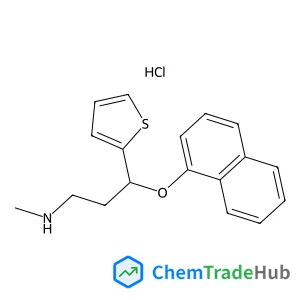
N-Methyl-3-(1-naphthyloxy)-3-(2-thienyl)-1-propanamine hydrochloride (1:1)
CAS番号:
1188266-11-6
分子式:
C18H20ClNOS
おすすめサプライヤー



免責事項
このページに表示される学術雑誌情報は、参考および研究目的のみを目的としています。当社は雑誌出版社とは提携しておらず、投稿の取り扱いも行っておりません。出版に関するお問い合わせは、各雑誌出版社に直接ご連絡ください。
表示されている情報に誤りがある場合は、support@chemtradehub.com までご連絡ください。迅速に確認し、対応いたします。