












![1,4-Dioxaspiro[4.5]dec-7-en-8-ylboronic acid structure](https://static.chemtradehub.com/structs/850/850567-90-7-6fff.webp "1,4-Dioxaspiro[4.5]dec-7-en-8-ylboronic acid structure")
Ultra-high molecular weight elastomeric polyethylene using an electronically and sterically enhanced nickel catalyst
文献情報
出版日
2017-09-29
DOI
10.1039/C7PY01606A
インパクトファクター
5.582
著者
Yanning Zeng, Erlin Yue, Tongling Liang
原文を見る
要旨
A collection of ten related 1,2-bis(imino)acenaphthene-nickel(II) halide complexes, [1-[2,6-{(C6H5)2CH}2-4-{C(CH3)3}-C6H2N]-2-(ArN)C2C10H6]NiX2 (X = Br: Ar = 2,6-Me2C6H3Ni1, 2,6-Et2C6H3Ni2, 2,6-iPr2C6H3Ni3, 2,4,6-Me3C6H2Ni4, 2,6-Et2-4-MeC6H2Ni5) and (X = Cl: Ar = 2,6-Me2C6H3Ni6, 2,6-Et2C6H3Ni7, 2,6-iPr2C6H3Ni8, 2,4,6-Me3C6H2Ni9, 2,6-Et2-4-MeC6H2Ni10), each bearing one sterically and electronically enhanced N-2,6-dibenzhydryl-4-t-butylphenyl group, have been prepared and fully characterized. The unsymmetrical nature of the chelating bis(imino)acenaphthene is confirmed in the paramagnetic 1H NMR spectra for Ni1–Ni10, while the molecular structures of Ni1, Ni2 and Ni6 highlight the unequal steric protection of the nickel center imposed by their respective N,N-ligands. On activation with either Et2AlCl or MMAO, all the nickel complexes were highly active catalysts in ethylene polymerization [as high as 1.26 × 10⁷ g of PE per mol of Ni per h] affording exceptionally high molecular weight (up to 3.1 × 10⁶ g mol−1) hyper-branched polyethylene. Analysis of the mechanical properties reveals the ultra-high molecular weight polymers possess high tensile strength, excellent shape fixity and elastic recovery (up to 69%) as well as high elongation at break (εb = 843.9%); such materials offer a promising alternative to current thermoplastic elastomers (TPEs).
関連文献
Enantioselection in peptide bond formation
Roger R. Hill, David Birch, Graham E. Jeffs, Michael North
2003-02-25
Paper
DOI: 10.1039/B211914E
Metallaphotoredox-catalyzed C–H activation: regio-selective annulation of allenes with benzamide‡
Zihao Zhu, Yuyuan Chen, Xueyao Li, Qingyun Yang, Jie Xia, Wenxuan Zhang, Chao Zhang, Song Wu
2021-01-04
Research Article
DOI: 10.1039/D0QO01127D
Recent advances in visible-light photocatalytic deuteration reactions
Rong Zhou, Lishuang Ma, Xiaona Yang, Jilei Cao
2020-11-20
Review Article
DOI: 10.1039/D0QO01299H
Chiral base-mediated benzylic functionalisation of tricarbonylchromium(0) complexes of benzylamine derivatives
Susan E. Gibson, Mark H. Smith
2003-01-23
Paper
DOI: 10.1039/B211222C
Synthesis and bioactivity of labelled germination stimulants for the isolation and identification of the strigolactone receptor
Anat Reizelman, Suzanne C. M. Wigchert, Cinzia del-Bianco, Binne Zwanenburg
2003-02-24
Paper
DOI: 10.1039/B210678G
Generation and precise control of sulfonyl radicals: visible-light-activated redox-neutral formation of sulfonates and sulfonamides
Mingjun Zhang, Xin Ding, Aidang Lu, Jin Kang, Yongyue Gao, Ziwen Wang, Hongyan Li, Qingmin Wang
2020-12-30
Research Article
DOI: 10.1039/D0QO01413C
The chemical synthesis of β-(1→4)-linked D-mannobiose and D-mannotriose
Gavin W. J. Twaddle, Dmitry V. Yashunsky, Andrei V. Nikolaev
2003-01-30
Paper
DOI: 10.1039/B210661M
The oxa-Michael reaction in the synthesis of 5- and 6-membered oxygen-containing heterocycles
Tauqir Ahmad, Nisar Ullah
2021-01-19
Review Article
DOI: 10.1039/D0QO01312A
こちらもおすすめ
化合物よくある質問
1-{3-[5-(エチルカルボンイル)-2,4-ジメチル-1H-ピロロール-3-基]プロパニル}ピペリジン-4-カルボン酸について、適用される法規ガイドラインは何ですか?
この化合物はCAS番号1142209-81-1であり、GHS分類では corrosive (腐食性物質) と classified (分類物質) として指定され...
1142209-81-11-{3-[5-(Ethoxycarbo...
化合物よくある質問
2,2-二氟-1,3-ベンゾジオキサン-5-カルボキシlic酸とは何ですか?
2,2-二氟-1,3-ベンゾジオキサン-5-カルボキシlic酸は、CAS番号656-46-2の化合物で、化学式はC8H4F2O4です。この化合物は白色の結晶性粉...
656-46-22,2-Difluoro-1,3-ben...
化合物よくある質問
8-氯-4-色原酮の代替品はありますか?
8-氯-4-色原酮(CAS番号: 49701-11-3)の代替品には、他の色原酮類似物や、構造が似ている化合物があります。例えば、8-メチル-4-色原酮や、他の...
49701-11-38-Chloro-2,3-dihydro...
化合物よくある質問
エチル6,6-ジメチル-4,5,6,7-テトラヒドロ-1H-インドアゼー-3-カルボキシレートとは何ですか?
エチル6,6-ジメチル-4,5,6,7-テトラヒドロ-1H-インドアゼー-3-カルボキシレートは、CAS番号1233243-56-5を有する化合物です。これは有...
1233243-56-5Ethyl 6,6-dimethyl-4...
化合物よくある質問
4-叔丁基-6-氯-嘧啶に適用される法規ガイドラインは何ですか?
4-叔丁基-6-氯-嘧啶はCAS番号3435-24-3で、GHS分類では毒性物質とみなし、GHSの危険性分類が適用されます。REACH規則では登録が必要で、Eu...
3435-24-34-Tert-butyl-6-chlor...
化合物よくある質問
維库溴铵杂质Bはどのように合成されますか?
維库溴铵杂质Bは、アンドロステンデンから始まり、一連の合成反応、包括的な選択性と高い収率で合成されます。具体的には、ブロミド化、酸化、ジマーゼ反応、アミド化など...
50587-95-6(2beta,3alpha,5alpha...
化合物よくある質問
2-(4-氟苄基)-吡咯烷の物理化学的性質は何ですか?
CAS番号350017-04-8の2-(4-氟苄基)-吡咯烷は、結晶性の白色粉末です。分子量は199.17 g/molで、水に溶けにくいです。化学反応では比較的...
350017-04-82-(4-Fluorobenzyl)py...
化合物よくある質問
3-喹啉甲醛(2-チロール-8-エチル)は安全ですか?
3-喹啉甲醛(2-チロール-8-エチル)は一定の毒性を持つため、取扱には注意が必要です。使用する際は適切な防護具を着用し、密閉容器で保管・搬送し、直接的な接触を...
335196-05-92-Chloro-8-ethyl-3-q...
化合物よくある質問
エチル3-(ヒドロキシメチル)-1H-ピロール-2-カルボキシレートはどのように保存すればよいですか?
エチル3-(ヒドロキシメチル)-1H-ピロール-2-カルボキシレートは、室温(25℃)以下で保存し、直射日光を避け、乾燥した環境で保管することが推奨されます。ま...
75448-69-0Ethyl 3-(hydroxymeth...
119410-05-88-Chloro-11-(4-piper...
掲載誌
Polymer Chemistry

CiteScore:
8.6
自己引用率:
7.3%
年間論文数:
457
Polymer Chemistry welcomes submissions in all areas of polymer science that have a strong focus on macromolecular chemistry. Manuscripts may cover a broad range of fields, yet no direct application focus is required.
おすすめ化合物
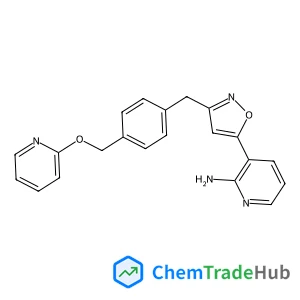
3-(3-(4-((Pyridin-2-yloxy)methyl)benzyl)isoxazol-5-yl)pyridin-2-amine
CAS番号:
936339-60-5
分子式:
C21H18N4O2
![(S,S)-2-{1-Carboxy-2-[3-(3,5-dichloro-benzyl)-3H-imidazol-4-YL]-ethylamino}-4-methyl-pentanoic acid structure](https://static.chemtradehub.com/structs/305/305335-31-3-1724.webp "(S,S)-2-{1-Carboxy-2-[3-(3,5-dichloro-benzyl)-3H-imidazol-4-YL]-ethylamino}-4-methyl-pentanoic acid structure")
おすすめサプライヤー







免責事項
このページに表示される学術雑誌情報は、参考および研究目的のみを目的としています。当社は雑誌出版社とは提携しておらず、投稿の取り扱いも行っておりません。出版に関するお問い合わせは、各雑誌出版社に直接ご連絡ください。
表示されている情報に誤りがある場合は、support@chemtradehub.com までご連絡ください。迅速に確認し、対応いたします。