












Synthesis of molecularly imprinted polymers by photo-iniferter polymerization under visible light
文献情報
出版日
2017-07-20
DOI
10.1039/C7PY01113J
インパクトファクター
5.582
著者
Mariano J. Garcia-Soto, Karsten Haupt, Carlo Gonzato
原文を見る
要旨
The easiest way to make polymers able to specifically recognize a target molecule consists of copolymerizing functional monomers and a cross-linker around a molecular template. This method affords a rigid material bearing high affinity binding sites, namely a synthetic receptor or antibody mimic, known as the “molecularly imprinted polymer” (MIP). MIPs find applications in many fields where a specific molecular recognition process is involved, and to suit their application there is a constant need for engineering their physical forms and synthetic methods, with photo-structuring being particularly attractive. Herein we report for the first time the use of a photo-iniferter precipitation polymerization for the synthesis of MIPs under low-power visible light. Microspheres imprinted with testosterone as model targets were synthesized under either blue or green light, and the living fragments on their surface were further used for chain extension with model poly-(ethylene glycol methacrylate phosphate) brushes by reversible addition–fragmentation chain transfer (RAFT) polymerization, demonstrating the versatility of this approach.
関連文献
Facile synthesis of drug-conjugated PHPMA core-crosslinked star polymers
Bryan S. Tucker, Stephen G. Getchell, Megan R. Hill, Brent S. Sumerlin
2015-05-13
Paper
DOI: 10.1039/C5PY00497G
Synthesis of non-fouling poly[N-(2-hydroxypropyl)methacrylamide] brushes by photoinduced SET-LRP
Mariia Vorobii, Andres de los Santos Pereira, Ognen Pop-Georgievski, Nina Yu. Kostina, Virgil Percec
2015-04-22
Paper
DOI: 10.1039/C5PY00506J
POSS-induced enhancement of mechanical strength in RAFT-made thermoresponsive hydrogels
Ujjal Haldar, Mridula Nandi, Binoy Maiti, Priyadarsi De
2015-06-05
Paper
DOI: 10.1039/C5PY00664C
Conjugated microporous copolymer networks with enhanced gas adsorption
Miao Yu, Xiaoyan Wang, Xiao Yang, Yang Zhao, Jia-Xing Jiang
2015-03-10
Paper
DOI: 10.1039/C5PY00295H
Cyclic azobenzene-containing amphiphilic diblock copolymers: solution self-assembly and unusual photo-responsive behaviors
Beibei Chen, Zhao Wang, Jinjie Lu, Xian Yang, Yong Wang, Zhengbiao Zhang, Jian Zhu, Nianchen Zhou, Yiwen Li, Xiulin Zhu
2015-03-09
Communication
DOI: 10.1039/C5PY00246J
A simple route to deuterated polystyrene block copolymers by reverse iodine transfer polymerisation
Trevor Gavin Wright, Harald Pasch
2015-03-17
Paper
DOI: 10.1039/C5PY00278H
Synthesis of all-aliphatic polyamide dendrimers based on a 3,3′-diaminopivalic acid scaffold
2015-03-09
Paper
DOI: 10.1039/C5PY00154D
こちらもおすすめ
28770-01-62-(2-Isopropyl-1,3-o...
化合物よくある質問
「邻羟基阿托伐他汀内酯标准品」に適用される法規ガイドelinesは何ですか?
CAS番号163217-74-1の「邻羟基阿托伐他汀内酯标准品」は、GHS分類では危険物に分類されず、主にREACH規則とFDA/EPAの管理対象となります。R...
163217-74-1ortho-Hydroxy Atorva...
化合物よくある質問
メチル(3R)-3-アミノ-2,3-ジヒドロ-1-ベンゾファンラニン-5-カルボイル酸塩塩酸塩の主な用途は何ですか?
メチル(3R)-3-アミノ-2,3-ジヒドロ-1-ベンゾファンラニン-5-カルボイル酸塩塩酸塩は、医薬品や合成化学の研究に広く用いられます。また、特定の薬物の前...
2241594-15-8Methyl (3R)-3-amino-...
化合物よくある質問
トランス-4-メチルピロリジン-3-オール塩酸塩はどのように合成されますか?
トランス-4-メチルピロリジン-3-オール塩酸塩は、4-メチルピロリジンの塩酸塩化によって合成されます。一般的な合成方法では、4-メチルピロリジンを塩酸に加えて...
265108-42-7trans-4-Methylpyrrol...
化合物よくある質問
硫雜環丁烷-1,1-二氧化物は安全ですか?
硫雜環丁烷-1,1-二氧化物は安全ではありません。毒性は報告されていませんが、高温下で分解し、可燃性があるため、高圧ガスは注意が必要です。密閉した容器で保管し、...
5687-92-3Thietane 1,1-dioxide
6054-10-02H, 8H-Benzo[1,2-b
化合物よくある質問
9-ヒドロキシエリプチシネ塩酸塩はどのように合成されますか?
9-ヒドロキシエリプチシネ塩酸塩は、エリプチシネから塩酸を添加することで合成されます。選択性は高いですが、収率は約70%です。
52238-35-49-Hydroxyellipticine...
化合物よくある質問
5-塩素-2-(メチルアミノ)フェニル-(2-塩素フェニル)メタン酮の物理化学的性質は何ですか?
5-塩素-2-(メチルアミノ)フェニル-(2-塩素フェニル)メタン酮のCAS番号は5621-86-3です。この化合物は白色の結晶性粉末で、分子量は415.03で...
5621-86-3[5-Chloro-2-(methyla...
化合物よくある質問
1-[2-(4-甲氧基-苯氧基)-乙基]-哌嗪はどのように保存すればよいですか?
1-[2-(4-甲氧基-苯氧基)-乙基]-哌嗪は、直射日光を避けて暗所に、室温(15-25℃)で保管し、密閉容器に入れることで安定性を保つことができます。
117132-44-21-[2-(4-Methoxy-phen...
化合物よくある質問
2-[3-(4-甲氧基フェニル)プロピル]-4,4,5,5-四メチル-1,3,2-ドイボロロールアンの主な用途は何ですか?
2-[3-(4-甲氧基フェニル)プロピル]-4,4,5,5-四メチル-1,3,2-ドイボロロールアンは、医薬品の合成、有機合成化学、および新材料の研究で使用され...
1073371-72-82-[3-(4-Methoxypheny...
掲載誌
Polymer Chemistry

CiteScore:
8.6
自己引用率:
7.3%
年間論文数:
457
Polymer Chemistry welcomes submissions in all areas of polymer science that have a strong focus on macromolecular chemistry. Manuscripts may cover a broad range of fields, yet no direct application focus is required.
おすすめ化合物

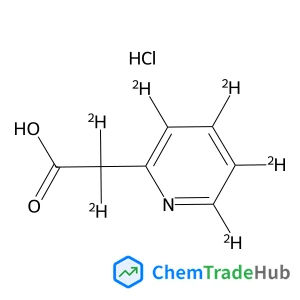
2,2-dideuterio-2-(3,4,5,6-tetradeuterio-2-pyridyl)acetic acid;hydrochloride
CAS番号:
1329799-67-8
分子式:
C7H2ClD6NO2
おすすめサプライヤー




免責事項
このページに表示される学術雑誌情報は、参考および研究目的のみを目的としています。当社は雑誌出版社とは提携しておらず、投稿の取り扱いも行っておりません。出版に関するお問い合わせは、各雑誌出版社に直接ご連絡ください。
表示されている情報に誤りがある場合は、support@chemtradehub.com までご連絡ください。迅速に確認し、対応いたします。