













The energy dissipation and Mullins effect of tough polymer/graphene oxide hybrid nanocomposite hydrogels
文献情報
出版日
2017-07-12
DOI
10.1039/C7PY01068K
インパクトファクター
5.582
著者
Ziqing Tang, Feng Chen, Qiang Chen, Lin Zhu, Xiaoqiang Yan, Hong Chen, Baiping Ren, Jia Yang, Gang Qin, Jie Zheng
原文を見る
要旨
Nanocomposite hydrogels (NC gels) are considered to belong to the class of high strength hydrogels. Graphene oxide (GO), owing to its amphiphilic, mechanical, and optical properties, is widely used as a filler incorporated into different hosting materials (elastomers, plastics, and hydrogels) to improve their mechanical properties. In this work, we used in situ free radical polymerization to synthesize polyacrylamide (PAAm)/GO hybrid NC gels in the presence of GO nanosheets and a very small amount of chemical cross-linkers (N,N′-methylenebisacrylamide, MBA < 0.1 mol%). By optimizing GO and MBA concentrations, the resulting PAAm/GO gels can achieve an elastic modulus of 66 kPa, a fracture stress of 0.27 MPa, a fracture strain of 13.76 mm mm−1, deformed energy of 2.52 MJ m−3, and tearing energy of 964 J m−2. Due to the presence of physical interactions between PAAm and GO nanosheets, PAAm/GO gels demonstrate λ-dependent energy dissipation and Mullins self-recovery behaviors. The gels can rapidly recover their stiffness and toughness by 76% and 60%, respectively, after 30 min of resting at room temperature. The possible toughening mechanisms and Mullins effects of PAAm/GO gels were proposed and compared with those of filler rubbers and other high strength hydrogels. This work provides new viewpoints to develop tough hydrogels by the introduction of GO into other hydrogels with a good mechanical balance between strong chemical bonding and reversible physical bonding.
関連文献
Highly alkynyl-functionalization of cellulose nanocrystals and advanced nanocomposites thereof via click chemistry
Jun Chen, Jin Huang
2015-05-05
Paper
DOI: 10.1039/C5PY00367A
Dual pH-responsive micelles with both charge-conversional property and hydrophobic–hydrophilic transition for effective cellular uptake and intracellular drug release
Shuai Li, Zhouxiang Zhao, Chunmei Ding, Jianshu Li
2016-02-18
Paper
DOI: 10.1039/C6PY00177G
Preservation of main-chain conjugation through BODIPY-containing alternating polymers from electronic interactions with side-chain substituents by cardo boron structures
Honami Yamane, Shunichiro Ito, Kazuo Tanaka, Yoshiki Chujo
2016-04-01
Paper
DOI: 10.1039/C6PY00377J
Dextrin and poly(lactide)-based biocompatible and biodegradable nanogel for cancer targeted delivery of doxorubicin hydrochloride
Dipankar Das, Priyapratim Patra, Paulomi Ghosh, Arun Prabhu Rameshbabu, Santanu Dhara, Sagar Pal
2016-03-24
Paper
DOI: 10.1039/C6PY00213G
Responsive single-chain polymer nanoparticles with host–guest features
Longyu Li, Lizong Dai, S. Thayumanavan
2015-05-21
Paper
DOI: 10.1039/C5PY00600G
Phosphonated furan-functionalized poly(ethylene oxide)s using orthogonal click chemistries: synthesis and Diels–Alder reactivity
Thi Thanh Thuy N'Guyen, Guillaume Contrel, Véronique Montembault, Gilles Dujardin, Laurent Fontaine
2015-03-04
Paper
DOI: 10.1039/C5PY00188A
A novel porphyrin-containing polyimide for memory devices
Ming-Chi Tsai, Chin-Li Wang, Ching-Yao Lin, Chia-Liang Tsai, Hung-Ju Yen, Huei-Chi You, Guey-Sheng Liou
2016-03-31
Communication
DOI: 10.1039/C6PY00158K
A dual stimuli responsive fluorescent probe carrier from a double hydrophilic block copolymer capped with β-cyclodextrin
Guang Yang, Zhen Yang, Chengguang Mu, Xiaodong Fan, Wei Tian, Qing Wang
2015-02-25
Communication
DOI: 10.1039/C5PY00255A
Cross-linked ROMP polymers based on odourless dicyclopentadiene derivatives
Sukdeb Saha, Yakov Ginzburg, Illya Rozenberg, Olga Iliashevsky, Amos Ben-Asuly, N. Gabriel Lemcoff
2016-04-14
Communication
DOI: 10.1039/C6PY00378H
こちらもおすすめ
28770-01-62-(2-Isopropyl-1,3-o...
化合物よくある質問
「邻羟基阿托伐他汀内酯标准品」に適用される法規ガイドelinesは何ですか?
CAS番号163217-74-1の「邻羟基阿托伐他汀内酯标准品」は、GHS分類では危険物に分類されず、主にREACH規則とFDA/EPAの管理対象となります。R...
163217-74-1ortho-Hydroxy Atorva...
化合物よくある質問
メチル(3R)-3-アミノ-2,3-ジヒドロ-1-ベンゾファンラニン-5-カルボイル酸塩塩酸塩の主な用途は何ですか?
メチル(3R)-3-アミノ-2,3-ジヒドロ-1-ベンゾファンラニン-5-カルボイル酸塩塩酸塩は、医薬品や合成化学の研究に広く用いられます。また、特定の薬物の前...
2241594-15-8Methyl (3R)-3-amino-...
化合物よくある質問
トランス-4-メチルピロリジン-3-オール塩酸塩はどのように合成されますか?
トランス-4-メチルピロリジン-3-オール塩酸塩は、4-メチルピロリジンの塩酸塩化によって合成されます。一般的な合成方法では、4-メチルピロリジンを塩酸に加えて...
265108-42-7trans-4-Methylpyrrol...
化合物よくある質問
硫雜環丁烷-1,1-二氧化物は安全ですか?
硫雜環丁烷-1,1-二氧化物は安全ではありません。毒性は報告されていませんが、高温下で分解し、可燃性があるため、高圧ガスは注意が必要です。密閉した容器で保管し、...
5687-92-3Thietane 1,1-dioxide
6054-10-02H, 8H-Benzo[1,2-b
化合物よくある質問
9-ヒドロキシエリプチシネ塩酸塩はどのように合成されますか?
9-ヒドロキシエリプチシネ塩酸塩は、エリプチシネから塩酸を添加することで合成されます。選択性は高いですが、収率は約70%です。
52238-35-49-Hydroxyellipticine...
化合物よくある質問
5-塩素-2-(メチルアミノ)フェニル-(2-塩素フェニル)メタン酮の物理化学的性質は何ですか?
5-塩素-2-(メチルアミノ)フェニル-(2-塩素フェニル)メタン酮のCAS番号は5621-86-3です。この化合物は白色の結晶性粉末で、分子量は415.03で...
5621-86-3[5-Chloro-2-(methyla...
化合物よくある質問
1-[2-(4-甲氧基-苯氧基)-乙基]-哌嗪はどのように保存すればよいですか?
1-[2-(4-甲氧基-苯氧基)-乙基]-哌嗪は、直射日光を避けて暗所に、室温(15-25℃)で保管し、密閉容器に入れることで安定性を保つことができます。
117132-44-21-[2-(4-Methoxy-phen...
化合物よくある質問
2-[3-(4-甲氧基フェニル)プロピル]-4,4,5,5-四メチル-1,3,2-ドイボロロールアンの主な用途は何ですか?
2-[3-(4-甲氧基フェニル)プロピル]-4,4,5,5-四メチル-1,3,2-ドイボロロールアンは、医薬品の合成、有機合成化学、および新材料の研究で使用され...
1073371-72-82-[3-(4-Methoxypheny...
掲載誌
Polymer Chemistry

CiteScore:
8.6
自己引用率:
7.3%
年間論文数:
457
Polymer Chemistry welcomes submissions in all areas of polymer science that have a strong focus on macromolecular chemistry. Manuscripts may cover a broad range of fields, yet no direct application focus is required.
おすすめ化合物
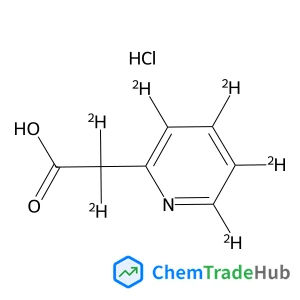
2,2-dideuterio-2-(3,4,5,6-tetradeuterio-2-pyridyl)acetic acid;hydrochloride
CAS番号:
1329799-67-8
分子式:
C7H2ClD6NO2
おすすめサプライヤー





免責事項
このページに表示される学術雑誌情報は、参考および研究目的のみを目的としています。当社は雑誌出版社とは提携しておらず、投稿の取り扱いも行っておりません。出版に関するお問い合わせは、各雑誌出版社に直接ご連絡ください。
表示されている情報に誤りがある場合は、support@chemtradehub.com までご連絡ください。迅速に確認し、対応いたします。