












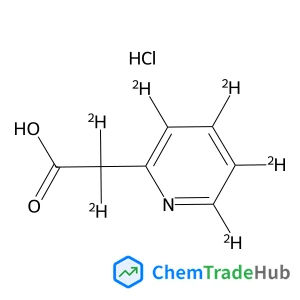
2,2-dideuterio-2-(3,4,5,6-tetradeuterio-2-pyridyl)acetic acid;hydrochloride
CAS番号:
1329799-67-8
分子式:
C7H2ClD6NO2
Xiaowei An, Robert H. Aguirresarobe, Lourdes Irusta, Fernando Ruipérez, Jon M. Matxain, Xiangqiang Pan, Nora Aramburu, Jian Zhu
Dynamic structures containing polymers are considered a new class of polymeric materials with very attractive properties, since they can behave as thermosets at room temperature but at the same time they can be reprocessed to any shape. Recently, aromatic disulfides have been explored as dynamic bonds because of their good exchange reaction rate at low temperatures. In this work, we explore the utilization of aromatic diselenides on the basis of their lower bond energies in comparison with their disulfide counterparts. By comparing a model exchange reaction between aromatic diselenides and aromatic disulfides, the ability of aromatic diselenides to exchange faster than aromatic disulfides has been demonstrated. These results are supported by molecular quantum chemical calculations, confirming the faster exchange of aromatic diselenides in comparison with disulfides. In addition, a [2 + 1] radical-mediated reaction mechanism is proposed for aromatic diselenides to understand their faster kinetic exchange. An aromatic diselenide has been incorporated into polyurethane networks using a para-substituted amine diphenyl-diselenide. The resulting materials not only exhibit faster self-healing properties than the corresponding disulfide based materials, but also show the ability to be processed at temperatures as low as 100 °C. The fact that aromatic amines are already used as crosslinkers in a wide range of commercial products makes this system very attractive.
Awaneesh Singh, Olga Kuksenok, Jeremiah A. Johnson, Anna C. Balazs
DOI: 10.1039/C6PY00325G
Guang Yang, Zhen Yang, Chengguang Mu, Xiaodong Fan, Wei Tian, Qing Wang
DOI: 10.1039/C5PY00255A
Chunyang Gu, Manjun Xiao, Meng Qiu, Mingliang Sun, Renqiang Yang
DOI: 10.1039/C5PY00117J
C. Tugui, S. Vlad, M. Iacob, C. D. Varganici, L. Pricop, M. Cazacu
DOI: 10.1039/C6PY00157B
Honami Yamane, Shunichiro Ito, Kazuo Tanaka, Yoshiki Chujo
DOI: 10.1039/C6PY00377J
Chen Zhang, Ji Zhang, Weixuan Zeng, Naihang Zheng, Wei Li, Wei Gao, Gui Yu, Chuluo Yang
DOI: 10.1039/C6PY00212A
Rebecca J. Williams, Andrew P. Dove, Rachel K. O'Reilly
DOI: 10.1039/C5PY00081E
Wenli Song, Chao Yin, Rongcui Jiang, Yiwu Quan, Congcong Tian, Jie Li, Wenbo Hu, Pengfei Sun, Weixing Deng, Quli Fan
DOI: 10.1039/C5PY00633C
CAS番号163217-74-1の「邻羟基阿托伐他汀内酯标准品」は、GHS分類では危険物に分類されず、主にREACH規則とFDA/EPAの管理対象となります。R...
メチル(3R)-3-アミノ-2,3-ジヒドロ-1-ベンゾファンラニン-5-カルボイル酸塩塩酸塩は、医薬品や合成化学の研究に広く用いられます。また、特定の薬物の前...
トランス-4-メチルピロリジン-3-オール塩酸塩は、4-メチルピロリジンの塩酸塩化によって合成されます。一般的な合成方法では、4-メチルピロリジンを塩酸に加えて...
硫雜環丁烷-1,1-二氧化物は安全ではありません。毒性は報告されていませんが、高温下で分解し、可燃性があるため、高圧ガスは注意が必要です。密閉した容器で保管し、...
9-ヒドロキシエリプチシネ塩酸塩は、エリプチシネから塩酸を添加することで合成されます。選択性は高いですが、収率は約70%です。
5-塩素-2-(メチルアミノ)フェニル-(2-塩素フェニル)メタン酮のCAS番号は5621-86-3です。この化合物は白色の結晶性粉末で、分子量は415.03で...
1-[2-(4-甲氧基-苯氧基)-乙基]-哌嗪は、直射日光を避けて暗所に、室温(15-25℃)で保管し、密閉容器に入れることで安定性を保つことができます。
2-[3-(4-甲氧基フェニル)プロピル]-4,4,5,5-四メチル-1,3,2-ドイボロロールアンは、医薬品の合成、有機合成化学、および新材料の研究で使用され...

Polymer Chemistry welcomes submissions in all areas of polymer science that have a strong focus on macromolecular chemistry. Manuscripts may cover a broad range of fields, yet no direct application focus is required.

![(3R,5R)-1-[(Benzyloxy)carbonyl]-5-methyl-3-piperidinecarboxylic acid structure](https://static.chemtradehub.com/structs/126/1269757-29-0-c552.webp "(3R,5R)-1-[(Benzyloxy)carbonyl]-5-methyl-3-piperidinecarboxylic acid structure")




